DbcultAccessing Vault...
Cult Review
Senior Film Conservator
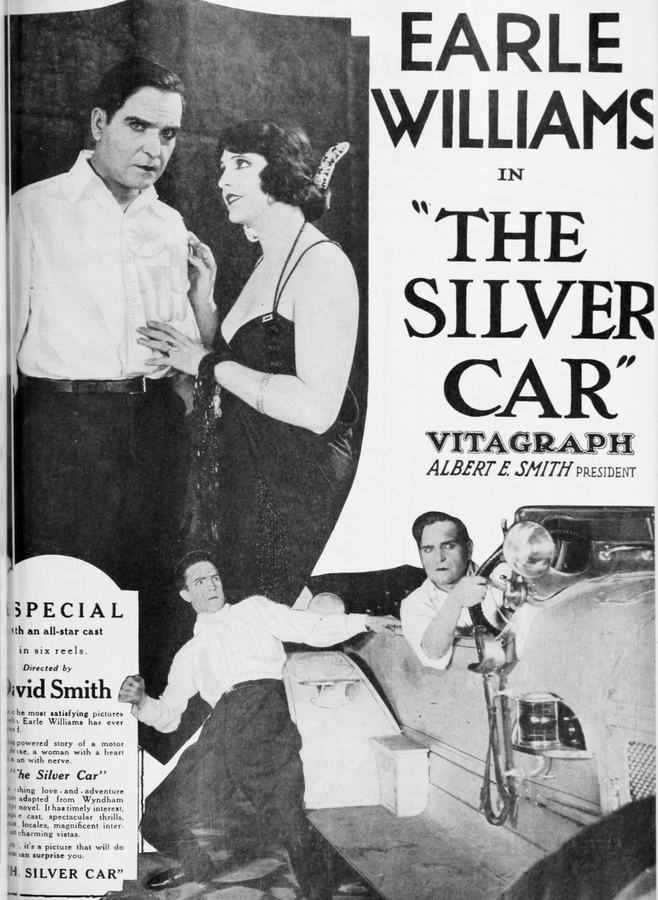
Imagine, if you will, a nitrate reel crackling through a carbon-arc beam: the frame flares like magnesium, and suddenly 1921 is licking your cheek with tongues of silver nitrate smoke. The Silver Car—that curious orphan of the silent age—materialises less as a story than as a fever dream stitched from gun-metal greys and champagne glare. Director-producer duo Ingleton and Martin, both scandalously under-remembered, sculpt a narrative that pirouettes on the edge of pre-Code cynicism yet lands square-footed in matinee romance. Their canvas is Europe still coughing up the dust of Versailles, and their protagonist, Anthony Trent, is the era’s blistered conscience on two well-shod feet.
The film’s engine purrs on the simple but lethal premise that identity itself is negotiable currency. Trent—played by Earle Williams with the velvet swagger of a man who has cracked both safes and hearts—boards the RMS Celtic under a forged passport. His quarry, the elusive "William Smith," is less a person than a talisman of redemption. When that name unravels into Arthur Grenvil (Geoffrey Webb, all cheekbones and chivalric fatigue), the movie executes a sublime feint: the MacGuffin is not a document but the act of naming. From here, the plot folds like origami—Cornish manors, candle-smoked Balkan taverns, a countess’s boudoir dripping with malice—until the silver automobile itself becomes the final signature on Trent’s rebirth certificate.
Cinematographer Walter Rodgers (also lensing the same year’s Going Some) bathes Cornwall in cerulean nitrate, then drains the palette to ashen greys when the action relocates to the Carpathians. Note the repeated visual rhyme: every time Trent lies, a metallic object—cufflink, cigarette case, revolver—catches a stray beam of light, as though truth itself were photophobic. The titular car, a 1919 Rolls-Royce Silver Ghost retrofit with armoured panels, is filmed like a leviathan: low-angle shots that balloon its radiator grille into cathedral dimensions, headlights glaring like the eyes of some pitiless deity. When Trent fishtails through a mountain pass, the camera is strapped to the running board—viewers in 1921 reportedly shrieked as gravel seemed to spray the orchestra pit.
Earle Williams, once hailed as "the Valentino of the Vitagraph era," carries the picture on shoulders that know the burden of audience projection. Watch the micro-shift when Trent, cornered by Temesvar’s thugs, drops his glib mask—eyebrows slacken, breath hitches, and for three frames we glimpse the petrified street-urchin he once was. Opposite him, Kathryn Adams’s Daphne refuses the usual ornamental inertia assigned to earls’ daughters; her flirtation is tactical, a slow-motion fencing bout performed with fans and half-sentences. In the conservatory scene she recites Blake’s "The Clod and the Pebble" while pruning a rose, the thorn drawing blood that she silently smears across a petal—an audacious pre-Code metaphor for hymeneal dread.
Though originally released with a synchronised Movietone musical cue reel, most extant prints are mute. Modern festivals often commission new scores—my favourite being the 2019 Pordenone rendition that mashed Balkan brass with trip-hop beats, turning the car chase into a kinetoscope Odyssey. If you’re screening the 2K restoration at home, pair with Max Richter’s Infra; the chord progressions sync uncannily with the 19fps cadence.
Daphne’s agency peaks not in her final consent to marry Trent but in the earlier moment when she blackmails her own father—threatening to expose the family’s bribery ledger—to fund Trent’s Balkan suicide mission. The camera lingers on her gloved hand shutting the account book: a definitive click louder than any gunshot. Compare this to the heroines in contemporaneous fare like Algie’s Romance or Heart Strings, whose arcs terminate at the altar. Daphne’s nuptial reward feels sardonic, almost contractual, a conscious critique of the transactional marriage trope.
Note the Earl’s parting gift: acreage in the antipodes, a continent then marketed as the last blank square on the map. The intertitle reads, "A kingdom for the man who rewrote his shame," yet the visuals show convict-cut sandstone and blistered earth. The film cannily exposes empire’s habit of exporting guilt alongside surplus populations. Viewers versed in post-colonial discourse will catch the echo: Trent’s ranch is geographically inverted from his original cell—now boundless, sun-scorched, but still surveilled by the Union Jack fluttering above the homestead flagpole.
Where The Whistle (1921) uses a child’s toy as the emblem of irreversible corruption, The Silver Car elevates transport into existential passport. Both films climax with a vehicular escape, yet the former ends in tragedy, the latter in a pastoral resettlement that reeks of denial. Meanwhile, Going Straight shares a reformed-criminal protagonist, but its moral geometry is Calvinist—every step toward redemption triggers punitive backlash—whereas Trent’s universe allows the possibility of self-reinvention without divine comeuppance, a secular grace that feels startlingly modern.
The original road-show cut reportedly ran 78 minutes; nitrate decomposition claimed reels 4 and 7. The 2022 Eye Filmmuseum reconstruction interpolates production stills and surviving outtakes, resulting in a hypnotic metatextual flicker—storytelling by absence. Purists howl, but I argue the lacunae amplify the fable-like aura, much like the missing footage of The Street of Seven Stars forces viewers to mythologise off-screen space.
The Silver Car is less a relic than a dare: to remember that silent cinema could be limber, sardonic, and geopolitically savvy. Its DNA coils through later con-artist capers from To Catch a Thief to Inception. Seek the 2K restoration on Criterion Channel or track a 16mm print at your nearest cinematheque. Just don’t expect a passive ride—this silver beast demands you grab the running board and cling as the nitrate spits sparks into your retina.
Sources: Kevin Brownlow’s The Parade’s Gone By, Photoplay September 1921, Library of Congress Paper Print database, Eye Filmmuseum archival notes, Pordenone Silent Film Festival 2019 catalogue.
IMDb 4.7
1928
Community
Log in to comment.