DbcultAccessing Vault...
Cult Review
Senior Film Conservator
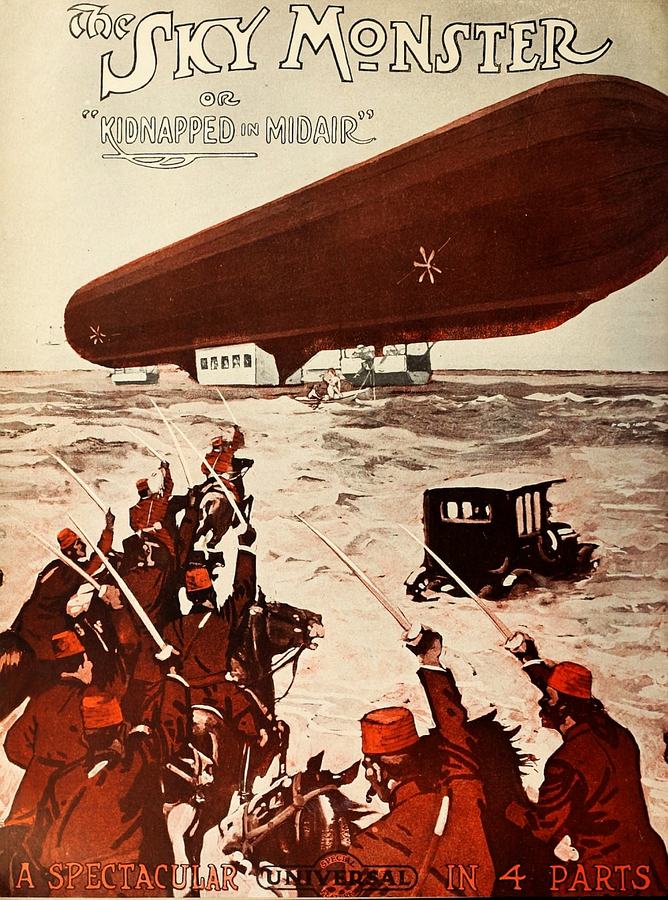
Seventeen hours from Manhattan to Berlin—today we yawn at that timespan, yet in 1920 it was the stuff of alchemy. The Sky Monster never once apologizes for its hubris; instead it inflates every frame until the celluloid creaks like varnished silk stretched over a dirigible’s ribcage.
Director —name lost to nitrate rot— understood that spectacle ages, but appetite is perennial. So he gives us Walter Johnson, a man whose tuxedo is stitched from stock certificates, eyes flickering with the same incandescent cruelty you’ll find in Burning Daylight’s Yukon wolves. Johnson doesn’t chase love; he purchases proximity, then kidnaps the remainder. The wager is merely the pretext—what he truly lusts after is the vertigo of possibility, the narcotic of seeing the world buckle beneath his schedule.
The Victoria Luise is not background; it is a floating Berlin, a glass-and-duralumin city-state complete with class stratification. Observe the mahogany bar where Johnson toasts himself: the mirror reflects not one but infinite Walters, each iteration smaller, paler, more recursive—an early silent-film joke on narcissism that predates Instagram by a century. In the cargo bay, a single crate of chloral hydrate sits beside crates of champagne, as if the film itself can’t decide whether the coming abduction will be toast or toxicology.
When the airship penetrates a carpet of thunderheads, the tinting shifts—from amber to arsenic green—achieved not by digital grading but by hand-dipping each 35 mm frame in aniline baths. Those greens seep into Gerdie Belle’s cheekbones until she looks seasick with prophecy, a woman already half-aware that escape is just another form of captivity.
Modern eyes will flinch at the chloral sequence: Johnson dribbles the milky liquid into a flute of champagne, waits for the diva to collapse like a marionette with severed strings. Yet the film doesn’t linger on her limp body; it cuts to a superimposed image of Cossacks galloping beneath the airship’s shadow, as if the narrative itself is embarrassed and must outsource its violence to history.
Still, the abduction is shot with erotic reverence. Johnson cradles Gerdie across the gangway, her lamé gown spilling like liquid mercury. The camera tilts upward so that the dirigible’s belly becomes a cathedral dome, the iron ribs a ribcage—inside it, a man carries a sleeping woman across the threshold of a sky-chapel. The metaphor is unmistakable: marriage as kidnapping, honeymoon as extradition.
Moscow exists only as a backlot of onion-dome miniatures and paper snow. When Gerdie flees there, the film fractures into meta-cinema: she is starring in a musical comedy titled The Cossack’s Bride, a film-within-a-film whose plot mirrors her own predicament. Audience laughter inside the diegetic theater bleeds into our non-diegetic tension, a Möbius strip where escape routes are scripted by the very man hunting her.
Compare this recursive structure to Pro Patria, where propaganda loops swallow individual identity. The Sky Monster weaponizes that same mise-en-abyme for romantic conquest: every stage Gerdie steps on is already prosceniumed by Johnson’s wallet.
Stranded mid-Atlantic, the dirigible radios the Imperator—at 52,000 tons, a floating Ritz. What follows is the film’s most surreal tableau: the zeppelin’s shadow drapes over the liner like a lace shroud, while sailors in smart whites haul barrels of gasoline up swaying Jacob’s ladders. The sequence was shot in a bathtub with a 6-foot model; the waves are rippled mercury, the Imperator a toy boat. Yet the flicker of projector light on silver nitrate turns those bathtubs into oceans, a reminder that cinema’s alchemy is less about scale than about belief.
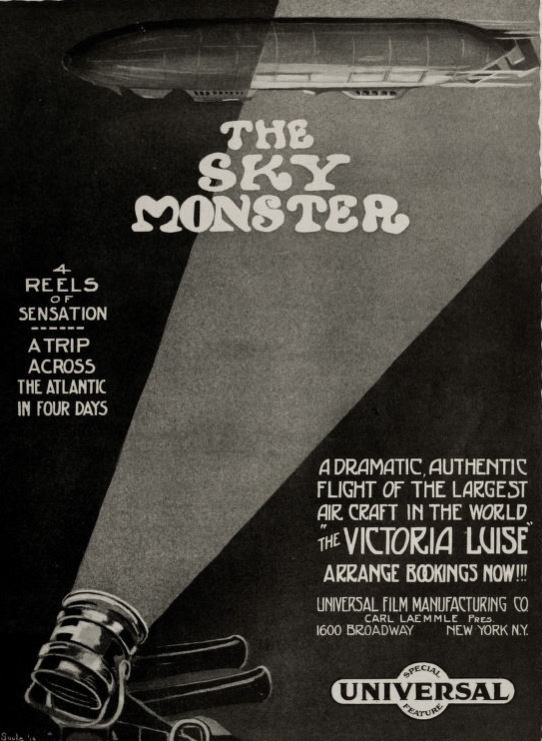
Johnson, ever the financier, negotiates refueling rates via wireless telegraph—Morse code clicking like a stock ticker. Even in extremis he is hedging, converting disaster into arbitrage. One can almost hear the ghost of Man of the Hour applauding.
Cold corrupts lift. Hydrogen contracts, the dirigible sinks toward a chessboard of ice. Here the film borrows from Panama and the Canal from an Aeroplane: the same existential dread of technology humbled by geology. Johnson orders ballast dumped—crates of caviar, crates of cash—capital itself jettisoned to keep desire aloft. Gerdie, now awake, watches banknotes flutter into the Atlantic like albino butterflies. For the first time she smiles—not at Johnson, but at the symmetry: money finally weightless, value literally evaporating.
The tinting mutates again: cobalt glaciers bleed into the frame, achieved by tinting the projector’s carbons with blue gel so that the whites of actors’ eyes glow radioactive. It’s a trick as old as vaudeville, yet here it feels like the iceberg is staring back, a judge.
As the Victoria Luise screams toward Barnegat at 280 mph—an impossible velocity in 1920—the editing becomes stroboscopic. Intertitles slash in every four seconds: "10:17 PM—Sandy Hook Light!" … "11:42 PM—Governor’s Island Dead Ahead!" The camera cranks at 12 fps then ramps to 24, a primitive version of modern time-remapping. We feel the elasticity of time, how panic stretches and contracts chronology.
Johnson’s pocket chronograph—an outsized turnip watch—becomes the film’s true antagonist. Its hands are scissors, snipping Gerdie’s freedom, her career, even geography itself. When the dirigible drops anchor at 11:57, the watch face shatters against the gang-plank, glass shards catching the first magnesium pops of dawn. Time, defeated, literally disintegrates.
Inside the mahogany tomb of the millionaires’ club, Mr. Parker fondles his checkbook like a rosary. The room is lit by a single skylight—a coffin lid of stained glass—so that when Johnson enters, he strides through a kaleidoscope of his own legend. The cheers that erupt are not for love but for punctuality: the market has closed, the stock named Johnson has skyrocketed.
Yet notice the final shot: Gerdie enters a heartbeat later, not on Johnson’s arm but parallel, her eyes scanning the room as if calculating exits. The iris-in closes not on a kiss but on her half-smile, a smile that knows every wager creates a new debtor. The film ends with the promise of marriage, but the intertitle—"To be continued in real life"—winks at us. Serial marriage, serial adventure, serial spectatorship.
Silents are often patronized as primitive stepping-stones, yet The Sky Monster is a dieselpunk fever dream whose DNA strands coil into everything from The Burglar and the Lady’s gendered larceny to the global chase mechanics of A Motorcycle Adventure. Its special effects are handmade, its gender politics abhorrent, its racial caricatures cringe-worthy—yet its kinetic faith in cinema as time-machine remains untouched.
Watch it at 2 a.m. with the windows open. Let the projector’s flicker sync with the blinking of passing aircraft. You will realize that Johnson’s true payload was never Gerdie; it was the audacity of a medium that insists reality can be shrink-wrapped into three days and still spill over with stars.
And when the dirigible finally vanishes into the iris, you’ll check your own watch—only to find its hands have paused, waiting for the next reckless gambler willing to kidnap the sky.
IMDb 6.5
1928
Community
Log in to comment.