DbcultAccessing Vault...
Cult Review
Senior Film Conservator
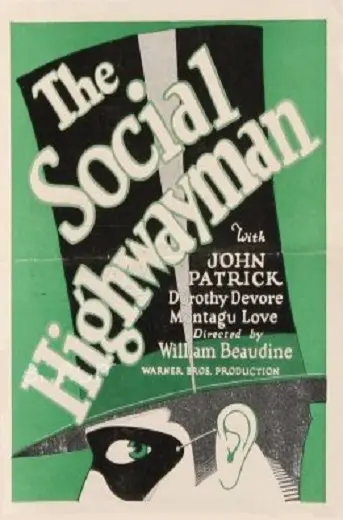
Is The Social Highwayman worth watching today? Short answer: Yes, but only if you have a refined appetite for the eccentricities of the silent era’s 'manhood' tropes and early studio-system storytelling.
This film is for fans of early Darryl F. Zanuck scripts and those who find charm in the high-energy, low-stakes capers of the mid-1920s. It is NOT for modern viewers who require gritty realism or a protagonist who actually knows what he is doing from the start.
1) This film works because it leans into the absurdity of its premise, specifically the gender-bending disguise of its antagonist which adds a layer of psychological humiliation rarely seen in 1920s procedurals.
2) This film fails because Jay Walker is written with such a high degree of incompetence that it becomes difficult to root for his redemption until the final act.
3) You should watch it if you want to see the DNA of the modern action-comedy being formed under the pen of a young Darryl F. Zanuck.
The Social Highwayman is a fascinating artifact of 1926. It captures a moment when the 'gentleman bandit' trope was being deconstructed by the emerging cynicism of the tabloid press. Lynn Cowan plays Jay Walker with a frantic, wide-eyed energy that borders on the neurotic. Unlike the stoic heroes found in The Vanishing American, Walker is a man defined by his failures. He is the Everyman who thinks he’s a Sherlock Holmes, only to be outsmarted by a man in a shawl.
The robbery scene is the film's centerpiece. Ducket Nelson’s disguise as an elderly Gypsy woman isn't just a plot device; it’s a brilliant bit of character work. It highlights the bandit’s understanding of social biases. He knows that a young, 'chivalrous' reporter won't suspect a grandmotherly figure. The moment the veil is lifted—metaphorically and literally—the film shifts from a standard crime story into a quest for reclaimed masculinity. It works. But it’s flawed.
Writing credits for this film include a young Darryl F. Zanuck, and his influence is palpable. The pacing is relentless. There is a specific rhythm to the newspaper office scenes that feels like a precursor to the screwball comedies of the 1930s. The dialogue cards are punchy, avoiding the flowery prose that bogged down films like Faith. Instead, we get a lean, mean narrative machine that understands the value of a visual gag.
Take the scene where Walker returns to the office after the robbery. The blocking of the other reporters circling him like vultures is a masterclass in silent directing. You don't need a single word of dialogue to feel the heat of his embarrassment. This is where the film shines—in the physical manifestation of social pressure. It is far more effective than the more somber tones found in Bring Him In.
Dorothy Devore provides a necessary grounding force as the female lead. While the era often relegated women to the role of the 'prize' to be won, Devore’s character feels like she has more common sense than the entire newsroom combined. Her chemistry with Cowan is serviceable, though the film is clearly more interested in the rivalry between Walker and Nelson.
John Patrick’s Ducket Nelson is an inspired villain. He carries himself with a swagger that suggests he’s enjoying the game. He isn't a dark, brooding criminal; he’s a social highwayman who treats the world as his stage. This theatricality makes the final confrontation feel earned. It’s a battle of wits as much as it is a physical struggle. The cinematography in the rural highway sequences utilizes the natural light of the California landscape to create a sense of isolation that contrasts sharply with the cluttered, smoky interiors of the city.
Yes, The Social Highwayman is worth watching for anyone interested in the evolution of the action-comedy genre. It offers a unique blend of slapstick and suspense. The film remains engaging because it doesn't take its hero too seriously. You will find yourself laughing at him as much as with him.
Pros:
- Excellent use of disguises and visual storytelling.
- Sharp, witty title cards that keep the story moving.
- A genuinely charismatic villain in John Patrick.
- Historically significant script by a young Darryl F. Zanuck.
Cons:
- The protagonist can be frustratingly dim-witted.
- Some of the secondary characters are underdeveloped compared to Molly and I.
- The resolution feels a bit rushed in the final five minutes.
Here is a hot take: Ducket Nelson is actually the protagonist of this film for the first forty minutes. Jay Walker is merely the victim of Nelson's superior narrative agency. We are watching a master at work (Nelson) being harassed by an amateur (Walker). It is only when Walker loses everything—his job, his dignity, his car—that he finally gains the 'main character' energy required to finish the story. This flip in power dynamics is what makes the film stand out from contemporary melodramas like The Call of the Cumberlands.
The Social Highwayman is a breezy, intelligent piece of silent cinema that deserves more than its current status as a footnote. While it lacks the emotional weight of something like The Vanishing American, it compensates with pure, unadulterated entertainment value. It’s a reminder that even in 1926, the movies knew that the best way to a man’s heart—and his wallet—was through a well-placed disguise and a healthy dose of public humiliation. It’s a solid 7/10 that feels like a 9/10 if you’re a fan of the era.
"A sharp-witted caper that proves the pen is only mightier than the sword if the reporter holding it doesn't get robbed by a bandit in a dress first."
IMDb 6.2
1935
Community
Log in to comment.