DbcultAccessing Vault...
Cult Review
Senior Film Conservator
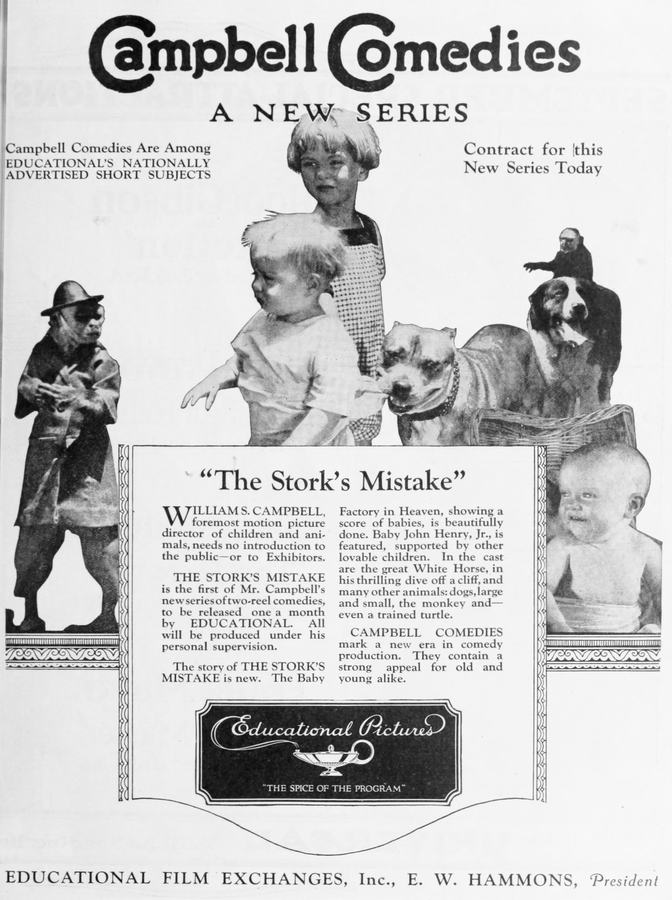
Imagine, if you can stomach the whimsy, a cosmos where procreation is literally patty-cake: elves slap river clay into pudgy limbs, season the blank figures with giggles, then shove the raw dough into brick ovens that wheeze like asthmatic dragons. The timer dings and—voilá—humanity in miniature, albeit graded by melanin saturation. Burnt crème brûlée? Too dark for the customer. Over-bronzed? Acceptable only if nobody lighter is on the shelf. This is not Margaret Atwood’s Gilead nor some guileless Spellbound dreamscape; it’s Babyland, the hallucinogenic backlot of The Stork’s Mistake (1920), a two-reel curio whose jaunty piano accompaniment can’t drown out the stench of racial pseudoscience.
“Satire, when it forgets compassion, becomes propaganda wearing a jester’s bells.”
The plot, thinner than tissue but twice as caustic, hinges on a delivery error: a white household orders a sibling the shade of fresh linen; the stork, nearsighted or nihilistic, drops a chocolate-hued bundle on the doorstep. Cue spit-takes from pastel-clad neighbors, the factory superintendent vaulting onto his aerial penny-farthing, and a corrective mid-air adoption that restores the pale bloodline. Roll credits, cue uncomfortable laughter that curdles into silence once you realize the film’s only tension is whether the “wrong” color will be allowed to remain in the crib.
Visually, the picture is a sugar-spun fever: sets painted like nursery wallpaper, forced-perspective ovens that yawn like caverns, and a stork rigged from umbrella ribs and feather dusters. The image of the foreman pedaling across the sky on that high-wheeler—wings soldered from coat hangers—should evoke Méliès wonder; instead it feels like a Klansman’s fever dream given stop-motion life. The film’s palette oscillates between Easter pastels and sooty sepia, as though cinematographer Coy Watson couldn’t decide whether he was shooting a bedtime story or a minstrel show.
The editing rhythm is almost musical: cut on the oven’s clang, iris in on the infant’s face, smash zoom to the stork’s comically dilated pupils. Yet each kinetic flourish serves only to underline the racial ledger at the narrative’s core. Color here is never atmospheric; it is destiny, barcode, brand. One expects the clay babies to emerge wielding certificates: “Returnable if melanin exceeds Pantone 7526C.”
Baby John Henry, billed without surname, plays the swapped infant with the opaque gurgle common to pre-talkie toddlers; his sole requirement is to look “happily negroid,” a phrase from the surviving press notes that makes modern skin crawl. Doreen Turner, as the older sister, flutters between mortification and reluctant affection, her eyes telegraphing the film’s single moment of moral hesitation before script orthodoxy reasserts itself. The true star is Teddy the Dog, a shaggy terrier who trots after the stork barking at systemic racism with more conviction than any human character. Watch Teddy’s ears flatten when the wrong baby is rejected—an inadvertent protest, a canine critique.
Released two years before Nobelpristagaren would test Scandinavian attention spans, The Stork’s Mistake lands in that uncanny zone where slapstick velocity collides with social cruelty. Without spoken dialogue, the intertitles do the dirty work: “Too dusky for the darling’s crib!” reads one card in ornate, mocking serif. The absence of diegetic voices amplifies every racist gag; you can almost hear the audience of 1920 chortle, can feel the Jim Crow wink ripple across the nickelodeon.
Scholars sometimes place this short alongside Home, Sweet Home or The Adopted Son as yet another artifact of early familial anxiety. That comparison sanitizes. The film’s closest cousin is The Great Circus Catastrophe, another so-called comedy that guffaws at the prospect of bodies misfitting social slots. Both rely on the gag of mistaken placement; only here the catastrophe is blackness itself. The punchline is that a white family might be forced to love outside its pigment bracket—an idea the film treats as both hilarious and horrifying.
There is a perverse creation myth at work: clay plus fire equals life, with shade the residue of inattentive omnipotence. The factory foreman occupies a Papa-Noel-meets-Dr.-Moreau role, doling out offspring like Amazon parcels. When he rockets across the sky to retrieve the “incorrect” shipment, he becomes a courier god whose paramount commandment is racial homogeneity. One wonders what theological councils convened in the writers’ room—did they cackle over Scripture, misread Babel as a color-segregation parable?
Mothers in Babyland are telephonic consumers, reduced to disembodied orders: “Send me a blond cherub, hold the melanin.” Their wombs are outsourced, their wifely duty distilled to catalog shopping. Meanwhile paternal authority is celestial; the superintendent’s bicycle is a flaming chariot, his ledger a divine tome. The film thus anticipates the commodification critiques later leveled at Greater Than Fame, yet doubles down on patriarchal control by making skin tone a SKU.
Trade papers of the era cooed over the short’s “whimsical anthropology.” Moving Picture World praised its “innovative tinting,” ignoring that the tinting encoded racial hierarchy. A century later, the same print screens in campus archives under trigger-warning introductions. Students gasp, then sit in stunned silence as the stork corrects his blunder with bureaucratic glee. The silence is pedagogical: history holding up a carnival mirror.
Surviving elements are a 35 mm nitrate positive discovered in a Czech monastery, replete with Czech intertitles that euphemize “burnt” as “extra toasted.” A 4K scan premiered at Il Cinema Ritrovato, prompting ethical debates: should a film this toxically frivolous be dusted off at all? Currently it streams on niche platforms in contextualized form—prefaced by scholars, followed by roundtables—earning micro-revenue through academic licensing. Physical media remains elusive; Kino Lorber has floated a “Racist Archetypes” box set but hasn’t cleared the rights from a labyrinthine estate.
Some archivists argue for aesthetic reclamation: admire the trick photography, the proto-steampunk bicycle, the hand-tinted ovens that glow like Van Gogh hearths. Yet every compositional grace is yoked to a moral grotesquery. Appreciating the film’s craft without foregrounding its racism is like rhapsodizing over Leni Riefenstahl’s crane shots—form cannot be unknotted from ideology when ideology is the film’s only subject.
In classrooms, instructors pair the short with North of Fifty-Three to illustrate how early cinema racialized labor, then contrast it with Fifty-Fifty to show shifting American attitudes toward hybrid identity. The juxtaposition underscores a grim trajectory: from playful dehumanization to coded othering, from minstrel slapstick to polite exclusion.
There is no rehabilitative reading strong enough to rinse the bile from this 22-minute parable. It is a relic of an era when skin tone was punchline, when Blackness functioned as narrative inconvenience, when studios bankrolled white anxiety in the guise of childlike fancy. Watch it only with protective gear—historical context, critical framing, and a resolve to remember so that no future oven ever again bakes prejudice into clay.
Stream if you must, but stream wisely. Let the stork’s mistake haunt algorithms that would otherwise serve algorithmic racism as harmless nostalgia. And when the foreman pedals across your 4K screen, feel free to hit pause, turn to whoever shares your couch, and say, “This is what cinephile amnesia looks like.” Then pick something—anything—where babies aren’t cataloged by complexion and love isn’t contingent on Pantone.
IMDb —
1915
Community
Log in to comment.