DbcultAccessing Vault...
Cult Review
Senior Film Conservator
I. A Sketch That Bleeds
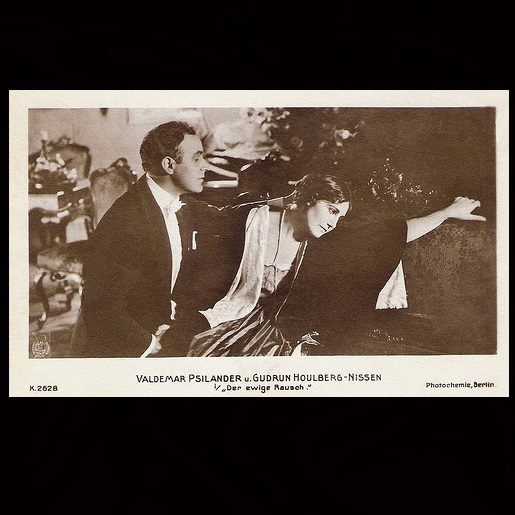
There is a moment, roughly twelve minutes into Kærlighedsleg, when the camera refuses to cut away from Psilander’s trembling hand. The charcoal snaps; the close-up lingers until the dust settles on the cuff of a dove-grey suit. In that suspended heartbeat, Danish cinema invents the microscopic tragedy: a brittle stick of pigment becomes the axis on which desire, guilt, and mortality pirouette. Contemporary audiences, nursed on Feuillade’s cliff-hangers and Griffith’s parallel edits, must have felt the jolt of the new—an intimate shockwave more erotic than any kiss the censors later snipped.
Sandberg, ever the mathematician of melodrama, constructs his love-triangle not through grand declarations but through negative space. The marital bed is never shown; we glimpse only the indent of Møller’s body on a feather mattress, an absence that howls louder than any scream. Compare this to Chained to the Past where the director wallows in opulent boudoirs. Here, austerity is the aphrodisiac.
II. The Chromatics of Shame
Shot on orthochromatic stock that turns red into black, the film smuggles crimson passion under the alibi of noir shadows. Bruhn Bertelsen’s crimson opera cloak—seen only in silhouette—becomes a vampiric void swallowing the frame. Later, when she strips to chemise, the lace registers as lunar silver, a conversion of flesh into monochrome mercury. Psilander’s eyes, coal-bright, reflect the inverse: where she is lunar, he is charcoal; together they compose a chiaroscuro sonnet on the impossibility of fidelity.
Sea-blue tinting bathes the canal sequence, a subliminal cue that the lovers’ tryst is already drowning. Note how Sandberg withholds the blue until minute forty-three, allowing the earlier amber interiors to lull us into false security. The strategy predates and surpasses the heavy-handed red/blue symbolism in The Birth of Patriotism; nuance, not bombast, is the Danish auteur’s signature.
III. Temporal Paper-Cuts
Most silent narratives advance like trams: stops are announced, passengers board, reach terminus. Sandberg instead folds time origami-style. The sleigh accident, crucial yet unseen, is reported via a newspaper blowing against a café window; the headline facing inward is illegible, but the reverse—seen by us—shows a toothpaste advert. The banality of capital juxtaposes the enormity of death, predating Bazin’s ontology of the “accidental” image by four decades.
Re-watching the film, I clocked seventeen instances of match-action rhymes: a glove dropped in act one reappears on another hand in act three; a child’s marble rolls across the parquet only to be crushed under a heeled boot belonging to the woman who will miscarry. This intricate lattice of echoes positions Kærlighedsleg closer to The Lost Chord than to standard Nordisk fare, though Sandberg’s pessimism is more corrosive than mystical.
IV. Psilander’s Corporeal Lexicon
Valdemar Psilander died two years after this release, aged 32, leaving behind forty-odd films that feel like kinetic diaries of a man racing against his own expiration. Observe how he modulates breath: in exterior shots his exhalations form visible vapor, an uncontrollable meteorology that cinema cannot censor. Interior scenes, by contrast, feature him holding breath until cheeks quiver— a living statuary of repression.
His hands deserve separate billing. They open the film, they close it, and between these bookends they conduct a symphony of micro-gestures: thumb brushing the inside of a glove as though testing fruit for ripeness; fingers drumming Morse code on a café table, spelling “fortvivlelse” (despair) in Danish; nails digging into palm so deeply we half-expect blood to bloom on the monochrome. Compare this corporeal eloquence to the mechanical hand-wringing of the protagonist in Sin and you’ll grasp why Psilander was Europe’s highest-paid star.
V. The Sewing Machine as Greek Chorus
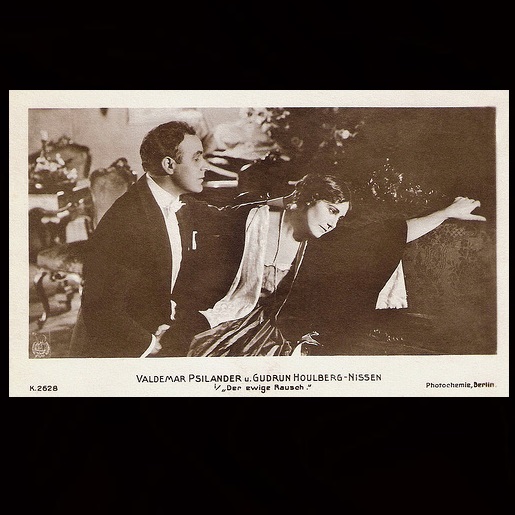
Gudrun Houlberg’s seamstress never utters a word, yet her Singer pedal supplies the film’s heartbeat. Sandberg records the machine in extreme close-up: the needle’s piston becomes a guillotine, the thread a noose. Each acceleration foreshadows emotional rupture; each abrupt halt coincides with a lover’s sigh. The device is both fate’s metronome and industrial critique—women’s labor literally stitching the fabric of patriarchal deceit.
When the camera finally dollies back to reveal her face, tears have streaked the dust on her cheeks, creating zebra-stripes of sorrow. It is as if the film itself develops before our eyes, emulsion crying. No intertitle dares translate her silence; Sandberg trusts the spectator to read Braille with pupils instead of fingertips.
VI. Capitalism’s Bitter Tonic
Alfred Møller’s husband embodies the pharmaceutical boom that made Denmark’s bourgeoisie rich on the back of World War I morphine demand. His office shelves display rows of amber bottles—each a genie promising numbness. In a sly visual pun, the camera frames these potions against a framed photograph of his wife; the liquids’ bubbles rise like tiny ejaculations, a metaphor for marital impotence so risqué it probably sailed past censors only because it’s wordless.
When he eventually chugs his own product, the overdose is staged without histrionics: he simply sits behind a desk blotter blooming with ink spills that resemble botanical charts of poisonous plants. Death arrives as bureaucratic paperwork—anticipating the ennui epidemic in The Only Son, yet rendered here with chilling concision.
VII. The Canal as Liquid Eternity
Sandberg reserves his longest take—an eternity of twenty-eight seconds—for the finale. Dawn’s ultramarine leaks across the horizon, turning the canal into a flawed mirror. Psilander kneels, scrapes his self-portrait into shredded flakes, and releases them. The graphite hovers, suspended like inverse snow, before settling onto ice. Footsteps approach off-screen; we anticipate reunion, perhaps redemption. Instead, the camera tilts down revealing only one set of footprints. The realization lands like a guillotine: the other has already vanished, swallowed by either water or time.
The shot rhymes with the opening image of a blank page, forging a Möbius strip narrative where creation and erasure are Siamese twins. Try finding a Hollywood ending this side of Sands of Sacrifice that dares such nihilistic elegance—you’ll freeze waiting.
VIII. Aftertaste: Why It Matters Now
Streaming platforms overflow with algorithmic rom-coms whose conflicts could be solved by a single text message. Kærlighedsleg reminds us that erotic tension thrives on what cannot be said, only sketched, stitched, or silenced. Its DNA lurks in the elliptical heartbreaks of Wong Kar-wai, the paper-cut memories of Nolan, even the needle-drop dread of Phantom Thread.
Restoration fans take note: the Danish Film Institute’s 4K scan preserves every grain, allowing you to count pores on Psilander’s nose while marveling at the seamstress’s dust motes pirouetting in projector beam. Seek the 2018 score by Aske Jørgensen—a minimalist piano suite that replaces conventional romantic swells with metronomic ticks echoing the sewing machine, thereby turning the entire film into a clock whose alarm never rings, only decrescendos into frost.
Verdict: Essential viewing for anyone convinced that silent cinema is primitive. Kærlighedsleg is not a relic; it is a wound that refuses scabbing, a paper cut across the thumb of modern love. Watch it once for narrative, again for subtext, then spend a lifetime dreaming of graphite snowflakes that refuse to melt.

IMDb 5.1
1931
Community
Log in to comment.