DbcultAccessing Vault...
Cult Review
Senior Film Conservator
Ah, the silent era! A time when narratives unfurled with a grand theatricality, where emotions were writ large on the faces of performers, and the very air of the cinema house crackled with the potential for melodrama and spectacle. It’s within this captivating landscape that we encounter The Strangler's Cord, a 1914 film that, despite its age, still manages to coil its narrative around the viewer with a surprising grip. This isn't just a historical curiosity; it's a fascinating glimpse into the nascent art of cinematic suspense and moral complexity, a story that, much like the titular cord, tightens its hold with each passing frame.
From the outset, the film plunges us into a world teetering on the edge of peril, focusing its lens on Don Louis, portrayed with an aristocratic disdain by Thomas G. Lingham. Louis, a man seemingly unburdened by consequence, finds his opulent existence at the Grand Hotel violently disrupted. The film wastes no time in establishing the stakes, throwing a series of increasingly audacious and deadly attempts at his life. Imagine the sheer terror of discovering a cobra, its scales gleaming menacingly, coiled within your very bed. The primal fear evoked by such an image, even in the absence of sound, is palpable. The slithering menace, a symbol of ancient evil and silent death, sets a chilling precedent for the horrors to come. This isn't merely an assassination attempt; it’s an intimate violation, a clear message that someone wishes to see Don Louis suffer, and suffer deeply.
But the cobra is merely an overture. The narrative then escalates the tension with a classic, almost archetypal instrument of murder: the strangler’s cord. This isn't a quick, impersonal bullet, but a slow, deliberate method, hinting at a killer who desires to feel the life ebb from his victim, to exert ultimate control. The visual of that cord swishing through the air, then encircling Don Louis's neck, is a masterclass in silent film suspense. The audience, leaning forward in their seats, can almost feel the constriction, the desperate struggle for breath. That he escapes this fate by a ‘miracle’ only serves to heighten the sense of a relentless, inescapable doom pursuing him. It’s a brilliant move to make the attempts so personal, so visceral, forcing Don Louis – and us – to confront the very fragility of existence.
The third attempt, the crashing chandelier, introduces a new dimension of terror: the theatricality of public danger, a spectacular display of malice that underscores the pervasive nature of the threat. This isn't a shadowy figure in a bedroom, but an almost divine act of retribution, a falling sword of Damocles. One might draw parallels to the grand, often melodramatic set pieces found in films like The Great Diamond Robbery, where spectacle often intertwines with danger. The sheer audacity of these attacks, escalating in their visibility and dramatic impact, leaves Don Louis utterly unnerved. His plea to Hilton, one of the hotel detectives, for protection is not merely a request for security; it’s a desperate cry for sanity in a world gone mad. Ollie Kirby’s Hilton, a figure of stoic resolve, represents the nascent cinematic hero, a man of action attempting to impose order on chaos.
Yet, even the presence of a lawman cannot deter the unseen hand of vengeance. Hilton’s subsequent discovery, bound and gagged, and Don Louis's kidnapping, plunges the narrative into deeper mystery. The disappearance of the victim, rather than his death, suggests a more elaborate, perhaps more cruel, agenda at play. This isn't merely about ending a life; it's about prolonged suffering, about a theatrical form of justice that transcends immediate demise. The plot thickens with the introduction of Renee, played by Marin Sais, the daughter of Valdez, the cigar-maker. Her father’s disappearance mirrors Don Louis’s, drawing Hilton into a parallel investigation that will ultimately converge with the main thrust of the narrative.
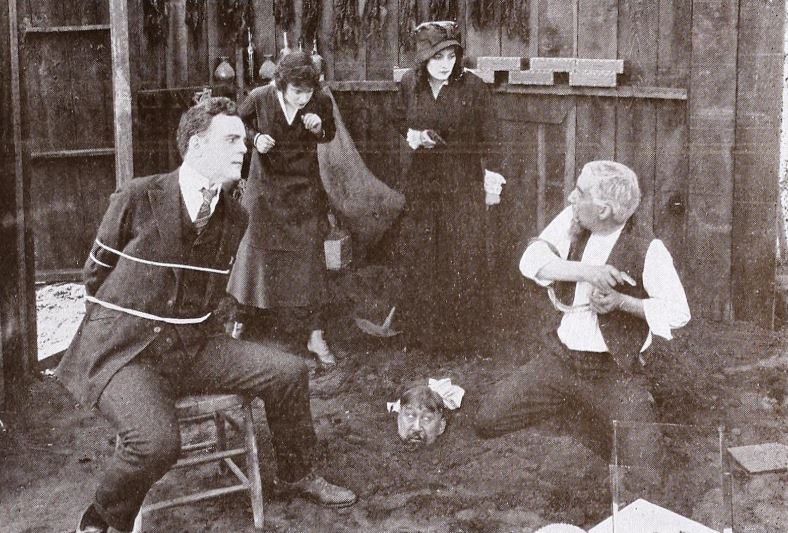
The journey to the curing house, a setting inherently atmospheric with its connotations of decay and transformation, marks a pivotal shift. Here, the film sheds its initial mystery and reveals its true, darker heart. The discovery of Valdez and Don Louis, the latter buried neck-deep in the ground, is a truly disturbing image, a potent symbol of helplessness and imminent doom. Charles Cummings’ portrayal of Valdez is particularly compelling here, conveying a man driven to the brink of madness by an all-consuming thirst for retribution. His initial appearance as 'insane' quickly gives way to a chilling clarity as he recounts his tragic tale.
Valdez’s narrative is the film’s emotional core, transforming Don Louis from a mere victim into a perpetrator of immense cruelty. The story of kidnapping, betrayal, and the theft of a beloved wife, culminating in her death in want, paints a stark picture of social injustice and personal devastation. This backstory elevates the film from a simple thriller to a profound exploration of revenge. It forces the audience to grapple with uncomfortable questions: Is Valdez’s thirst for vengeance justified? Can any act of retribution truly right such a grievous wrong? This moral ambiguity is a hallmark of more sophisticated storytelling, even in the early days of cinema. One might think of the complex moral landscapes explored in films like The Price, where characters are often trapped by their pasts and forced to make impossible choices.
The climax, with Valdez kneeling beside Don Louis and slowly shoving a cobra toward his face, is nothing short of terrifying. It’s a moment of excruciating suspense, where the audience is fully aware of the stakes, the history, and the raw emotion driving Valdez’s actions. The silent film medium, with its reliance on exaggerated gestures and facial expressions, excels in conveying such intense psychological drama. The close-up on the cobra, then on Don Louis’s contorted face, would have been particularly impactful for audiences of the era, unaccustomed to such visceral cinematic experiences. This scene, more than any other, cements the film’s status as a harrowing psychological thriller.
The timely arrival of Frances Ballou, summoned by Renee, serves as the narrative’s deus ex machina, a necessary intervention to halt the cycle of violence. Her presence, a beacon of mercy, prevents Valdez from crossing the final threshold into murder, thus preserving a semblance of moral order. Hilton’s subsequent retelling of the story to Frances, while liberating Don Louis, is crucial. It’s through this recounting that the full weight of Don Louis’s past transgressions is laid bare, not just for Frances, but for Don Louis himself. The ‘terrible ordeal’ has functioned as a crucible, forging a new, humbled man from the ashes of his former arrogance. Lingham’s portrayal of Don Louis’s transformation, from haughty victim to shamed wretch, is conveyed through subtle shifts in posture and expression, a testament to the power of silent acting.
The resolution, with Don Louis slinking away and Frances resolving to keep the matter from the police, is perhaps the film’s most intriguing and morally complex decision. It suggests a form of justice that operates outside the confines of the legal system, a justice rooted in personal shame and the transformative power of suffering. Frances, her heart touched by the tragic narrative, chooses compassion over punitive measures, recognizing that Don Louis has already endured a profound reckoning. This ending, while perhaps surprising to modern viewers accustomed to clear-cut legal resolutions, speaks to a different sensibility, one where personal redemption and the quiet understanding of human frailty held significant weight. It's a nuanced conclusion that avoids easy answers, leaving the audience to ponder the true cost of revenge and the delicate balance between justice and mercy.
From a technical perspective, The Strangler's Cord showcases the burgeoning cinematic language of its time. The use of intertitles is effective, providing crucial exposition and dialogue without disrupting the visual flow excessively. The camera work, while often static by today's standards, is strategically employed to emphasize dramatic moments, particularly in the close-ups during the climax. The pacing, a gradual build-up of suspense followed by rapid, shocking revelations, keeps the audience engaged. The film’s ability to conjure such palpable tension and convey complex emotions without a single spoken word is a testament to the skill of its uncredited writers and director, as well as the expressive power of its cast.
The performances, particularly by Thomas G. Lingham as the tormented Don Louis and Charles Cummings as the vengeful Valdez, are noteworthy. Lingham’s initial arrogance and subsequent terror are conveyed through broad yet effective gestures, a hallmark of silent film acting. Cummings, on the other hand, masterfully oscillates between apparent madness and a chillingly lucid recounting of his grievances, making Valdez a truly memorable antagonist. Marin Sais, as Renee, provides a crucial emotional anchor, her concern for her father driving a significant portion of the plot and ultimately leading to the climax. Ollie Kirby’s Hilton is the quintessential upright detective, a figure of calm amidst the storm, whose determination provides a steady counterpoint to the escalating chaos.
Comparing The Strangler's Cord to other films of its era, one can see its place in the evolution of the thriller genre. While perhaps not as overtly fantastical as some contemporary adventures, its focus on psychological torment and personal revenge aligns it with the emerging trend of more grounded, character-driven dramas. Its intricate plotting and escalating stakes might remind one of the intricate mysteries found in films like The Mystery of St. Martin's Bridge, though The Strangler's Cord leans more heavily into the dark recesses of human motivation. The film’s willingness to explore the dark side of human nature, the corrosive power of resentment, and the fine line between justice and vengeance, makes it a surprisingly modern viewing experience.
Ultimately, The Strangler's Cord is more than just an early cinematic thriller; it’s a compelling moral drama wrapped in a shroud of suspense. It explores themes of betrayal, retribution, and the possibility of redemption with a depth that belies its age. The film asks us to consider the enduring legacy of our actions and the profound impact they can have on others. It reminds us that sometimes, the most potent form of justice is not found in a courtroom, but in the quiet, agonizing realization of one’s own infamy. For anyone interested in the foundational narratives of cinema, the evolution of suspense, and the enduring power of a good, old-fashioned tale of revenge, The Strangler's Cord offers a rich and rewarding viewing experience. It’s a silent film that speaks volumes, a testament to the timeless appeal of human drama, and a stark reminder that some wounds run so deep, they can only be healed, or avenged, by the most extraordinary means.
IMDb —
1926
Community
Log in to comment.