DbcultAccessing Vault...
Cult Review
Senior Film Conservator
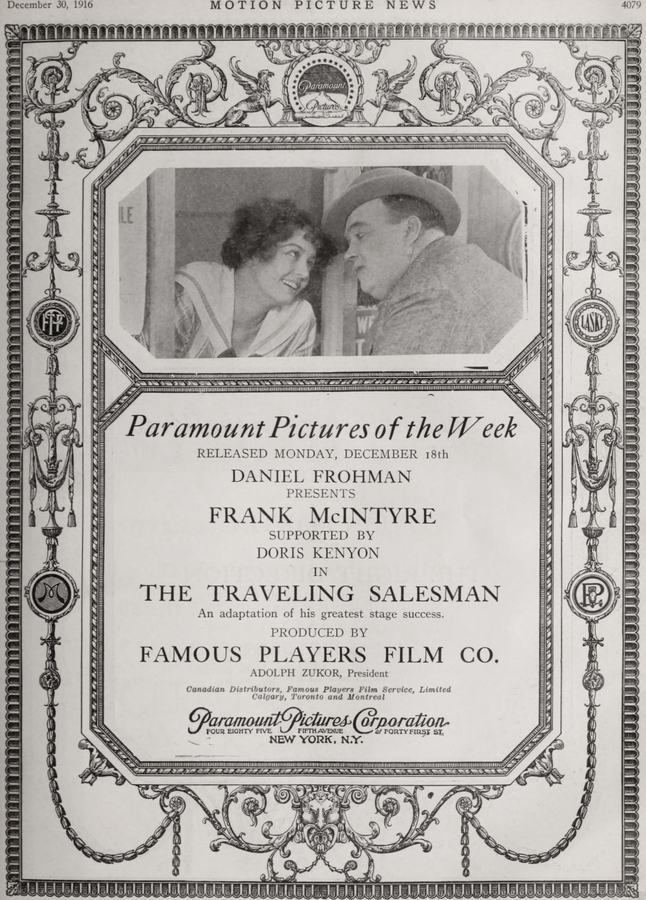
In the pantheon of early American cinema, few archetypes resonate with as much cultural specificity as the 'drummer'—the itinerant salesman whose arrival in a dormant town signaled the encroachment of modernity and the hum of commerce. James Forbes’ 1916 adaptation of The Traveling Salesman, directed with a keen eye for both pastoral charm and kinetic suspense, stands as a quintessential artifact of this era. It is a film that balances the levity of situational comedy with a surprisingly trenchant critique of land speculation and the predatory nature of nascent capitalism. At its center is Frank McIntyre’s Bob Blake, a protagonist whose physical rotundity is not merely a sight gag, but a visual shorthand for a surplus of soul and a sturdy, unwavering moral compass.
The narrative’s inciting incident—a missed station due to a sleeping porter—serves as a brilliant subversion of the traditional hero’s journey. Blake does not set out to find adventure; adventure, in the form of the snow-dusted hamlet of Grand Cross, finds him. The cinematography immediately establishes a dichotomy between the warmth of the telegraph office and the biting chill of the Christmas morning exterior. When Blake peers through the glass to see Beth Elliott (played with a delicate yet resilient grace by Doris Kenyon), the window acts as a proscenium arch, framing a romance that is as much about mutual salvation as it is about chemical attraction.
Unlike the heavy-handed melodrama found in contemporary works like The Waif, The Traveling Salesman maintains a breezy tempo that masks its underlying tension. Blake is the quintessential 'outsider' who possesses the social intelligence to navigate a community that is simultaneously welcoming and insular. His 'jovial and trustworthy' appearance is his greatest weapon, allowing him to bypass the natural reserve of the townspeople and penetrate the inner sanctum of the local power structure.
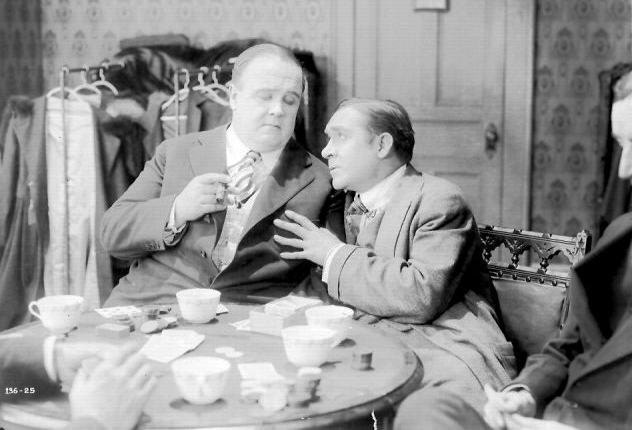
The conflict at the heart of Grand Cross is one of property and progress. Martin Drury, the 'local capitalist,' and his henchman Royce represent a specific type of American villainy: the man who profits from the misfortune of his neighbors. The plot point regarding Beth’s home being sold for taxes is a recurring motif in the era’s cinema, often used to highlight the vulnerability of single women in a rigid economic system. We see similar themes of domestic displacement in Husband and Wife, though here the stakes are amplified by the industrial greed of the railroad expansion.
"The railroad is the invisible hand of destiny in this film, a force that promises wealth to the few and displacement to the many. Blake, though a man of trade himself, becomes the monkey wrench in Drury's well-oiled machine of exploitation."
The revelation that Beth has been supporting Mrs. Stratton, a woman whose own store was liquidated by Drury, adds a layer of moral complexity to Beth’s character. She is not merely a damsel in distress; she is a pillar of the community’s social safety net, making Blake’s intervention feel less like a romantic conquest and more like a necessary restoration of justice. The film’s critique of Drury’s 'capitalist' ethics echoes the social commentary found in The Middleman, where the exploitation of labor and land is laid bare for the audience’s scrutiny.
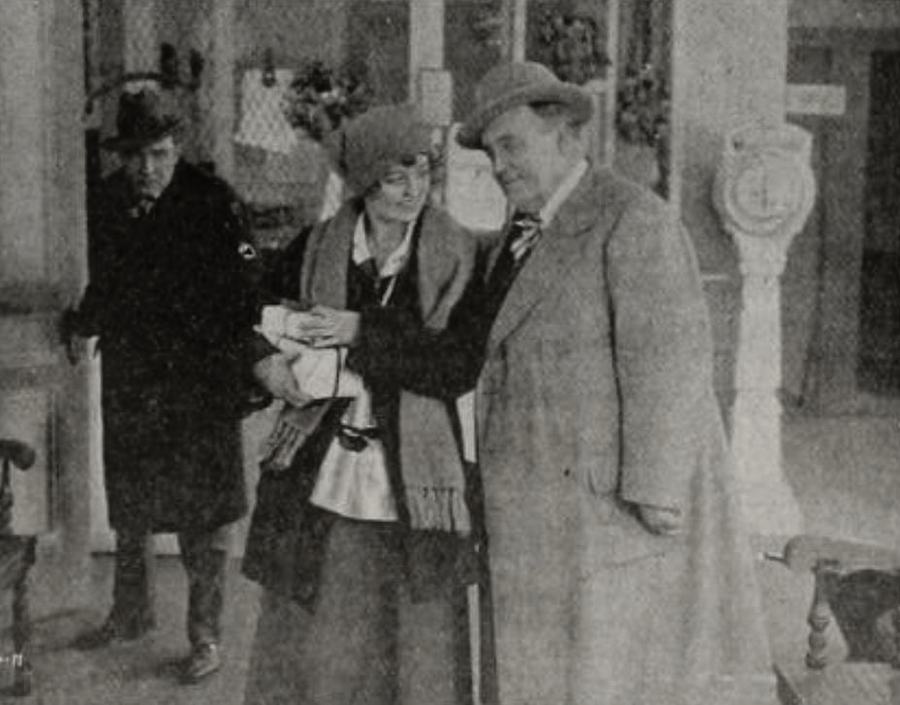
One of the film’s most celebrated sequences is the poker game, fueled by 'Scotch tea.' In an era before sophisticated dialogue, the filmmakers used the ritual of the card game to communicate a wealth of character information. The way Blake handles his cards—relaxed, confident, slightly performative—contrasts sharply with Royce’s nervous aggression. This scene is a fascinating precursor to the high-stakes gambling tensions seen in The Cold Deck. Here, the 'tea' acts as a social lubricant that dissolves Royce’s inhibitions, causing him to boast of his and Drury’s plan.
The use of alcohol as both a comedic device and a narrative tool is handled with a light touch. It facilitates the film’s pivot from a comedy of manners to a high-stakes race against time. When Blake realizes the depth of the deception, his transformation from a rotund fun-lover to a man of action is remarkably effective. He leverages his friends to neutralize Royce, showcasing a communal solidarity that stands in stark contrast to the individualistic greed of the antagonists.
The third act of The Traveling Salesman shifts gears into a proto-action thriller. The race between the rig and the 'small car' is a marvel of early location shooting. While the film lacks the exotic scale of The Adventures of Kathlyn, it compensates with a grounded, visceral sense of speed. The overturning of the car is a genuine 'stunt' moment that would have thrilled 1916 audiences, emphasizing the physical danger Blake is willing to endure for a woman he barely knows.
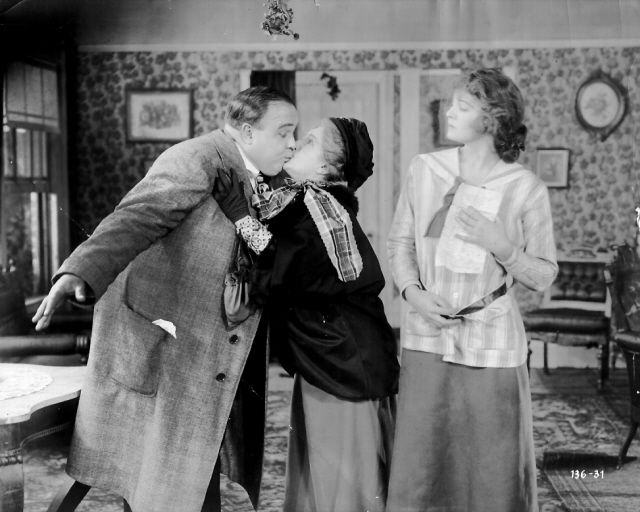
This sequence also highlights the technological transition of the time. The horse-drawn rig versus the automobile is a visual metaphor for the changing world Bob Blake inhabits. His success in reaching the courthouse to pay the taxes in Beth’s name is a victory for the 'new' man—the salesman who uses the tools of the modern world (the car, the telegraph, the legal system) to protect the traditional values of the 'old' world (the home, the hearth, the community).
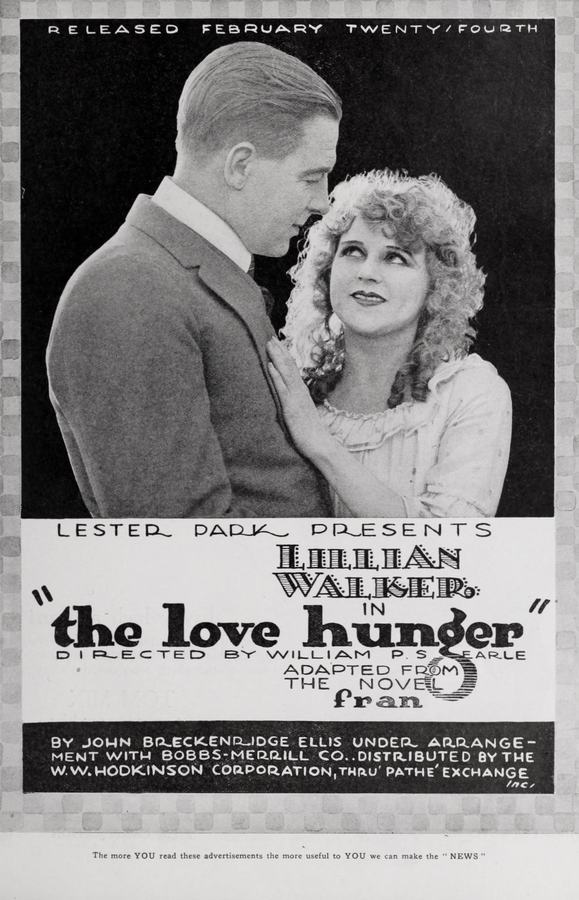
The final confrontation at the Elliott place, where Royce attempts to coerce Beth into signing over the property, introduces a darker, more claustrophobic tone. This 'locked door' scenario is a staple of silent melodrama, reminiscent of the domestic peril in Fesseln or the suspenseful entrapment in The Children in the House. Royce’s desperation turns him from a mere opportunistic henchman into a genuine threat, highlighting the 'spice of jealousy' that has fermented throughout the film.
Blake’s arrival and the subsequent 'desperate struggle' provide the physical catharsis the audience craves. However, the true resolution lies in the destruction of the check. By tearing up the $5,000 offer, Blake isn't just saving a house; he's invalidating the entire transactional worldview that Drury and Royce represent. It is a moment of pure idealism that aligns with the wholesome spirit of Little Mary Sunshine, yet it carries the weight of a mature legal drama like Evidence.
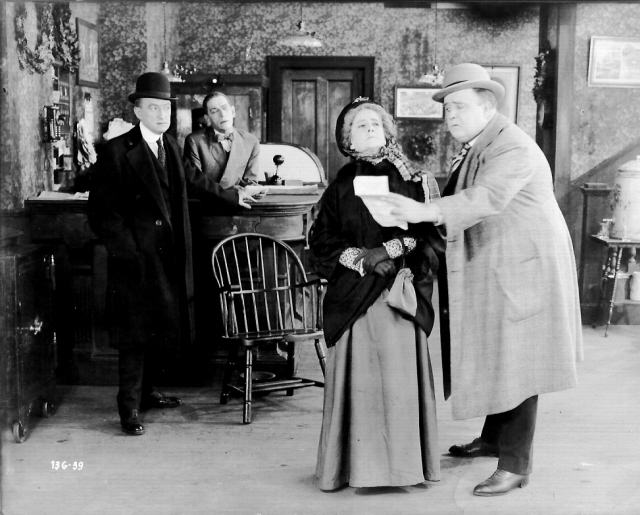
Frank McIntyre is a revelation. His performance avoids the hyper-exaggerated mugging common in the slapstick of the era, opting instead for a charm rooted in timing and presence. He embodies the 'Salesman' as a folk hero, a man whose bag of samples contains not just merchandise, but hope. Doris Kenyon, as Beth, provides a necessary emotional anchor. While her role is occasionally relegated to the 'object' of the struggle, her early scenes in the telegraph office establish her as a capable, working-class woman—a far cry from the passive wards seen in Cardinal Richelieu's Ward.
The direction by the uncredited (though often attributed to Joseph Kaufman or similar studio hands of the time) filmmaker shows a sophisticated understanding of spatial relationships. The use of the telegraph office window as a recurring motif suggests a world connected by wires but separated by glass and social strata. The pacing is relentless, eschewing the meandering subplots that often bogged down features like The Spy or the convoluted intrigue of I tre moschettieri.
Ultimately, The Traveling Salesman is a film about the ethics of intervention. Bob Blake could have simply waited for the next train and continued his mercantile journey. Instead, he chose to engage with the 'vicissitudes' of a stranger’s life. This theme of moral responsibility is a recurring thread in the works of James Forbes, who understood that the best comedy is always rooted in a sense of justice. The film manages to avoid the nihilism of The Curse of Iku or the heavy psychological manipulation of In the Hollow of Her Hand, opting instead for a festive, redemptive conclusion.
As the credits roll (or rather, as the final title cards fade), we are left with a sense of profound satisfaction. The 'precious parcel' here is not a physical object, as in The Precious Parcel, but the integrity of the Elliott home and the burgeoning union between Blake and Beth. It is a reminder that even in a world of taxes, railroad schemes, and 'Scotch tea,' a little bit of rotund joviality can go a long way.
Final Verdict: A sparkling example of silent-era storytelling that remains as refreshing as a Christmas morning in Grand Cross. 9/10
IMDb 5.3
1929
Community
Log in to comment.