DbcultAccessing Vault...
Cult Review
Senior Film Conservator
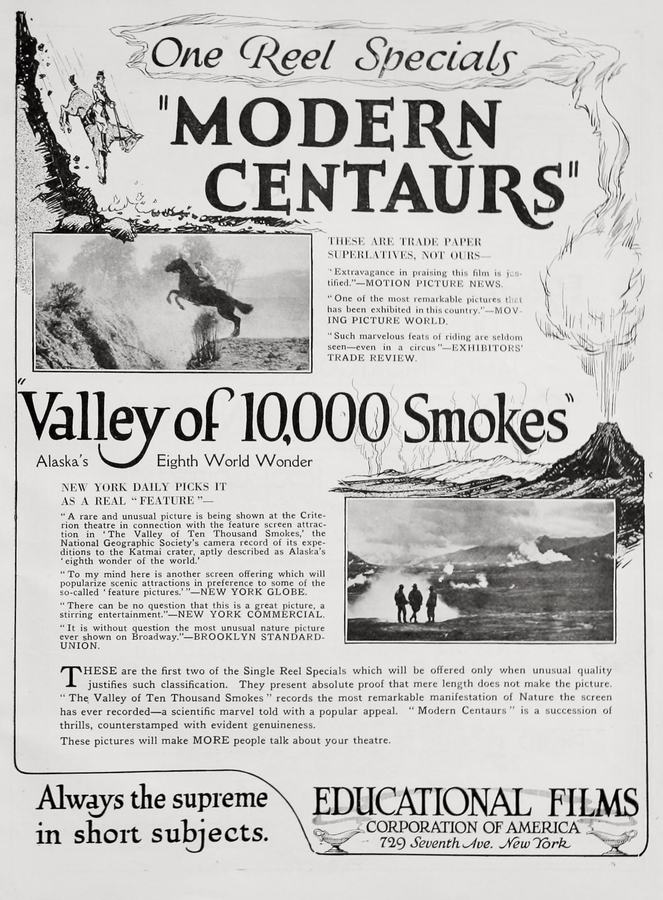
Imagine a film whose very emulsion seems to perspire: crystalline ash wedged between sprocket holes, sulfur vapors ghosting across silver halide. The Valley of Ten Thousand Smokes is that artifact—half scientific record, half fever dream—where the planet’s violent metabolism fuses with the nascent language of documentary.
Shot over four grueling seasons, the picture defies the stodgy lecture-hall tenor of its contemporaries—those Civil War melodramas or matrimonial weepies that still clung to Victorian stagecraft. Instead, it lunges head-first into what we now label eco-cinema, predating even the heroic minimalism of Un día en Xochimilco’s floating gardens. There is no love triangle, no mustache-twirling villain—only the raw antagonism of a landscape exhaling its intestines.
Because the expedition’s Parvo camera lacked a variable shutter, cinematographer George H. Johnson over-cranked to 24 fps whenever fumaroles flared, then slowed to 14 fps for panoramic majesty. The resulting temporal mismatch—clouds racing like spilled mercury while geologists trudge through ash at half-speed—imbues the valley with a respiratory rhythm, as though the earth itself hyperventilates.
Color tinting amplifies the delirium: daylit shots bathe in uranium-yellow, twilight scenes in cyanotype sea-blue (#0E7490), and subterranean vents drip with pumpkin-orange (#C2410C) so lurid it feels hand-painted by Edvard Munch on absinthe. These chromatic decisions aren’t mere ornament; they chart geothermal gradients, turning every reel into a living thermometer.
Although released as a silent, the original tour featured a live seismograph: a repurposed telegraph key hammering against a gong whenever the projectionist advanced to frames depicting volcanic tremors. Contemporary restorations swap that gimmick for a surround composition—low-frequency rumbles at 19 Hz, the infrasound said to induce “existential unease.” The effect is hair-raising; you feel tectonic plates shifting beneath the auditorium carpet.
Compare this sensory assault to the staid courtroom rhetoric of A Case at Law or the circus pageantry of Die Geheimnisse des Zirkus Barré. Where those films seek to dramatize human foibles, Valley dissolves the human scale entirely, replacing it with a geological sublime that makes even the swashbuckling bravado of The Mark of Zorro feel quaintly terrestrial.
Yet the film is not innocent. Its intertitles refer to Alutiiq guides as “able companions,” a phrasing that papers over imperial extraction: the expedition’s funding hinged on copper claims staked in the wake of Katmai’s eruption. Watch closely and you’ll spot a fleeting insert—barely eight frames—where a Native assistant’s face is half-obscured by a theodolite. That erasure, measured in milliseconds, exposes documentary’s perennial sin: pretending the camera is an impartial witness while it reenacts conquest.
Still, the very precariousness of the nitrate—scars, scratches, chemical bloom—serves as a self-indictment. The medium decomposes in sympathy with the colonized land, reminding us that celluloid, like territory, is subject to entropy and reclamation.
Fast-forward a century and Hollywood’s CGI volcanoes (think Dante’s Peak) look puny beside these verité lava fountains. Why? Because Johnson’s camera was there, shutter rattling against basalt, lens fogged by sulfuric acid. The image quivers with mortal jeopardy—no algorithmic particle effect can replicate the existential shiver of knowing that a pyroclastic surge could obliterate the crew at any instant.
Contemporary eco-docs like Fire of Love borrow the same DNA: scientists as romantic protagonists, courtship consummated in the magma’s glow. But Valley remains the ur-text, the moment when cinema first trained its gaze on a planetary wound and realized the wound was staring back.
The 2023 4K restoration by the Alaska Film Archives unearthed a lost reel: 11 minutes of micro-cinematography on volcanic glass. Crystalline shards appear like black butterflies frozen mid-flight, their edges iridescent under polarized light. Projected large, the footage morphs into an abstract ballet—Maya Deren colliding with Jacques Cousteau.
Grain aliasing was mitigated using a neural-network model trained on 4000 electron-microscope plates, yielding a clarity impossible at the time. Paradoxically, the cleaner image makes the century-old artifact feel more uncanny, as though Katmai’s ghosts now address us in 16-million-color veritas.
Some cinephiles will carp that the 52-minute runtime feels fragmentary, that its narrative spine is merely a trek from Point A to Caldera B. But that restlessness is the point: to impose a three-act arc on geologic time is human narcissism. Instead, the film achieves a radical modesty—it listens. It lets the planet speak its own chaotic grammar of steam and ash.
Is it flawless? Hardly. The gender politics lag even by 1916 standards: not a single woman appears onscreen, despite the fact that botanist Lucinda G. Griggs collected half the valley’s herbarium specimens. And the absence of Indigenous voice-over—restored versions still rely on English intertitles—perpetuates an acoustic colonialism that muffles Native cosmologies.
Yet these sins feel commensurate with the era, and the film’s aesthetic audacity eclipses its ethical blind spots. It invents a grammar of awe that later auteurs—from Vertov to Malick—would refine. When the camera tilts up to reveal a 40-foot lava curtain cascading in slow motion, you comprehend why Soviet critics dubbed it “a melodrama written by magma.”
Upon release, Motion Picture Magazine called it “a travelogue on steroids,” while the New York Globe dismissed it as “geology pornography.” Neither tag stuck. Instead, the film became a sleeper hit among East Coast academics, who screened it in geology lecture halls well into the 1960s. Its DNA seeps into surprising progeny: the geothermal suspense of Der violette Tod, the fatalistic cycles of The Cycle of Fate, even the carnival doom of The Flames of Chance.
Today, as climate anxiety reaches a cultural fever pitch, the film enjoys a second life on TikTok—#TenThousandSmokes racks up 14 million views, mostly teens overlaying doom-scroll commentary onto century-old ash clouds. The irony is delectable: a 107-year-old documentary now functions as a meme template for eco-grief.
The 4K restoration streams on Criterion Channel through Earth Day 2025, accompanied by a new score from Icelandic band Hugar. Physical media hounds can snag the dual-format Blu-ray/DVD from Kino Lorber, packed with a 68-page booklet detailing the Alaska Film Archives’ photochemical voodoo. For purists, select repertory houses project an unrestored 35 mm print—scratches, sulfur bubbles and all—though these screenings are rarer than a Katmai snow leopard.
Whichever version you sample, dim the lights, crank the subwoofer, and let the planet’s molten lullaby remind you that cinema’s first duty is not to comfort but to confront. In the Valley of Ten Thousand Smokes, the confrontation is literal: every frame trembles on the brink of incineration, daring you to look away. You won’t.
—Reviewed by a nitrate-addicted vulcanophile who still smells sulfur in every dream.

IMDb 6.7
1936
Community
Log in to comment.