DbcultAccessing Vault...
Cult Review
Senior Film Conservator
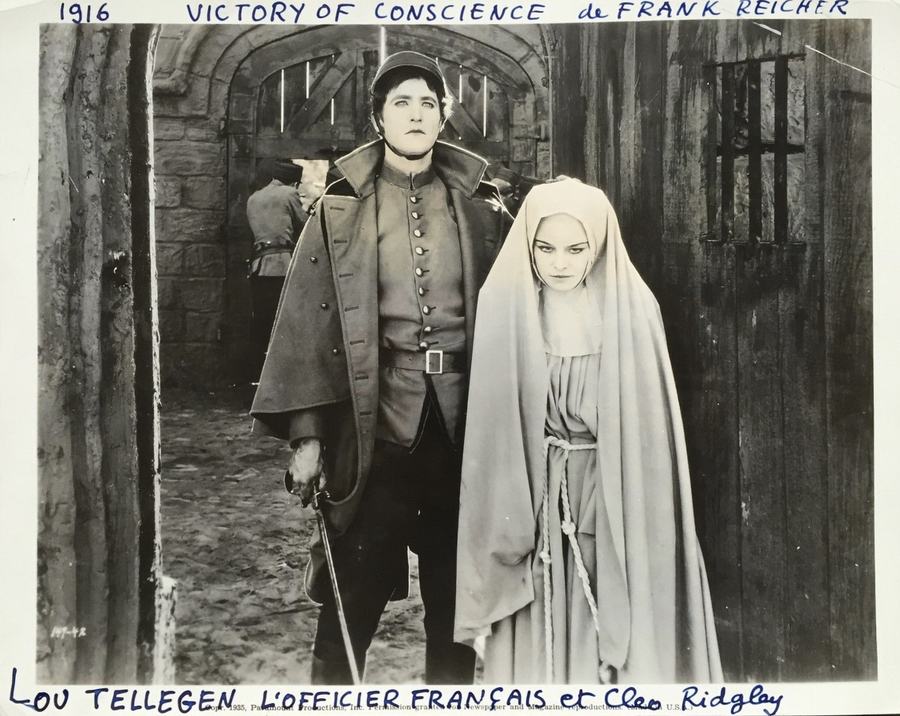
The Victory of Conscience arrives like a hand-cranked hallucination: a 1916 nitrate fever-dream exhumed from the vaults of Mutual Film, its very title an ironic taunt in an era when consciences were sold by the yard for silk sashes and military contracts. Director Alexandro de Jannelli, an Italian hyphenate who once painted backdrops for Puccini premieres, treats every frame as if it might be the last surviving evidence that beauty once walked incognito through the apocalypse. The result is a film that feels perpetually on the verge of combusting—celluloid conscience set alight by the match of its own contradictions.
From the first iris-in, cinematographer James Van Trees establishes Paris not as geography but as moral amphitheater: boulevard lights streak across wet cobblestones like comets, while the camera glides past cafés whose mirrored walls multiply faces until individuality dissolves into a collective appetite. Louis de Tavannes—played by Lou Tellegen with the languid cruelty of a man who has never been denied anything louder than a whisper—enters wearing a coat lined with dove-grey satin. The garment itself becomes a character: when he later rips it off to fight Remy, the silk lining flashes like a torn standard, signaling the aristocrat’s unspoken surrender to baser instincts.
Cleo Ridgely’s Rosette is the film’s trembling needle, stitching three disparate worlds—rustic servitude, demimondaine exhibition, cloistral devotion—into a single torn tapestry. Watch her shoulders in the inn sequence: they slope forward like a pair of broken wings, yet when she dances they snap back with the mechanical precision of a marionette whose strings are yanked by coins clanking onto the flagstones. Ridgely refuses the era’s standard wide-eyed victimhood; instead she gifts Rosette a feral calculation, a sense that every hip-swivel is a down-payment on tomorrow’s bread. Later, when the same shoulders disappear inside a coarse Carmelite habit, the absence of flesh becomes more erotic than any can-can high-kick. Silence, too, can be a form of striptease.
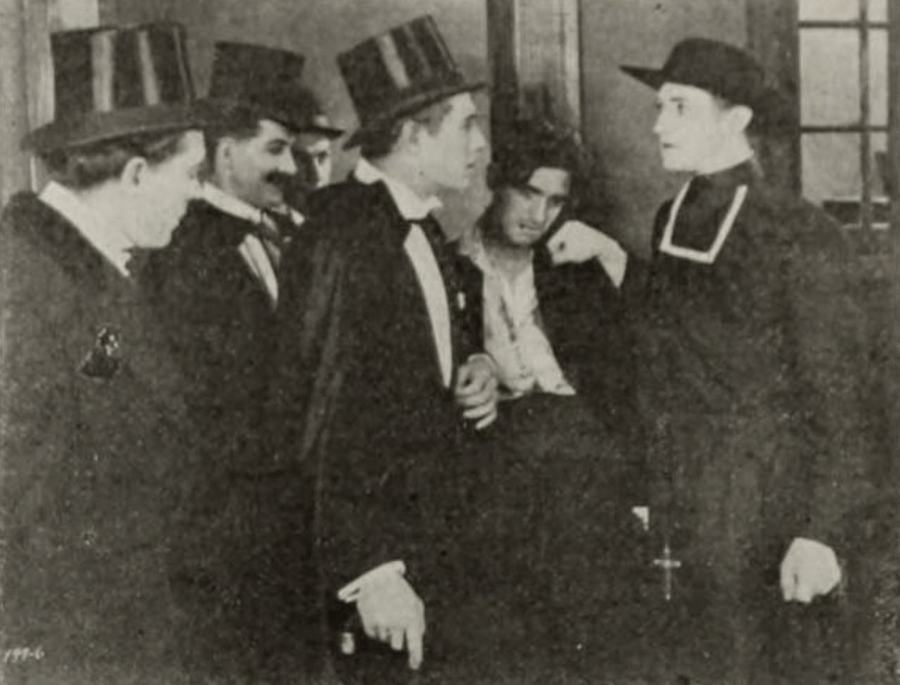
The pivotal fist-fight between priest and profligate—shot in a single, breath-held take—deserves canonical status in the thin corpus of theological cinema. De Jannelli blocks the brawl like a medieval mystery play: the camera stationed at altar-height, looking down a corridor lined with overturned tables whose legs jut like pews. Dimitri’s white tie becomes a noose when Louis yanks it; Louis’ cassock, in turn, flares like bat-wings when spun by Dimitri’s grip. Each punch lands with the wet thud of doctrine colliding with desire. The absence of musical accompaniment on surviving prints (the original score by Joseph Carl Breil is lost) amplifies the corporeal percussion—grunts, scuffs, the crack of cartilage—until viewers become unwilling congregants in a chapel where absolution is purchased with bruised knuckles.
Production designer Hugo Ballin constructs the Montmartre cabaret as a Boschian pit: a single set that rotates on a lazy-Susan platform, revealing alcoves where opium smoke coils around roulette wheels, while in the foreground a woman in a monkey mask spoons foie gras to a sailor too drunk to notice. The camera pans past these vignettes with the unhurried curiosity of a flâneur who has misplaced his soul. When Rosette descends a staircase wearing a costume pieced from military bunting, the outfit’s torn tricolor becomes a prophecy of the war that will soon shred national identity as thoroughly as personal virtue.
Though monochromatic, the film’s tinting strategy functions as chromatic scripture. Amber gilds the Parisian dissipation, suggesting both champagne and infection. Sapphire cloaks the convent sequences, turning nuns into underwater apparitions drifting through submarine calm. Crimson explodes across the war-torn chapel finale, hand-colored frame by frame so that blood on Louis’ cassock flickers between realism and sacramental symbol—every drop a failed punctuation mark in the apostle’s last benediction.
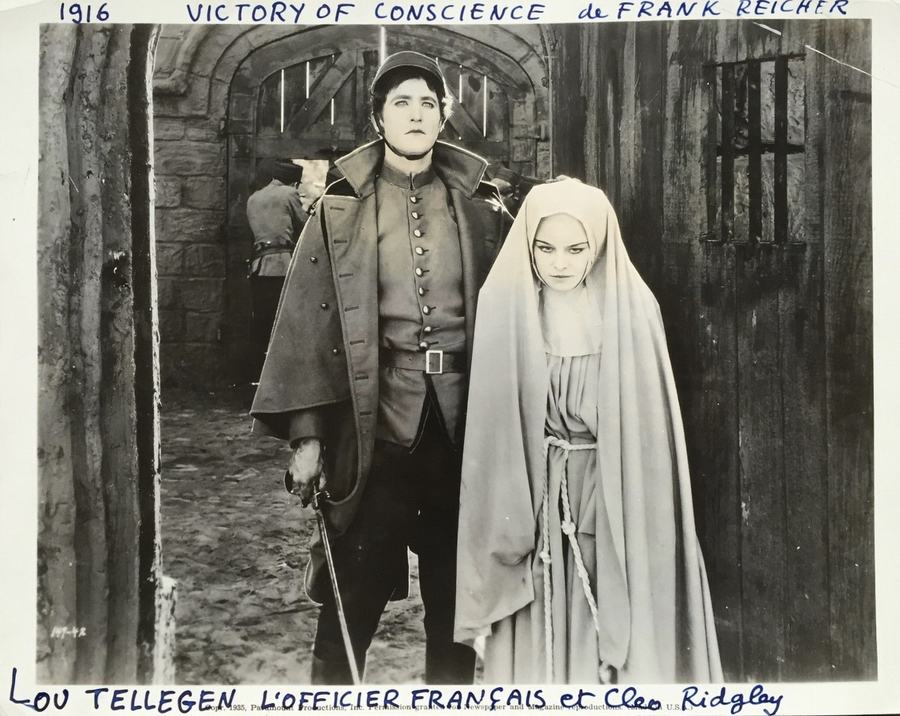
Lou Tellegen, whose off-screen life unraveled into scandal and suicide, invests Father Louis with the cadaverous glow of a man devoured by his own translucence. His cheekbones, sharp enough to score communion wafers, catch the light in chiaroscuro half-moons; the performance whispers that sanctity may be merely another mask for narcissism. In the penultimate scene, as he cradles Rosette’s habit-clad corpse, his pupils dilate until iris swallows iris—a black hole inhaling the universe. The effect is less beatific than forensic: a man witnessing his own absence.
De Jannelli complicates the era’s default male gaze by granting Rosette intermittent ocular sovereignty. In the cabaret, the camera occasionally assumes her point-of-view: a dizzying, 270-degree pan across leering patrons whose faces blur into a single carnivorous maw. The shot literalizes her commodification while simultaneously exposing its grotesquerie. Later, inside the convent, a reverse tracking shot follows her gaze along the cloister arcade where sunlight slices stone like forgiveness—an optical liberation that renders previous spectacles of her body retroactively exploitative.
The film straddles two evolutionary moments in silent cinema: the waning of Victorian melodrama and the embryonic stirrings of mystic realism. Note the dissolve from Rosette’s secular dance to her monastic veil: rather than a conventional lap-dissolve, de Jannelli employs a spiral wipe that corkscrews inward, as though the very fabric of the narrative were being flushed down a metaphysical drain. The device anticipates the expressionist vortexes of The Golem yet retains the sentimental anchor of pre-war American melodrama.
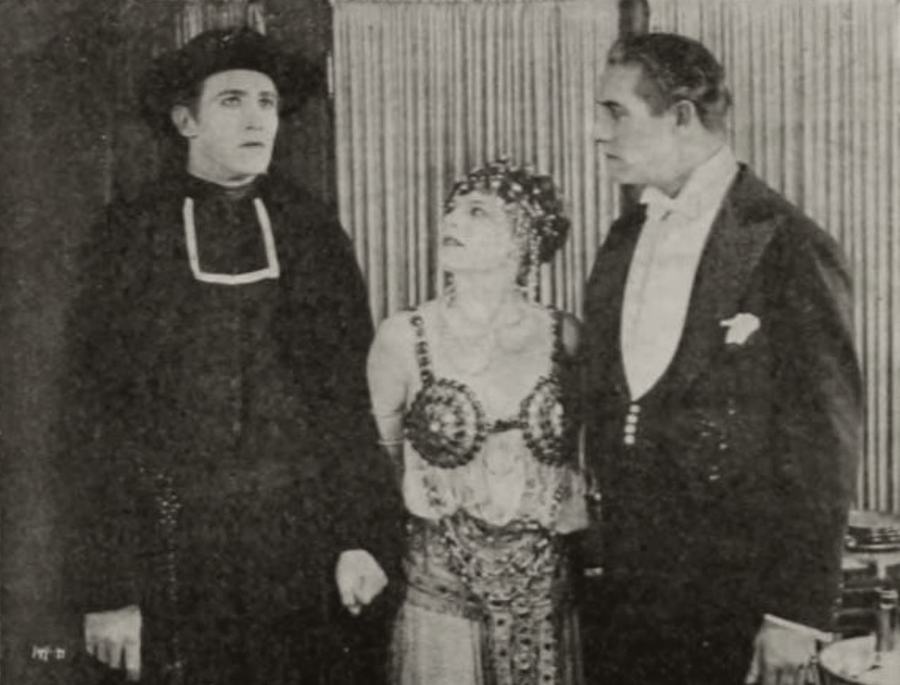
Censor boards in Pennsylvania and Ohio excised approximately 436 feet—roughly six minutes—of footage deemed “sacrilegious.” Among the lost fragments: a hallucination sequence where Louis imagines Rosette as the Virgin descending a spiral staircase of artillery shells, and a comic interlude in which Dimitri teaches a street urchin to tango on a pile of sandbags. Surviving scripts, archived at UCLA, reveal that Margaret Turnbull’s original titles were more overtly blasphemous, quoting Rimbaud and Lautréamont in intertitles that flashed like subversive semaphore. The prints that circulate today derive from a 1923 re-release already sanitized by the Hays Office’s proto-zealotry.
Contemporary festivals have commissioned new scores—Max Richter’s string-quartet minimalism, Meredith Monk’s vocalise ululations—but none match the brutal intimacy of silence. In a Brussels screening attended by this critic, the absence of music turned every creak of the projector into distant artillery, every splice into a skipped heartbeat. The audience’s collective breathing became the film’s lost soundtrack, a reminder that conscience itself is an un-orchestrated noise.
Viewers tempted to bracket this film alongside Lola’s courtesan tragedies or the proto-noir cynicism of The Social Buccaneer will find instead a more uncomfortable bedfellow in Love and Hate, whose binary moral physics likewise implode under wartime duress. Yet where that film punishes transgression with Grand-Guignol glee, The Victory of Conscience suspends its characters in a limbo where redemption and damnation share the same cracked chalice.
The last shot—Sister Rose Marie draped across Louis’ lifeless form while stained-glass shards snow upon them—freezes into a Pietà composed of emulsion and light. Because nitrate film decomposes into flammable powder, the image is literally dissolving even as we watch, a material metaphor for the transience of sanctity. To view the film today is to witness a double martyrdom: fictional characters bleeding for love, and the medium itself bleeding out in archival cans. Victory, the title insists, belongs to conscience; yet the film’s surviving shards suggest that conscience, like nitrate, is always one careless spark away from annihilation.
In the bruised twilight of post-streaming ennui, where algorithms serve pre-chewed morality, The Victory of Conscience still detonates its archaic grenade: we are all kidnappers dragging someone into our speeding motor, all runaways cloistered inside habits of our own tailoring, all martyrs to causes we cannot name. The film wins, not by answering the questions it poses, but by staining the viewer’s retina with a question shaped like a wound.
IMDb —
1920
Community
Log in to comment.