DbcultAccessing Vault...
5.4/10
Senior Film Conservator
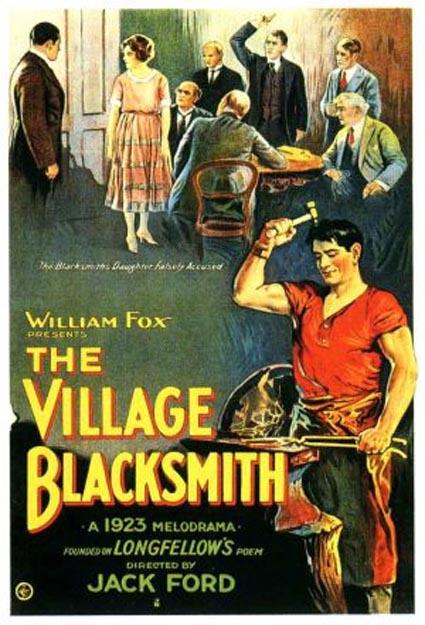
A definitive 5.4/10 rating for a film that redefined the boundaries of cult cinema. The Village Blacksmith remains a cornerstone of transgressive art.
When we invoke the ghost of Henry Wadsworth Longfellow, the mind instantly drifts to the rhythmic, comforting thud of the hammer against the anvil. However, the 1922 Fox production of The Village Blacksmith, directed by a nascent but already visionary John Ford (though often credited through the lens of his ensemble, including Francis Ford), transmutes that rhythmic comfort into a volatile cauldron of class warfare and domestic tragedy. This isn't merely an adaptation of a poem; it is an expansion of an American mythos, a film that attempts to reconcile the bucolic idealism of the 19th century with the gritty, industrial anxieties of the post-Great War era.
At its core, the film operates on a binary of moral geography. On one side, we have the forge—a place of honest, manual labor, sweat, and integrity. On the other, the Squire’s manor—a site of inherited wealth, stagnant bitterness, and the psychological rot that accompanies unrequited love. The prologue sets a harrowing tone that many contemporary viewers might find surprisingly dark. The crippling of young Johnnie is not just a plot point; it is a visceral metaphor for the way the sins of the elite are visited upon the working class. The Squire's son, Anson, acts as the catalyst for this tragedy, yet it is the Squire himself whose shadow looms largest. His inability to move past the loss of the woman he loved—the woman who chose the blacksmith—poisons the very soil of the village.
This structural conflict reminds one of the pastoral tensions found in The Wishing Ring: An Idyll of Old England, though Ford’s work here is significantly more muscular and less whimsical. While The Wishing Ring dances with the concept of class reconciliation through romance, The Village Blacksmith suggests that such bridges are often built over the broken bodies of the innocent.
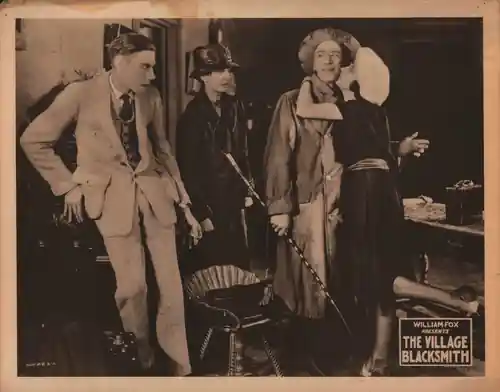
The transition to the characters' adulthood brings Bessie Love to the forefront. As Alice, Love provides a performance of fragile luminosity. In the early 1920s, the trope of the "fallen woman" or the "wrongly accused maiden" was a staple of the genre, yet Love imbues Alice with a specificity of grief that feels modern. Her affair with the Squire’s son is not portrayed as a simple act of rebellion, but as a desperate reach for a life outside the soot of the forge—a reach that ultimately burns her. The scene where she is accused of stealing church money is a masterclass in silent era pathos. The camera lingers on her face, capturing a descent from confusion to a hollowed-out despair that leads her to the river’s edge.
The blacksmith’s rescue of Alice is perhaps the film’s most iconic sequence. It serves as a literal and figurative baptism, a cleansing of the shame cast upon her by the Brigham family. Here, the cinematography—utilizing the high-contrast lighting of the era—emphasizes the blacksmith’s strength not as a tool of labor, but as a vessel of paternal salvation. It’s a stark contrast to the more theatrical staging found in The Victim, where the melodrama often feels untethered from the environment. In Ford’s hands, the environment is a character itself.
One cannot discuss 1920s cinema without acknowledging the fascination with the locomotive. The train accident that injures Bill is a pivotal narrative engine. It serves to level the playing field, stripping the upwardly mobile son of his physical agency just as his brother Johnnie was stripped of his years prior. This thematic echoing is sophisticated storytelling for 1922. It suggests a cyclical nature of suffering that can only be broken by an extraordinary act of will. The medical miracle that follows—Bill’s surgery on Johnnie—is the film’s ultimate synthesis of the old world and the new. The blacksmith’s son uses the tools of modern science to heal the wound caused by old-world malice.
In comparison to other films of the period like The Silver King, which also deals with redemption and the sudden shifts of fortune, The Village Blacksmith feels more grounded in the dirt and the heat of its setting. While The Silver King leans into the theatricality of its source material, Ford’s direction here begins to show the hallmarks of his later masterpieces: the focus on the family unit as the ultimate fortress against a hostile world.
Technically, the film is a marvel of its time. The use of the forge’s fire as a primary light source in several key scenes creates a chiaroscuro effect that predates the noir aesthetic by decades. The flickering orange glow (which we honor in our color palette today) symbolizes both the creative and destructive power of the patriarch. The blacksmith creates horseshoes and tools, but he also creates the moral framework of the village. When the Squire attempts to extinguish this light, he is met not with violence, but with a steadfastness that is far more intimidating.
The editing, particularly during the climax, shows a burgeoning understanding of parallel action. We jump between the medical theater where Johnnie’s future is being decided and the social theater where the Squire’s lies are being unmasked. This cross-cutting builds a tension that was rarely achieved in the more static productions of the late 1910s, such as Putting One Over or the shorter comedic riffs like The Paper Hanger.
Is The Village Blacksmith sentimental? Unquestionably. But it is a curated sentimentality, one that understands the necessity of the "happy ending" as a form of social catharsis for an audience still reeling from the global upheavals of the era. The restoration of Johnnie’s legs is not just a medical success; it is a cosmic correction. It rights the wrong of the first act and allows the village to move forward, unshackled from the Squire’s ancient grudges.
The film’s legacy is often overshadowed by Ford’s later Westerns, but the DNA of The Searchers and The Grapes of Wrath is visible here. The reverence for the land, the dignity of the laborer, and the inevitable clash between tradition and progress are all present. It stands as a formidable example of how silent cinema could take a simple poem and expand it into a complex, multi-layered exploration of the human condition. It lacks the cynicism of modern dramas, opting instead for a sincere belief in the possibility of mending what is broken—whether it be a bone, a reputation, or a family.
For those who enjoy the intricate character studies of The Boomerang or the gritty social observations of Grafters, The Village Blacksmith offers a more epic, emotionally resonant experience. It is a film that demands to be seen not just as a historical curiosity, but as a vibrant, breathing piece of art that still has the power to move us. The anvil may be silent now, but the echoes of this film’s hammer-strikes continue to resonate through the history of American cinema.
IMDb —
1921
Community
Log in to comment.