DbcultAccessing Vault...
6.8/10
Senior Film Conservator
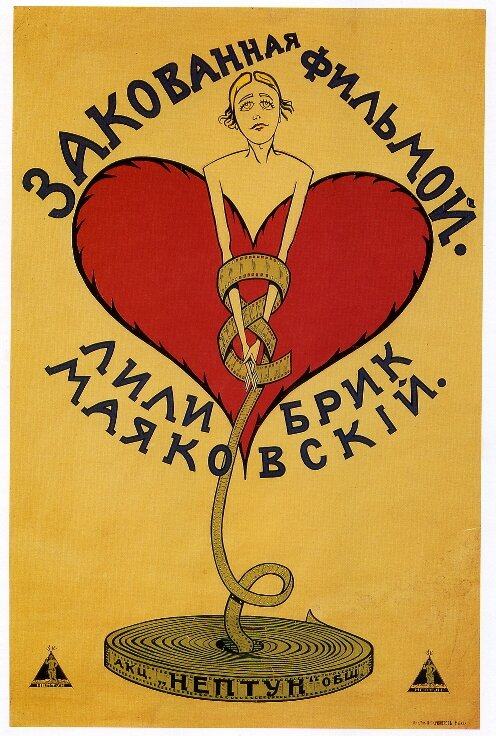
A definitive 6.8/10 rating for a film that redefined the boundaries of cult cinema. Zakovannaya filmoi remains a cornerstone of transgressive art.
To approach Zakovannaya filmoi (Shackled by Film) is to engage with a phantom of cinematic history. Written by and starring the volcanic Vladimir Mayakovsky, this 1918 artifact remains one of the most tantalizing 'lost' films of the Soviet era. It represents a singular moment where the poetic violence of Russian Futurism collided head-on with the nascent machinery of the motion picture. Unlike the more traditional narratives of the period, such as the melodramatic leanings found in Sposa nella morte!, Mayakovsky’s vision was one of ontological disruption. He wasn't merely telling a story; he was interrogating the very substance of the image.
The film’s conceit—an artist falling in love with a cinematic projection—predates the meta-cinematic flourishes of Woody Allen or Buster Keaton by decades. It positions the screen as a permeable membrane, a theme that resonates with the haunting psychological depths of Gefangene Seele. In the ruins of post-revolutionary Moscow, Mayakovsky and his muse, Lilya Brik, crafted a work that was as much a private romantic ritual as it was a public artistic declaration. The Painter, played by Mayakovsky with his characteristic brawny melancholy, is a man suffocating under the weight of the everyday. His salvation, or perhaps his ultimate undoing, arrives in the form of the 'Heart of the Cinema,' a role Brik inhabits with an otherworldly, almost predatory grace.
The technical ambition of Zakovannaya filmoi cannot be overstated, even if we are forced to reconstruct its brilliance from surviving stills and the fragmented screenplay. The film utilizes the concept of the 'film-within-a-film' not as a gimmick, but as a philosophical anchor. While contemporary American works like The Foundling were refining the art of sentimental realism, Mayakovsky was pushing toward a fractured, cubist reality. The interaction between the Painter and the Ballerina is a dance of disparate dimensions. When she steps off the screen, the lighting shifts from the high-contrast expressionism of the 'movie world' to the stark, gritty textures of the Painter’s studio.
"The screen is not a mirror of life, but a cage that we must break, or a heaven we must storm." - A sentiment echoing the Futurist ethos of the production.
This thematic preoccupation with the 'imprisoned' image mirrors the internal struggles found in A Soul Enslaved, yet Mayakovsky strips away the Victorian morality in favor of a raw, proletarian mysticism. The Ballerina is not a damsel in distress; she is an aesthetic force of nature that cannot be tamed by the domesticities of the 'real' world. The tragedy of the film lies in the incompatibility of these two realms. As the Painter tries to clothe her in the garments of reality, she begins to fade. Her vibrancy is tied to the flickering light of the projector, a metaphor for the way art loses its potency when forced into the service of mundane utility.
The screenplay, penned by Mayakovsky himself, reads like an extended lyric poem. He discards the conventional intertitles of the era, which often relied on heavy-handed exposition—a flaw seen in even successful dramas like The Weakness of Man. Instead, he opts for visual metaphors that speak to the subconscious. The cast, including Margerita Kibalchich and Aleksandra Rebikova, supports this fever dream with performances that lean into the stylized gestures of the avant-garde theater. There is a sense of urgency here, a feeling that the filmmakers were trying to invent a new language while the old world was still smoldering.
Consider the parallels with Drama v kabare futuristov No. 13. Both films treat the camera as a participant in the chaos rather than a passive observer. However, Zakovannaya filmoi possesses a deeper, more melancholic core. It explores the loneliness of the creator in a way that feels startlingly modern. The Painter is a surrogate for Mayakovsky himself—a man whose heart was too large for the screens of his time. The film’s disappearance is a cruel irony; the very medium that 'shackled' the ballerina has now shackled the film itself to the realm of memory and myth.
In the broader landscape of 1918 cinema, where The Witching Hour explored the supernatural through a theatrical lens, Zakovannaya filmoi sought a more radical synthesis. It was a time of intense experimentation. The film’s cinematographer, working under the direction of Nikandr Turkin, had to navigate the limitations of primitive equipment to achieve the double exposures and transitions required for the Ballerina’s 'exit' from the screen. These technical hurdles were not merely obstacles but generative constraints that forced a new kind of visual thinking.
The influence of this film can be traced through the lineage of Soviet montage and into the surrealist movements of Western Europe. While La tigresa or Fekete gyémántok might offer more cohesive narrative arcs, they lack the raw, jagged energy of Mayakovsky’s experiment. He was not interested in the 'finish' of a film, a concept explored in the lighthearted Ann's Finish; he was interested in the rupture. The film’s ending, where the Ballerina returns to the screen, leaving the Painter in a state of terminal solitude, serves as a searing critique of the artist's inability to reconcile the ideal with the real.
What remains of Zakovannaya filmoi is a collection of evocative photographs and the lingering scent of revolution. To write about it today is to engage in a form of cinematic archaeology. We see in the stills the intensity of Mayakovsky’s gaze—a gaze that seems to pierce through the lens and into the future. His chemistry with Lilya Brik is palpable, transcending the silence of the medium. Their relationship, which famously defied the conventions of the time, is the invisible engine of the film’s emotional resonance.
When compared to the rugged individualism of Immediate Lee or the historical pageantry of The Cloister and the Hearth, this Russian avant-garde piece stands as a testament to the power of the conceptual. It suggests that the most profound cinematic experiences are those that challenge our perception of what is 'real.' The Painter’s struggle is the struggle of every viewer who has ever been captivated by the silver screen—the desire to reach out and touch the light, and the inevitable heartbreak when the lights come up and we are left in the dark.
Ultimately, Zakovannaya filmoi is a film about the tyranny of the image. The Ballerina is shackled not just by the film, but by the Painter’s perception of her. She is a prisoner of his desire for perfection. This theme of restrictive love finds echoes in The Stronger Love, but Mayakovsky elevates it to a cosmic scale. The film posits that art is a jealous god that demands total devotion, often at the cost of one's sanity or life. The Painter’s failure to keep the Ballerina in his world is not a failure of will, but a recognition of the fundamental divide between the creator and the created.
As we look back through the fog of a century, the film takes on an almost religious significance. It is the 'lost gospel' of Futurist cinema. While other films of 1918, like Hoodman Blind or When Baby Forgot, provided necessary escapism for a world ravaged by war, Mayakovsky offered a confrontation. He wanted his audience to feel the jagged edges of the frame. He wanted them to understand that the screen was a battlefield. Though the physical reels may have perished in the fires of history, the spirit of Zakovannaya filmoi continues to haunt the margins of every frame that dares to dream of breaking its own boundaries. It remains a towering achievement of the imagination, a reminder that even in the dawn of cinema, the medium was already dreaming of its own transcendence.
IMDb —
1918
Community
Log in to comment.