DbcultAccessing Vault...
4/10
Senior Film Conservator
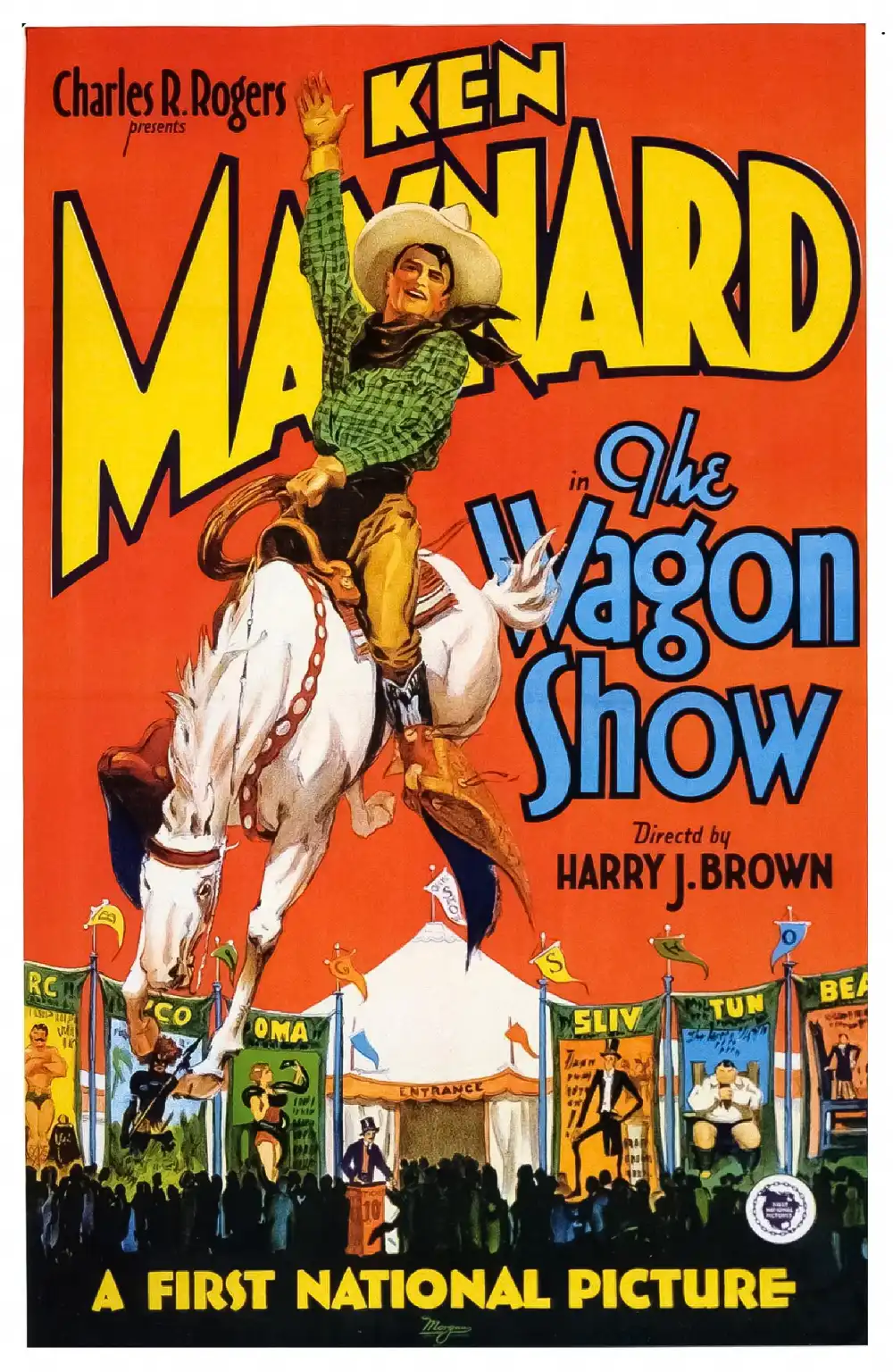
A definitive 4/10 rating for a film that redefined the boundaries of cult cinema. The Wagon Show remains a cornerstone of transgressive art.
If you’re sitting down to watch The Wagon Show, you’re likely here for one of two reasons: you’re a silent western completist, or you really like horses. If you fall into neither camp, this might feel like a bit of a slog. It’s a movie that lives and breathes on the charisma of Ken Maynard and his horse, Tarzan, and while they’re both great, the movie around them is sometimes as thin as the canvas on one of those titular wagons.
It starts off with Colonel Beldan’s Wild West show in a bit of a tailspin. The star attraction leaves for a rival, Vicarino, who is played by Fred Malatesta with the kind of mustache-twirling energy that feels a bit dated even for 1928. There’s a scene early on where Sydney Jarvis (the Colonel) is looking at his ledgers, and he looks genuinely exhausted. It’s one of the few moments where the stakes feel real—the actual stress of a failing business. Then Ken Maynard’s Bob Mason shows up, and the movie pivots into a much more standard hero-arc.
The middle of the film drags. There is a lot of footage of the 'show' itself. You get to see the trick riding and the performances, which are technically impressive, but they go on for a long time. It feels like the director, Harry Joe Brown, knew he had a star who could actually do his own stunts and decided to get every penny’s worth of film out of it. There’s one sequence where Maynard is doing some rope work that lingers about thirty seconds past the point of being interesting. You can almost feel the editors hesitant to cut away from a good take, even if it kills the momentum.
One thing that’s hard to ignore is how much better the horse is at 'acting' than some of the humans. Tarzan has these reaction shots where he nudges Maynard or looks alert, and it feels more natural than the romance between Bob and Sally (Ena Gregory). Ena Gregory is fine, but she’s mostly there to look concerned or impressed. Their scenes together have this very stiff, polite quality to them. It’s the kind of chemistry that feels like two people who just met at a bus stop and are trying to be nice to each other while they wait.
The sabotage plot is where things get weirdly specific. Vicarino doesn't just try to out-perform them; he steals their wagons. It’s such a literal interpretation of the title. There’s a shot of the wagons being driven away in the dead of night that’s actually quite well-lit for a lower-budget silent. The shadows of the wheels against the scrubland look great. But then we get back to the dialogue—or the intertitles, rather—and it’s back to the usual 'I’ll get you for this!' style of writing.
If you've seen The Wolver or Galloping Ghosts, you know the drill with these Maynard films. They aren't trying to be high art. They are about the physical thrill of the chase. The climax of The Wagon Show involves Bob Mason trying to recover the stolen property before the big show starts, and the stunt work here is genuinely fun. There’s a bit where he’s transferring from a horse to a moving wagon that made me lean in. No wires, no green screen, just a guy who really knows how to move in the saddle.
The crowd scenes are a bit of a letdown. When the 'big performance' finally happens, the audience looks remarkably small. It’s supposed to be this huge, make-or-break event, but you can see empty patches in the bleachers. It gives the whole thing a slightly lonely, desperate feeling that I don't think was intentional. It reminded me of the sparse atmosphere in The Master Mystery, where the world feels just a little too empty to be believable.
I also couldn't help but notice the costumes. Everyone is so clean. For a movie about people living in wagons and working with livestock, their shirts are remarkably white. It’s a small thing, but it pulls you out of the 'Wild West' vibe and reminds you that you’re watching a Hollywood production. Only the villain, Vicarino, seems to have any grease on him, and that’s mostly just in his hair.
Is it worth it today? Only if you want to see a masterclass in 1920s trick riding. The plot is a framework for the stunts, and the romance is a framework for the plot. It’s a series of nested excuses to watch a man and his horse jump over things. It’s not as emotionally heavy as something like The Unpardonable Sin, and it doesn't have the weird, trippy energy of The Hypnotic Violinist. It’s just a straightforward, slightly clunky western that knows exactly what its audience wanted: more Tarzan.
The ending is exactly what you expect. No surprises here. But there’s a final shot of the horse that almost feels like he’s winking at the camera. He knows he’s the real star. If you can tolerate the slow middle section and the cardboard villain, it’s a decent enough way to spend an hour, especially if you appreciate the era when 'action' meant someone actually doing something dangerous on camera.
IMDb 5.9
1920
Community
Log in to comment.