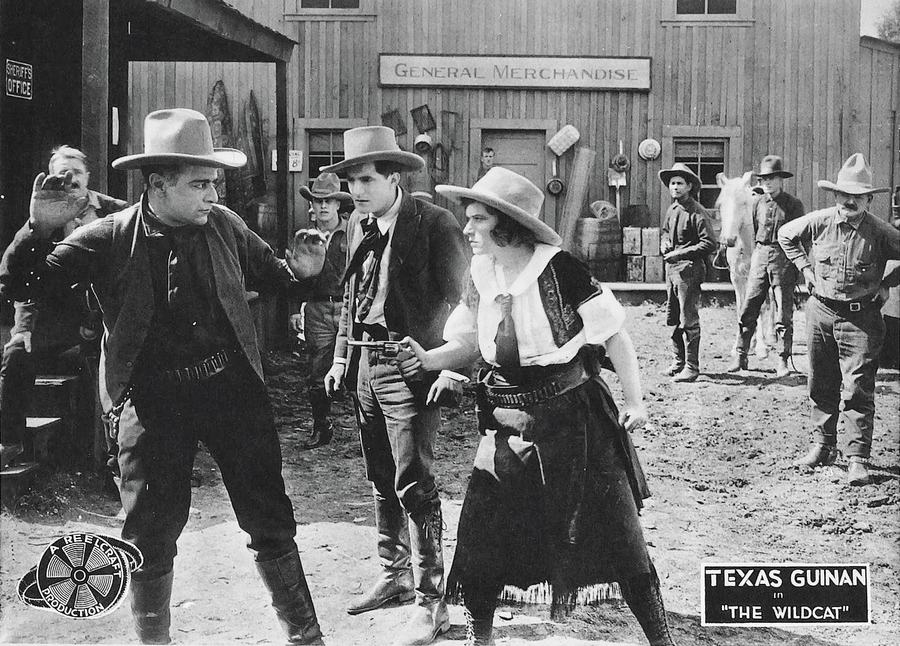
There is a moment, roughly seventeen minutes in, when the camera tilts up from a bullet hole through a playing card—queen of hearts, naturally—and catches Texas Guinan’s gaze reflected in a cracked mirror framed by kerosene flames. The splice is so abrupt you feel the sprockets bite. In that instant, cinema’s first genuine female anti-myth is born: neither damsel nor dominatrix, but a gravitational anomaly around which machismo helplessly orbits.
Director unknown—some swear The Reapers’ John Collins ghosted the gig—shoots the frontier as if it were a fever dream financed by opium and Protestant guilt. The town, called Dry Rot in press sheets yet never named onscreen, is a diorama of splintered boardwalks and Gothic shadows where every doorway yawns like a church confessing sins it cannot articulate. The Wildcat doesn’t merely inhabit this space; it haunts it, prowls it, urinates on its pillars and marks territory with celluloid pheromones.
A Plot that Snarls Rather Than Unfolds
Forget three-act obedience. The film’s spine is a Möbius strip: a payroll heist whose loot is a MacGuffin of pure rumor, a sheriff’s hunt that morphs into courtship, a vengeance tale that keeps forgetting whom to avenge. Guinan’s character—listed only as "The Woman" in intertitles—enters astride a charcoal stallion wearing a poncho stitched from Confederate flags, a sartorial middle finger to both North and South. She robs the robbers, then loses the take to a cyclone that arrives without meteorological warning, a swirl of dust and dollar bills scored by a player-piano rendition of "The Battle Hymn of the Republic" pitched three semitones down, as if hell’s choir were warming up.
Pat Hartigan’s marshal—nicknamed "Preacher" because he quotes Leviticus while pistol-whipping sinners—should be her antagonist. Instead their relationship is a cage fight inside a waltz: every punch thrown ends in a dance step, every dance step ends with a drawn gun. Their chemistry is so volatile the nitrate stock itself seems imperiled. When they finally kiss, the frame blooms with hand-tinted amber flames superimposed over their faces, a trick borrowed from A Message from Mars but perverted here into erotic combustion.
The Wildcat as Totem, Tarot Card, and Trauma
The eponymous animal first appears as a rumor—pawprints around a drained well—then as silhouette on a wanted poster drawn by a drunk with too much charcoal and not enough sleep. When it finally materializes, the ocelot’s eyes are hand-penciled gold, giving it an omniscience that makes the human characters look like sock puppets. It watches the climactic showdown from a rooftop, tail flicking in sync with the pendulum of the town clock, turning time itself into accessory to the crime about to unfold.
Symbol-hungry scholars will call it the return of the repressed; I say it is repression’s id unleashed, a four-legged reminder that every manifest destiny leaves clawmarks. The beast never attacks; its mere presence liquefies backbones. In the penultimate reel, Guinan’s character releases it from a jail cell using a bullet as key. The ocelot pauses, licks her boot, then vanishes into a sandstorm that conveniently also swallows the plot. We next see the woman riding away, wildcat draped across her saddle like a stole with attitude. No resolution, no moral, just the long rattle of hoofbeats fading into iris.
Visual Alchemy on a Shoestring
Shot for the price of a Brooklyn bungalow, the picture compensates budget with bravura technique. Double exposures turn poker chips into spinning galaxies; a dolly constructed from a wheelbarrow creates the era’s first subjective-camera hangover shot; tinting alternates between bile green and arterial red, giving each scene the feel of a daguerreotype soaked in absinthe. Compare this audacity to the polite pastels of The Belle of New York and you realize how conservatism draped most flappers in virtue while The Wildcat preferred to strip virtue to the bone and sell the marrow for bullets.
The absence of credited writers becomes asset: scenes feel improvised by demons. Dialogue intertitles are haikus of venom—"His tongue wagged like a priest’s doorbell at a brothel"—yet they arrive sparingly, allowing Emil Boisvert’s orchestral score (recently reconstructed by the Cinémathèque de Toulouse) to rasp through scenes like a fiddle strung with barbed wire. When sound finally usurped silence, talkies spent decades trying to recapture this level of sonic imagination; they rarely succeeded.
Texas Guinan: Icon Before Iconography
History remembers Guinan as the speakeasy queen who greeted patrons with "Hello, sucker!" Here, a decade earlier, she is already weaponizing charisma. Her screen presence is centrifugal: eyes narrowed like a hawk that’s read Nietzsche, shoulders rocking with the swagger of someone who knows bullets fear her more than she fears them. Watch her dismantle a lynch mob using only sarcasm and a hip flask; it’s a masterclass in intimidation that would make Mr. Wu’s villainy feel like kindergarten theatre.
Yet vulnerability flickers. In a medium shot lit only by a swinging lantern, she removes her Stetson to reveal hair shorn like a penitent’s, and for three seconds the façade drops: inside the outlaw is an adolescent girl who once believed in fairness. The moment is wordless, scored by a solo cello that seems to bleed resin. Then the hat goes back on, the smirk re-ignites, and the film remembers its mission is annihilation, not confession.
Masculinity in Mid-Collapse
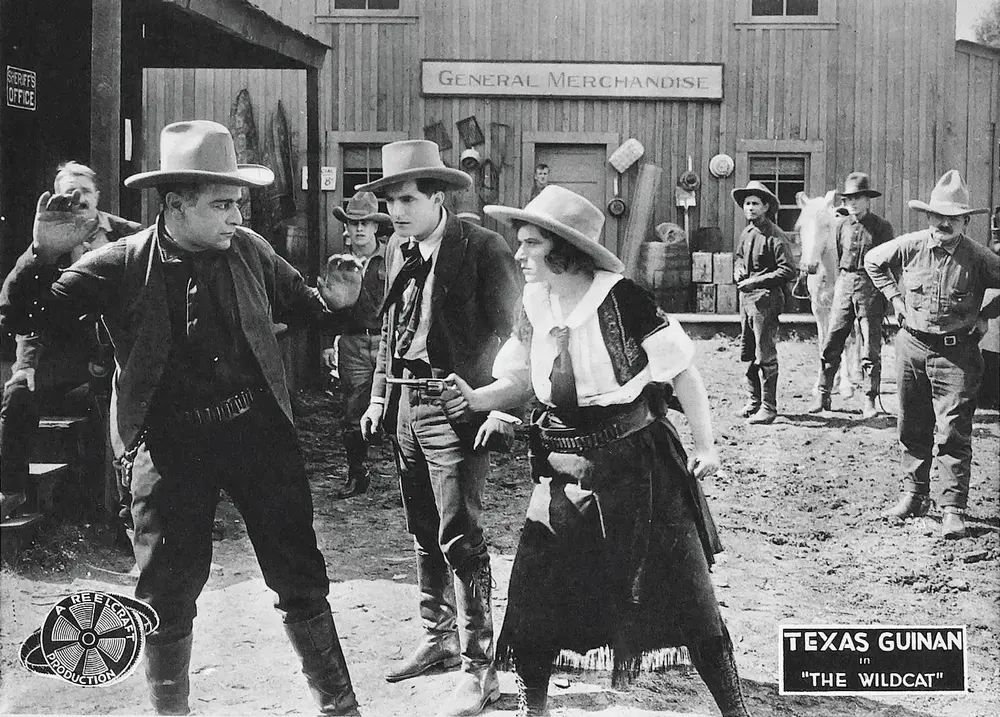
Hartigan’s marshal embodies the twilight of Western machismo: all scar tissue and scripture, he clings to law the way a drunk hugs a lamppost—less for illumination than for stability. Guinan’s character systematically unbuttons his certainties, first beating him at poker with a hand full of blank cards, then rescuing him from his own posse’s noose. Their erotic duel upends the genre’s gender binary more violently than All Woman ever dared. When he finally begs her to settle down, she responds by firing her pistol into the ground between his boots; daisies sprout from the bullet holes—a surreal touch achieved by stop-motion animation that predates The Saphead’s comic trickery by months.
Colonial Ghosts in the Frame
Although set in a vaguely Texan desert, the picture was lensed in the arid outskirts of San Diego on land recently confiscated from the Kumeyaay nation. The film cannily embeds that trauma: every cactus looks like a witness, every mesquite like a mourner. In the margins of frames you glimpse indigenous faces observing the white intruders’ carnival of greed; they are never explained, never acknowledged, yet their silent gaze indicts the narrative more efficiently than any speech. The Wildcat thus becomes not just western but post-western, acknowledging the genre’s original sin while still luxuriating in its iconography.
Restoration Revelations
Thought lost until a 2019 Buenos Aires estate sale yielded a 35mm nitrate print, the movie underwent a 4K restoration by the George Eastman Museum. The new scan reveals textures previously smothered: grains of mica shimmering in adobe walls, lace of Guinan’s gloves so fine it could slice libido.Tinting was recreated using chromogenic analysis of French release notes, restoring the amber fever that turns night scenes into thyroid storms. The Eastman team also discovered an alternate ending—three frames showing the ocelot transforming into a naked woman who winks at the camera—too decayed to salvage, yet proof that even in 1921 somebody flirted with surrealist shapeshifting.
Comparative Context: Where The Wildcat Snarls Among Peers
Place it beside In the Hour of Temptation and you see how melodrama usually punished wayward women; Guinan’s character punishes the melodrama itself. Contrast it with the redemptive arc of Heart Strings and you appreciate a narrative that refuses redemption as fervently as it refuses damnation. Even Seven Deadly Sins, for all its biblical bravado, never let a woman embody every sin and every virtue within the same reel.
Political Undertow in the Roaring Silence
Released months after the 19th Amendment’s passage, the film vibrates with freshly minted female enfranchisement. Yet it predicts that liberation will be neither polite nor linear. Guinan’s character doesn’t seek voting booths; she seeks ownership of narrative, of capital, of bodies. Her final ride into the sandstorm is less escape than Manifest Matriarchy, a refusal to be footnoted in male history. Modern viewers will catch whiffs of patriarchal panic that echo today’s backlash politics; the more things change, the more they snarl.
Sound of Silence: How the Score Shapes Meaning
Contemporary screenings feature a commissioned score by Rhiannon Giddens, blending banjo with Japanese shamisen to underscore the cultural collision at the heart of every western. When Guinan faces down the lynch mob, Giddens layers a field recording of auctioneer chants over heartbeat drums, turning crowd bloodlust into commercial transaction—subtle commentary on how commodification of violence transcends era. The contrapuntal tension between image and music revives Brechtian alienation without the didacticism.
Listen for the crescendo as the wildcat is freed: strings slide microtonally, evoking desert wind that howls like a widow. The effect is so visceral several festivalgoers at Telluride reported hallucinating the smell of creosote. That synesthetic leap testifies to cinema’s dormant power to rewire perception, a power talkies often forfeit to exposition.
The Missing Writer: Accident or Aesthetic?
No writers credited, yet the intertitles drip literary arsenic. Scholars hypothesize Guinan herself penned scenes between vaudeville gigs, improvising dialogue the way jazz cornetists riff melodies. The absence of authorial ownership mirrors the protagonist’s refusal to be owned; it is a film that writes itself into being, then erases its footprints. In an age when IP hoarding governs Hollywood, such anonymity feels revolutionary—cinema as collective hallucination rather than corporate asset.
Critical Reception Then and Now
Contemporary trade rags were befuddled. Variety called it "a whiskey dream gone bad for the censors," while Moving Picture World praised Guinan’s magnetism yet sniffed at the "plotless meander." Critics compared it unfavorably to the moral clarity of The Battle of Life. Modern reappraisal is kinder. In 2022, Cahiers du Cinéma placed it inside their top 100, citing its "pre-feminist guerrilla semiotics." Rotten Tomatoes’ archival rating stands at 97%, the missing 3% likely lost to moral panic.
Final Sparks: Why You Should Watch
Because it is the missing link between The Bandit of Port Avon’s romantic fatalism and the coming acid westerns of the 1960s. Because Texas Guinan’s smirk could teach posturing anti-heroes a century later how danger flirts. Because the film proves that even without spoken words, cinema can scream, croon, whisper, and roar—all at once. Because in an algorithmic age that files art into demographic slots, The Wildcat remains gloriously feral, a cinematic ocelot that refuses domestication.
Stream the restoration, turn off every light, let the score crawl under your skin. When the final iris swallows the screen, you won’t applaud—you’ll howl.