DbcultAccessing Vault...
Cult Review
Senior Film Conservator
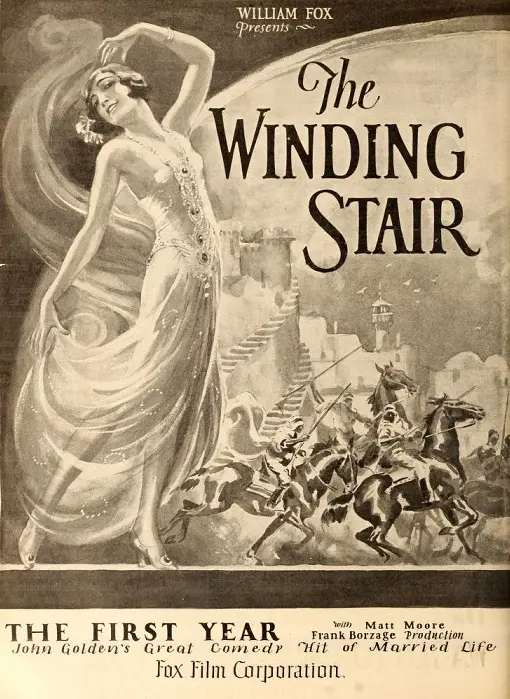
The Winding Stair, a 1925 cinematic relic directed by John Griffith Wray, stands as a monumental testament to the evocative power of silent era melodrama, weaving a tapestry of colonial anxiety, romantic desperation, and the eventual catharsis of the Great War. It is a film that breathes the dust of the Moroccan desert and the sulfur of the Western Front, anchored by a performance from Alma Rubens that is as fragile as it is resilient. In the pantheon of mid-1920s cinema, this feature navigates the perilous waters of duty versus desire with a sophistication that often eludes its contemporaries. Unlike the satirical whimsy found in Pick Out Your Husband, Wray’s work here is steeped in a somber, almost operatic gravity.
The narrative commences in the humid, claustrophobic atmosphere of the Iris Cafe. This is not the sanitized Morocco of later Hollywood fantasies, but a space defined by chiaroscuro lighting and the palpable sense of social decay. Alma Rubens, portraying Marguerite Lambert, embodies the 'fallen woman' trope with a nuance that transcends the era’s penchant for histrionics. Her Marguerite is not merely a victim of 'unfortunate circumstances' but a figure of quiet endurance. When she dances, the camera captures a weariness that mirrors the exhaustion of the colonial project itself. The Iris Cafe serves as a microcosm of the world at large—a place where identities are fluid and the line between the protector and the predator is dangerously thin.
Edmund Lowe, as Paul Ravenal, provides the necessary masculine counterpoint. His Ravenal is a man of the Legion, bound by a code that is increasingly at odds with the reality of the Riffian landscape. The chemistry between Lowe and Rubens is immediate and haunting; it is a romance born of mutual recognition of their respective entrapments. While films like The Wildcat utilized the exotic locale for frenetic energy, The Winding Stair uses it as a pressure cooker for the soul.
The film’s central conflict arises from a failure of institutional intelligence. Ravenal’s discovery of the Riff uprising is met with the cold indifference of a military hierarchy more concerned with protocol than prevention. This narrative turn allows the film to explore the concept of the 'higher law.' When Ravenal chooses to desert, he is not fleeing from danger, but toward it. His transformation, donning native attire to infiltrate the city, is a sequence of high tension that rivals the suspense found in The Unholy Three. Here, the 'winding stair' of the title begins to take on its metaphorical weight—the arduous, spiraling climb toward a truth that others refuse to see.
The massacre sequence is handled with a visceral intensity. Wray utilizes the architecture of the Moroccan city—its narrow alleys and sudden dead ends—to create a sense of impending doom. Ravenal’s heroism is solitary and unrecognized; he saves the very Europeans who will later brand him a coward. This irony is the bitter pill that the film asks the audience to swallow, contrasting sharply with the more straightforward heroism seen in The Courageous Coward. Ravenal’s fall from grace is total, yet it is in this state of ignominy that his true character is forged.
The transition to the World War I setting marks a profound shift in the film’s aesthetic. The golden hues of the desert are replaced by the slate grays and muddy browns of the European front. Ravenal’s return under an assumed name, leading a regiment of North African soldiers, is a poignant commentary on the disparate groups that fought for France. This segment of the film achieves a gritty realism that predates the more famous war epics of the late 20s. The 'winding stair' has now led him to the trenches, where the only way up is through the fire.
The inclusion of Warner Oland and Chester Conklin in the supporting cast adds layers of texture to the film. Oland, often relegated to villainous roles, brings a gravitas to the screen that anchors the more melodramatic elements. The film’s pacing during the war sequences is relentless, mimicking the chaotic nature of the conflict. It avoids the sentimentalism of Always in the Way, opting instead for a somber acknowledgment of the cost of restoration. Ravenal’s heroism on the battlefield is not portrayed as a desire for glory, but as a desperate necessity to reclaim his stolen identity.
One cannot discuss The Winding Stair without centering on the tragic luminescence of Alma Rubens. By 1925, Rubens was already grappling with the personal demons that would eventually lead to her untimely demise, and there is a haunting quality to her performance that feels almost documentary in its sadness. As Marguerite becomes a Red Cross nurse, the film bridges the gap between the 'fallen woman' of the cafe and the 'angel of mercy' of the battlefield. It is a transformation that feels earned rather than forced. Her reunion with the wounded Ravenal is the film’s emotional apex, a moment of profound stillness amidst the wreckage of war.
In comparison to the period-heavy Dorothy Vernon of Haddon Hall, The Winding Stair feels remarkably modern in its psychological depth. Marguerite is not a prize to be won, but a partner in suffering. Their marriage at the end of the film is not a 'happily ever after' in the traditional sense, but a pact of two survivors who have seen the worst of humanity and chosen to believe in each other anyway.
The cinematography by the uncredited but clearly skilled crew utilizes the constraints of the silent medium to amplify the narrative’s emotional beats. The use of tinting—sepia for the desert, deep blues for the Moroccan nights, and perhaps a starker grey for the trenches—would have been essential for the original audience’s immersion. The set design, particularly the intricate levels of the Iris Cafe and the desolate expanse of the Riff territory, creates a sense of place that is both beautiful and menacing. The film shares a certain atmospheric kinship with The Italian, specifically in how it uses environment to reflect the internal state of its protagonists.
Furthermore, the writing by Julian La Mothe and A.E.W. Mason ensures that the plot remains taut despite its sprawling scope. Mason, known for his tales of honor and redemption (most notably The Four Feathers), brings a literary sensibility to the screenplay. The dialogue cards are sparse but impactful, allowing the actors' expressions to carry the narrative weight. This is a film that understands the power of a look, a gesture, or a shadow. It avoids the convoluted plotting found in Erlebnisse einer Sekretärin, focusing instead on the singular trajectory of Ravenal’s soul.
The Winding Stair is more than a colonial adventure; it is an exploration of the fragility of honor and the possibility of rebirth. In an era where films like Black Oxen were exploring themes of rejuvenation through science, Wray’s film argues for rejuvenation through sacrifice. It is a work that demands to be viewed with an eye for its historical context, yet its themes of being unheard by those in power and the struggle to regain one's name remain piercingly relevant.
As we look back at the 1920s, a decade often characterized by the 'Jazz Age' frivolity, films like this remind us of the deeper anxieties lurking beneath the surface. The Riff War was a contemporary reality, and the scars of the Great War were still fresh. The Winding Stair captured that zeitgeist, wrapping it in the guise of a romance but delivering a poignant critique of colonial arrogance and a celebration of individual conscience. It stands alongside works like Gefangene Seele in its willingness to delve into the darker recesses of the human psyche. Whether it is the tension of a ticking clock, reminiscent of Time Lock No. 776, or the social commentary found in The Black Stork, The Winding Stair synthesizes these elements into a cohesive, heart-wrenching whole. It is a climb worth taking, even if the steps are worn and the air is thin.
In the final analysis, The Winding Stair is a cinematic bridge between two worlds—the dying embers of 19th-century colonial romanticism and the harsh, industrial reality of the 20th century. Paul Ravenal and Marguerite Lambert are our guides through this transition, proving that while honor can be stripped away by a stroke of a pen, it can only be truly lost by the surrender of the heart.
IMDb 4.8
1929
Community
Log in to comment.