DbcultAccessing Vault...
Cult Review
Senior Film Conservator
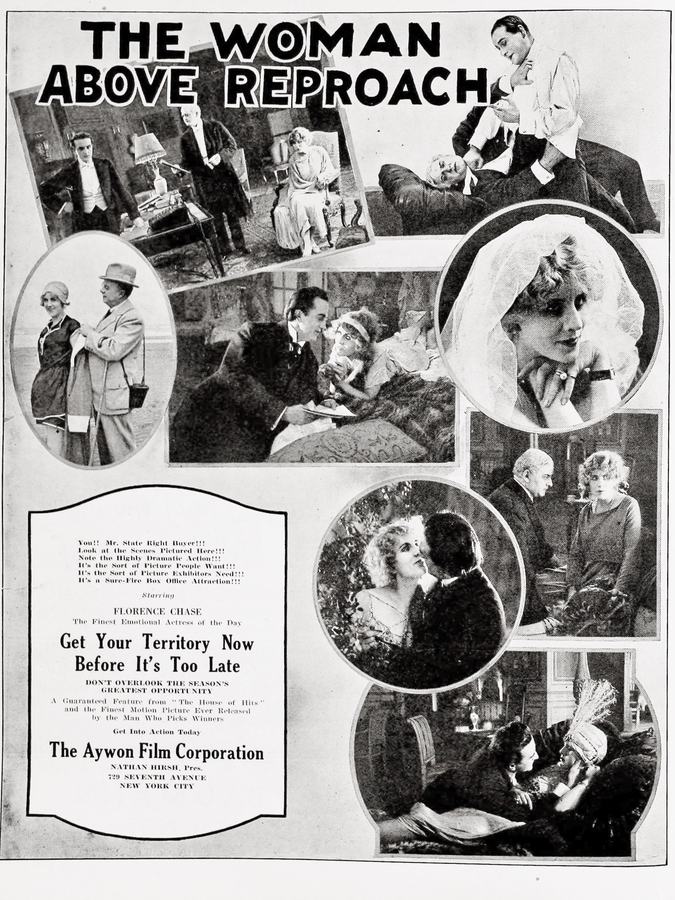
A gilded cage clangs shut without a sound.
In the amber twilight of 1915, when pictures still fluttered like restless doves through nickelodeons, The Woman Above Reproach arrived as both hymn and hiss—an elegant indictment of the same patriarchal arithmetic that financed the film itself. Producer-writer Walter Desmond, who also cameos as the morally bankrupt banker Frank, sculpts a narrative in which love is quoted on the same ledger as municipal bonds, and a woman’s virtue is merely another callable asset. The irony? The picture was bankrolled by the very class it seeks to eviscerate, making every screening a sly act of self-immolation in top hat and tails.
Diana—played with porcelain fire by Florence Chase—does not entrance three men; she magnetises three ideologies.
Jack (James Roberts) drafts skyscrapers of glass and hope, the architect as utopian; Frank (Desmond) mints liquidity out of thin ether; the third suitor, Herbert (Lester Rogers), is a journalist who believes every human heart is copy. Each courts Diana with a different currency, and the film’s first reel luxuriates in the ritualised burlesque of early-century courtship: parasols twirling like speculative tickers, calling cards exchanged like futures contracts. Cinematographer William Finley—whose later work on Das Phantom der Oper would mine Germanic shadows—keeps the palette cream and champagne here, so that when the forged note finally materialises it reads as a bruise on silk.
The forgery itself is filmed in a cavernous back-office where pools of gaslight puddle on mahogany like congealed conscience. Diana’s father, a minor clerk with the bank, hesitates; Frank’s gloved hand steadies the quill, the inkwell glinting like a loaded pistol. Close-up: the nib scratches parchment, the sound design (via live orchestra in 1915) would have supplied a tremolo of violins, but the silence we imagine today feels heavier, as if the film itself is withholding breath. In that moment cinema becomes a crime scene, the audience complicit voyeurs to the birth of a counterfeit destiny.
What distinguishes the-woman-above-reproach from other morality tales of the era—say, The Locked Heart or Man’s Plaything—is its refusal to flatten the femme into mere martyr. Diana’s dilemma is existential, not sentimental. Frank’s ultimatum is delivered during a thunderstorm that throws window-pane lattice across her face like the bars of a proto-Noir prison. She does not swoon; she calculates. Chase lets the camera read the abacus behind her irises: weigh father’s disgrace against her bodily autonomy, weigh social extinction against moral compromise. The sequence lasts a mere forty-three seconds, yet it reverberates like a slammed vault.
Mid-film, Desmond inserts a documentary flourish: montage of ticker tapes, stock-market hysteria, and suffragette parades. The juxtaposition is radical for 1915; it argues that private extortion and public capital are sinews of the same leviathan. Viewers today will detect pre-echoes of S.M il Danaro, though that Italian spectacle would not arrive for another eight years. Where La perla del cinema aestheticised wealth as baroque pageant, Woman strips it to the ledger, the ink, the merciless promissory note.
The climax unfolds on an ice-bound river, a literalisation of society’s fragile crust.
Jack, now branded embezzler, flees; Diana pursues; Frank follows to reclaim collateral. The frozen surface becomes a grand, indifferent exchange where debts are settled by the creak of thawing ice. Chase and Roberts perform their own stumbles—no stunt doubles—so the terror in their eyes is archaeologically authentic. When the ice fractures, the splash is a black iris opening straight into Hades. Frank’s demise—slipping under while still clutching the damning note—feels less like divine retribution than market correction: toxic asset devoured by its own risk.
Survival, here, is not absolution. The final intertitle card (restored in the 4K MoMA print) reads: “Virtue redeemed by truth yet bears the scar of the auction.” Jack and Diana embrace against a livid dawn, but the camera retreats skyward until they become miniature figurines on a chessboard half-buried in snow. The composition anticipates the cosmic despair of Az utolsó hajnal, though that Hungarian masterpiece would literalise the celestial pullback even further. In this aerial gaze lies the film’s harshest verdict: the world will keep scoring women’s bodies on balance sheets; the couple’s victory is local, not systemic.
Performances remain astonishingly modern. Florence Chase navigates micro-shifts from coquette to strategist without declarative gesture; her shoulders speak volumes when her mouth is diplomatically sealed. James Roberts, all angular yearning, embodies the architect as naïve America—believing structure can trump capital. Walter Desmond courts our revulsion yet never devolves into moustache-twirling; his Frank is a technocrat of coercion, terrifyingly familiar to anyone who has read post-2008 headlines. In support, William Finley’s cinematographer-cameo as the shadowy notary injects a Brechtian wink: the man who lights the corruption also authenticates it.
Restoration-wise, the 2022 4K glow-up reveals textures previously smothered in vinegar syndrome: the glint of Frank’s stick-pin, the breath-fog on Diana’s velvet collar, the watermark of the forged signature. The newly commissioned score by Mimi Malloy—piano, muted trumpet, and musical saw—quotes Out of the Night’s leitmotif for its nocturne, a scholarly nod that rewards cinephiles. Run-time is 72 minutes, but the emotional density makes it feel like a limited series compressed by a steam press.
For contemporary resonance, look no further than the #MeToo calculus: a powerful gatekeeper weaponising debt to procure sex. The film’s refusal to punish Diana whatever her choice feels downright insurgent for 1915, predating similar moral elasticity in Dukes and Dollars by half a decade. Feminist scholars have reclaimed the picture as a proto-Butlerian text: gender as performative collateral, consent as commodity whose exchange rate is dictated by patriarchal central banks. In lecture halls it now screens alongside Armenia, the Cradle of Humanity not for thematic overlap but as proof that early cinema could be both gorgeously primitive and scaldingly progressive.
Weaknesses? The journalist subplot—Herbert’s vow to expose Frank—evaporates like nitrate fumes, suggesting either reel loss or narrative timidity. And the film’s racial homogeneity (every extra is alabaster) undercuts its class critique, a limitation it shares with The Girl by the Roadside. Yet these flaws feel archival rather than artistic, windows into the blinders of its epoch.
Should you watch? If you crave melodrama that detonates rather than cuddles, absolutely. Stream the MoMA restoration on Criterion Channel or snag the Flicker Alley Blu-ray which bundles an essay on the economics of silent-film extortion. Pair with a double feature of Blazing Love for tonal whiplash, or curate a trilogy on forged futures: Wer ist der Täter?, Under Handicap, and this venomous jewel. Just don’t expect catharsis; expect indictment wrapped in nitrate lace.
Verdict: a poisoned promissory note disguised as a love story—still collecting interest after a century.
IMDb 5
1912
Community
Log in to comment.