DbcultAccessing Vault...
Cult Review
Senior Film Conservator
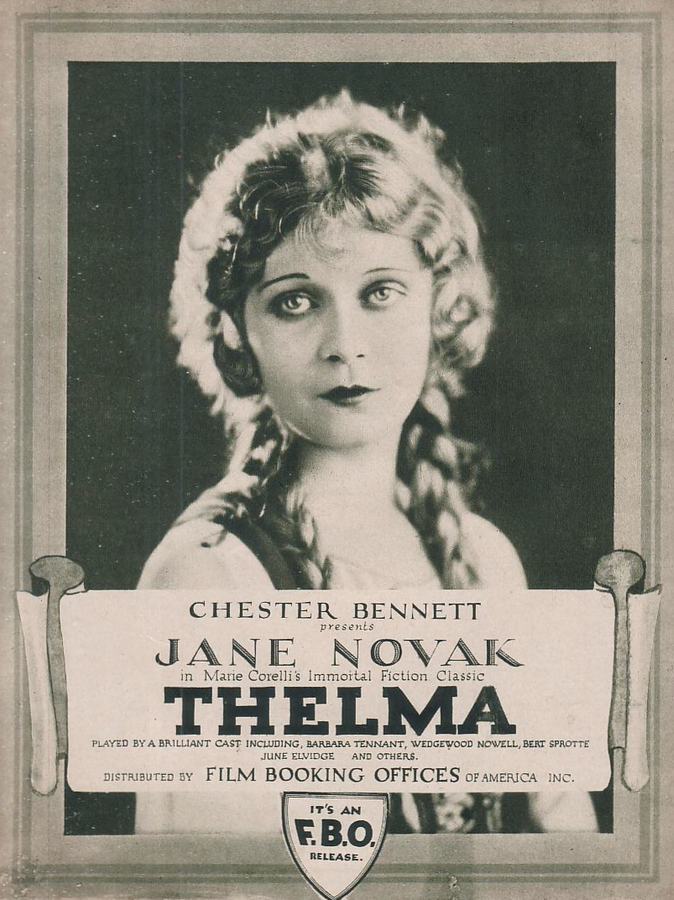
Thelma arrives like a frost-bitten letter from a century ago, its wax seal still fragrant with pine and saltwater.
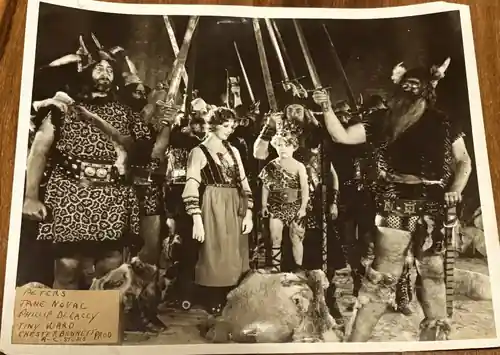
Shot through with Nordic myth and Edwardian stiffness, the picture pivots on the oldest cinematic hinge: love, suspicion, redemption—yet every frame feels hewn from ice and obsidian. Director Chester Bennett translates Marie Corelli’s florid novel into a visual saga where silence roars louder than dialogue. The fjord-glazed prologue could hang in the National Gallery: fishermen’s lanterns bob like Van Gogh stars while Thelma’s silhouette glides across virgin snow, her wool cloak the only splotch of mortal color against a world that seems carved by Thor himself.
Enter Phillip—Jack Rollens channels a young Disraeli, all sideburns and sovereign self-belief. His courtship is brisk, almost colonial: he wants the pearl, not the oyster. Their wedding night is a master-class in chiaroscuro; the bridal veil becomes a silver screen onto which future sorrows are already projected. Bennett withholds the customary close-up until Thelma lifts that veil in a London ballroom, revealing Jane Novak’s face—an ecstatic wound of hope and terror. One frame and we comprehend every immigration story ever told: the provincial prodigy swallowed by the imperial maw.

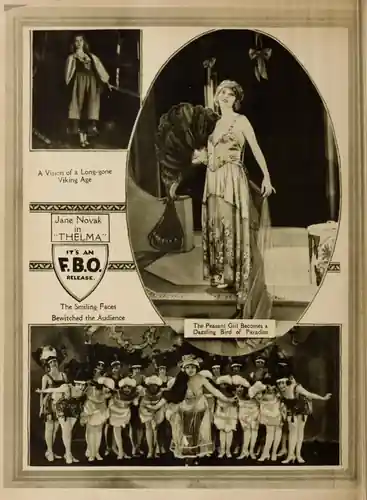
The metropolis pulses with electric malevolence. Interior sets by William Cameron Menzies (uncredited) exaggerate staircases until they loom like altars to social Darwinism. Lady Clara—Virginia Novak in a twin-role sleight-of-hand—slinks through these cavernous spaces like a serpent wearing sables. She weaponizes etiquette: a misplaced glove becomes a landmine, a whispered “my dear” a garrote. The conspiracy sequence is edited with Soviet-tinged montage—juxtaposing a laughing clown at a music-hall with Thelma’s tear sliding into her champagne. Viewers conditioned by The Eternal City will recognize the same Papal opulence, but here the cathedral is society itself, its vaulted ceiling the class system.
Trondheim’s return ushers in the film’s metaphysical half-life. Cinematographer Alfred Ortlieb switches from soft-focus cosmopolitan sheen to razor-sharp naturalism. Pines quiver like Gothic organ pipes; avalanches rumble off-camera, a reminder that nature, not London, scripts final acts. Thelma’s reclusion is staged as secular penance—she refuses church bells, wrapping herself instead in the green wool of her dead mother’s shawl. The costume becomes a portable coffin, a cocoon of grief shot through with gold thread whenever candlelight strikes, hinting at metamorphosis.
Phillip’s pursuit plays like Peer Gynt rewritten by Dostoevsky. He trudges across plateaus of tundra, his London boots absurdly thin, until he collapses outside Thelma’s cabin. Bennett dares an almost static two-shot: the lovers separated by a pine door, snow drifting between them like cosmic punctuation. No intertitles intrude for a full ninety seconds—just the wind’s howl and the flicker of Novak’s eyes conveying galaxies of distrust. It is silent cinema at its most eloquent.
Resolution detonates on a crystalline lake at twilight. Phillip challenges Lennox to a duel—no seconds, no pistols at dawn, but a savage face-off beneath an aurora that undulates like a living scripture. The ice fractures; the men fire while standing on drifting floes. Each gunflash paints the night blood-orange, a hue that bleeds into the next reel’s triumphant embrace. Thelma, no longer passive, strides onto the ice, her parka white against the spectral green sky—a Valkyrie arbitrating destiny rather than fleeing it.
Jane Novak—often dismissed as a “poor man’s Mary Pickford”—delivers a master-class in incremental revelation. Watch the way her fingers tighten around a teacup when slander is first murmured; by film’s end the same hand unclenches in a gesture of absolution, the porcelain long since shattered. She ages a decade without cosmetic aid, relying on the slump of a shoulder, the cadence of a blink.
Jack Rollens walks a tightrope between arrogance and abjection. His contrition scene—kneeling on a church flagstone that reflects candlelight like a checkerboard of guilt—avoids the usual chest-beating. Instead, he presses his gloved hand to the cold stone until the leather warms, a tactile metaphor for thawing suspicion.
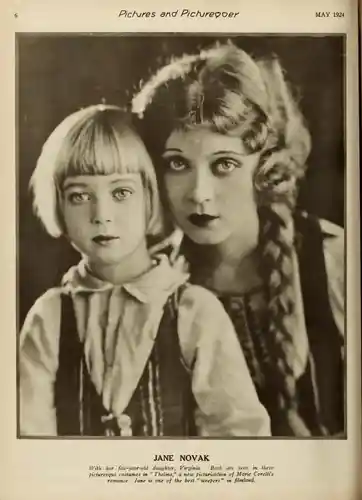
Virginia Novak, as both benevolent cousin and scheming doppelgänger, gets the film’s sole iris-in shot: her pupils dilating the moment her poison-pen letter is read. It is a micro-close-up lasting perhaps eight frames, yet it sears the retina.
Bennett’s visual grammar alternates between horizontal majesty and claustrophobic verticality. Norway sections privilege extreme long shots, humans as specks against glacial vastness—an antidote to the anthropocentric bustle of London, where ceilings loom low and doorframes threaten scalps. The transition is accentuated by tinting: arctic sequences in cerulean-blue tones, ballroom scenes in amber that looks almost feverish on 21st-century restorations.
Superimpositions recur like leitmotifs. Thelma’s first nightmare layers her drifting body over a church altar, then over a storm-tossed sea—faith and doubt colliding in a single frame. Later, Phillip’s hallucination overlays her face onto the aurora, turning the sky itself into a jealous god. These tricks predate Vertigo’s spirals by thirty-five years, yet feel eerily modern thanks to the subtlety of their matte lines.
Intertitles—penned by Thomas Dixon Jr. in an uncharacteristically tender mode—serve as liturgical pauses rather than expositional crutches. One reads: “Love, like snow, conceals the jagged rock until the thaw.” The aphorism dissolves into the image of footprints filling with meltwater, a fusion of word and picture that rivals the greatest Soviet experimentation.
Original 1922 screenings featured a Norwegian folk sextet performing Grieg-tinged arrangements. Today’s restorations commissioned by the San Francisco Silent Film Festival pair Stephen Horne’s live piano with subtle electronics—bowed wine glasses, processed Hardanger fiddle drones. The effect is spectral yet intimate, as though the fjords themselves were exhaling through concert-hall speakers. When Thelma flees back to Norway, Horne introduces a heartbeat-like kick drum that syncs with the intertitles’ flicker, turning text into percussion.
Post-colonial readings abound. Phillip’s conquest of Thelma mirrors Britain’s absorption of Norway’s maritime resources; her eventual rejection of London society stages a quiet decolonization of the heart. Lady Clara’s machinations can be decoded as aristocratic panic over foreign infiltration—the “pure” English bloodline sullied by Nordic otherness. Yet the film refuses easy dichotomies: Thelma’s final return south is voluntary, suggesting hybridity rather than victory.
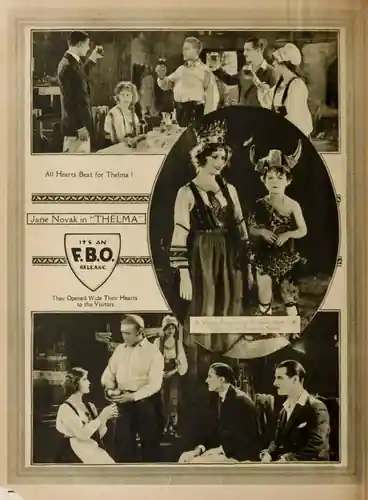
Feminist critics note how Thelma’s supernatural stillness—her ability to freeze time with a gaze—subverts the era’s trope of the hysterical woman. She weaponizes passivity, turning the very quality used to infantilize her into a fortress. Compare her to the flapper heroines of Felix in the Swim: both resist patriarchy, but while the latter uses flippant speed, Thelma wields glacial patience.
For decades only a 9.5 mm Pathé baby print survived, vinegar-scented and perforated like lace. Enter the National Library of Norway’s 2021 4K restoration, scanning a rediscovered 35 mm nitrate at 16-bit grain neutrality. The resulting Blu-ray reveals textures previously lost: individual sequins on Thelma’s ballgown shimmer like captured stars; the frost on Phillip’s beard resembles crystallized sorrow. HDR grading intensifies the amber/gold palette without blooming highlights, preserving shadow detail in the duel sequence where ice, sky and blood converge.
Extras include a side-by-side comparison with The Hick (shot by the same DP on leftover sets), proving how lighting alone can mutate a barn into a palace. A 20-page booklet features an essay by Shelley Stamp situating Thelma within the 1920s “Nordic Wave” that also produced Das Buch Esther.
Modern period dramas—from The Dutchess to BridgertonThe Banshees of Inisherin than to bodice-ripping rom-coms. Today’s streamer algorithms equate Scandinavia with noir thrillers; Thelma reminds us that before Nordic crime there was Nordic grace—slow cinema attuned to spiritual tectonics.
For cineastes, Bennett’s picture prefigures Carl Th. Dreyer’s tonal austerity and Ingmar Bergman’s metaphysical chill. The ice-duel anticipates the penultimate showdown in The Revenant, minus the grizzly bear. It even rhymes with the snow-logged finale of Go Get 'Em Hutch, though here redemption, not revenge, steers the narrative.
Watch Thelma on the largest screen you can find, volume loud enough to hear the glacier creak inside your ribs. Let its tint-shifted poetry remind you that silence, when wielded by masters, can drown Dolby thunder. And when the aurora curls across the final frame—Phillip and Thelma silhouetted, hands interlocked like vowels in a shared breath—feel free to envy an era that still believed love could be proven, innocence restored, and that somewhere beyond the frame an audience might still possess the patience to look, truly look, without a phone in sight.
★★★★★ out of 5 — A frostbitten masterwork thawed for the ages.
IMDb —
1920
Community
Log in to comment.