DbcultAccessing Vault...
Cult Review
Senior Film Conservator
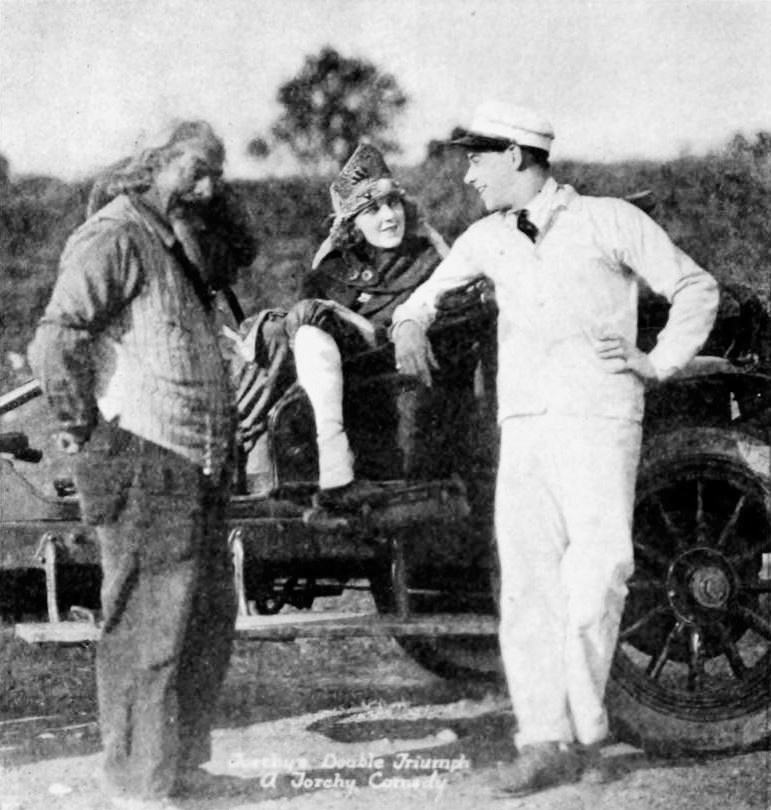
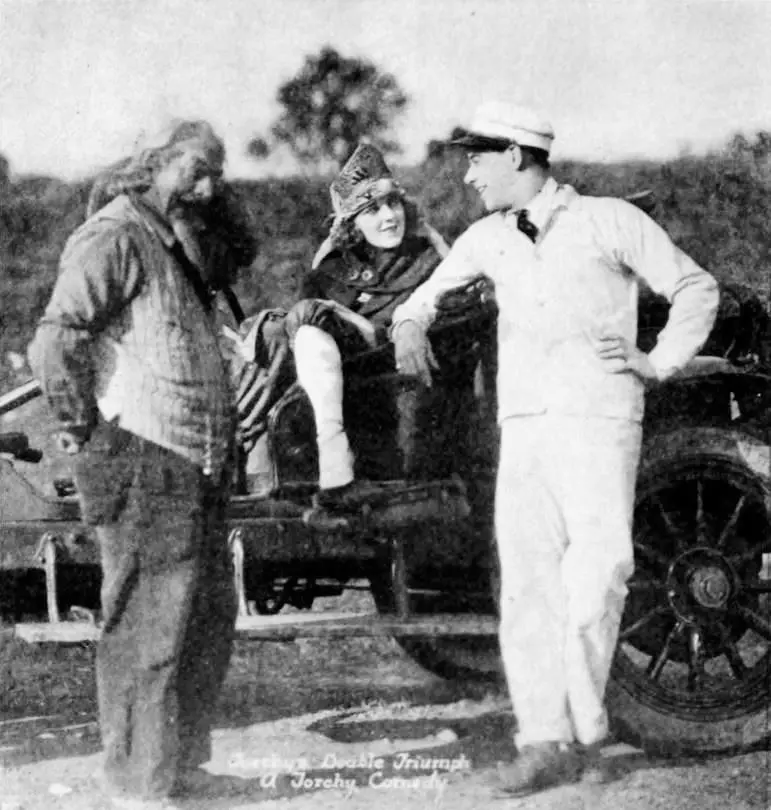
The first time you see Johnny Hines sprint down that gravel carriage road—arms semaphore-wild, overalls daubed like a futurist canvas—you realize Torchy’s Double Triumph is less a narrative than a controlled detonation inside a country-estate snow globe. Paramount released it in the dog-days of 1924, when slapstick was supposedly wheezing its last, yet here arrives a film that hiccups helium.
A studio synopsis can flatten the oddball topography of this 60-minute whirl into “painter unmasks fake psychics,” but Raymond L. Schrock’s scenario is really a relay of mistaken pigment. Every character slathers on a fresh identity—fortune-teller, flapper, farmer—until identity itself drips onto the Persian rugs. The titular Double Triumph is not merely Torchy’s recovery of the gems; it’s the conquest over social stratification masquerading as weekend leisure.
Hines, who wrote much of his own physical business, treats the frame like a trampoline. Watch him ricochet off a mahogany banister, somersault across a library ladder, and land inside a suit of armor whose visor snaps shut on his nose—a three-beat crescendo accomplished in one unbroken take. Cinematographer Frank Kugler keeps the camera at hip-height, withholding nothing, so each pratfall arrives with the blunt clarity of a lithograph.
The film’s chromatic scheme—hand-tinted for certain prestige prints—sneaks commentary into comedy. When the pseudo-gypsy woman lifts her crimson veil, the tint flares candy-apple, the shade of alarm. Later, emeralds shimmer sea-blue (#0E7490 decades before hex codes) against the monochrome parlor, a transient promise that wealth can, indeed, be colorfast.
Contemporary critics carped that the picture lacked “a single subtitle worth framing,” yet the scarcity of intertitles forces your eye to the percussion of boots on parquet, the hush before a chandelier crystal pings loose. The absence becomes an instrument.
Dorothy Leeds, as society filly Barbara Marberry, pirouettes from ingénue to improvisational accomplice without shedding her satin cloche. In a decade when heroines too often waited trussed on train tracks, Barbara commandeers a roadster, knocks out a henchman with a croquet mallet, and still lands a kiss that fogs the camera lens. The film quietly proposes that the real double triumph belongs to the women who refuse to stay inside the gilded cage—even when invited to tea.
Historians hunting for proto-screwball need look no further. The DNA of Bringing Up Baby and His Girl Friday coils inside these reels: rapid-fire courtship, class anxiety, priceless MacGuffins lobbed like hot potatoes. Viewing it in tandem with Flappers and Friskies reveals how early the cocktail of flirtation and felony percolated.
Stack Torchy beside the continental gloom of Unsühnbar or the crucifixional angst of Golgofa zhenshchiny and you confront the bipolar soul of 1924 cinema: one hemisphere drunk on existential guilt, the other on Keystone fizz. Yet even the comedies were shadowed; post-WWI audiences nursed survivor’s euphoria, desperate to laugh before the next telegram arrived. Torchy’s manic resilience reads, in hindsight, as a coping mechanism for a nation still coughing up mustard gas memory.
Let’s not varnish the era’s prejudices. A comic relief butler shuffles in eye-rolling servitude, a caricature that curdles modern stomachs. The fortune-teller charade, though deliciously plotted, leans on “exotic” clichés—kohl eyelids, tambourines, pidgin curses. Restored prints carry a content warning now, and rightly so. The laughter comes perforated with historical shrapnel.
The film’s pièce de résistance—Torchy folded inside a straw man—works as both gag and existential metaphor. A lone figure stuffed with chaff, voiceless, hunted, yet suddenly omnipresent in the cornfield dusk: he is the country’s post-war self-portrait. When crows land on his hat brim, he must wink without moving a muscle; survival becomes vaudeville. The gag echoes across decades, resurfacing in The Coward and, obliquely, in the scarecrow nightmares of The Wizard of Oz.
Released against a circus of heavyweight melodramas—The Barrier, Sporting Life—Torchy’s Double Triumph earned a respectable if not stratospheric purse. Exhibitor reports praised “kid-packed matinees,” hinting that Hines’s true domain was the sticky-floored neighborhood house, not the chandeliered picture palace. Yet its footprint faded; only four 35mm prints survive in institutional vaults, and the Library of Congress 2022 restoration scanned a badly abraded Czech archive dupe, leaving certain scenes swimming in photochemical bruise.
Digitization ironed out projector chatter but also amputated the jittery grain that once twinned candlelight. Purists howl; pragmatists shrug. Either way, the tinting notes were lost, so the restoration team color-graded by committee, reviving the sea-blue jewels and the mustard waistcoats described in period press sheets. The result—streaming on several niche platforms—leans toward over-saturation, like a child let loose on a Tintoy set. Still, better an exaggerated rainbow than perpetual charcoal.
Hines, all teeth and torque, recalls a hybrid of Harold Lloyd’s optimism and Buster Keaton’s physics. Where Lloyd scales façades, Hines ricochets through social strata. Leeds supplies screwball spark, while villain Herbert Fortier oozes the silk-shirt menace of a man who has read too much Bulwer-Lytton and believes every word.
Torchy’s Double Triumph is no buried masterpiece, but it is a kinetic time capsule, effervescent enough to carbonate your veins. Approach it with popcorn skepticism; leave humming the realization that escapade, not empire, built Hollywood. If you crave a triple-feature, pair it with Business Is Business for cynicism, then A Vermont Romance for pastoral balm. Together they chart the wild emotional meridians of 1924, a year that danced on the lip of an economic crater and refused to look down.
Score: 8/10 (for vitality, not posterity)
IMDb 7.6
1916
Community
Log in to comment.