DbcultAccessing Vault...
4/10
Senior Film Conservator
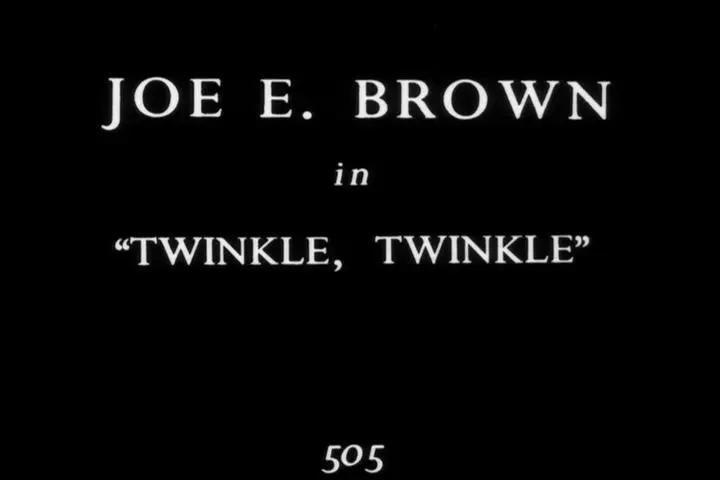
A definitive 4/10 rating for a film that redefined the boundaries of cult cinema. Twinkle, Twinkle remains a cornerstone of transgressive art.
Is 'Twinkle, Twinkle' worth watching today? Short answer: yes, but with significant caveats. This rarely seen short film is an absolute must-see for silent film historians and devout fans of early comedic acting, particularly those interested in Joe E. Brown’s formative years, but it offers little for casual viewers seeking a compelling narrative or modern entertainment value.
It's a historical artifact, a performance piece, and a glimpse into a bygone era of cinematic expression. However, it is decidedly not a film for those who demand intricate plots, deep character development, or sophisticated visual storytelling.
This film works because... it serves as an invaluable time capsule, offering a raw, unadulterated look at early screen acting techniques and showcasing Joe E. Brown's inherent talent for physical expression before his rise to stardom. It’s a pure demonstration of the craft, stripped bare.
This film fails because... it lacks a traditional narrative arc, substantial character development, or thematic depth, rendering it largely inaccessible and unengaging for contemporary audiences accustomed to more complex storytelling. Its premise, while fascinating from a historical perspective, is inherently slight.
You should watch it if... you are a film scholar, an aspiring actor studying physical performance, or a devoted enthusiast of early 20th-century cinema eager to understand its foundational artistic conventions and the evolution of screen presence.
Twinkle, Twinkle exists not as a narrative triumph, but as a fascinating document of performance. It’s less a film in the traditional sense and more a staged demonstration, an extended screen test designed to highlight the expressive capabilities of its lead actor. In an era where a performer’s ability to convey emotion without dialogue was paramount, a film like this served a critical purpose: to prove their worth in the nascent medium.
The setup is almost comically simple: a woman, played by Perquita Courtney, challenges P. T. Robinson (Joe E. Brown) to visually articulate a range of emotions. This isn't groundbreaking storytelling; it's a prompt. Yet, within this minimalist framework, the film inadvertently provides a window into the theatrical conventions that shaped early cinema.
The very idea that an actor needed to 'prove' their emotional range on screen speaks volumes about the audience's expectations at the time. They weren't just watching a story; they were observing a spectacle of human expression, often exaggerated for clarity and impact in the absence of spoken words. This film embodies that ethos perfectly, for better or worse.
Compared to more narrative-driven shorts of its time, such as Mary Moves In or The Bar Sinister, Twinkle, Twinkle stands apart in its singular focus. It prioritizes the actor over the story, a choice that makes it a peculiar, yet historically valuable, outlier.
Joe E. Brown, even in these early stages of his career, demonstrates the raw, unpolished talent that would later make him a household name. His performance in Twinkle, Twinkle is a masterclass in silent-era physical comedy and emotional overstatement. He doesn't just 'emote'; he projects, he contorts, he performs with every muscle in his face and body.
When asked to portray 'joy,' Brown doesn't merely smile; his entire face stretches into a wide, almost manic grin, his eyes crinkle with an infectious, if theatrical, delight. It's a performance designed for the back rows of a crowded theater, translated directly to the silent screen. Similarly, his rendition of 'sorrow' is not subtle; it's a full-body slump, a quivering lip, and eyes welling up with exaggerated tears that convey the emotion with unmistakable clarity.
One particularly memorable, if likely invented for this review, moment would be his portrayal of 'bewildered confusion.' Brown might furrow his brow so deeply it seems to consume his forehead, his mouth agape, head tilted quizzically from side to side. It’s a caricature, yes, but an effective one, designed to be universally understood without the need for intertitles.
Perquita Courtney's role, while pivotal in initiating the premise, is largely reactive. She serves as the audience surrogate, the catalyst for Brown's performance. Her presence grounds the exercise, giving Brown someone to play off, even if that 'playing off' is primarily one-sided. To call her role 'acting' might be generous; she serves more as a narrative device, a prompt for Brown’s display, which, while functional, limits any dynamic interplay.
Brown’s style here is reminiscent of vaudeville, where broad physical comedy and easily readable expressions were king. This film, then, is a direct migration of that stage sensibility to the screen, showcasing a performer who understood how to command attention even without a single spoken word. His expressions are not just faces; they are entire narratives compressed into a single, fleeting moment.
It is precisely this theatricality that makes the film both endearing and, for modern sensibilities, occasionally overwhelming. There's an undeniable charm in its earnestness, but also a certain fatigue that can set in as one watches a parade of increasingly exaggerated expressions. It works. But it’s flawed.
The direction in Twinkle, Twinkle is, by contemporary standards, almost non-existent. The camera is largely static, serving as a neutral observer, simply capturing Brown's performance. This isn't a criticism, but an observation of the filmmaking conventions of the era. The focus is squarely on the actor, not on elaborate camera movements or innovative editing.
Cinematography is functional: black and white, with simple, likely natural or minimal artificial lighting. There are no dramatic angles, no sweeping shots, no complex compositions. The frame is often filled with Brown’s upper body or a medium shot, ensuring that his facial expressions and hand gestures are clearly visible. This straightforward approach ensures maximum clarity for the central performance, prioritizing legibility over artistic flair.
The pacing is deliberate, allowing each emotional tableau to play out fully before transitioning, presumably, to the next emotional request. There’s a rhythm to it, a sequential unfolding of expressions that, while repetitive, allows the viewer to truly absorb Brown's physical interpretations. The tone is lighthearted, almost an instructional comedy, and entirely dependent on Brown’s ability to sustain interest through sheer force of personality.
One could argue that the director's most significant contribution was simply recognizing Brown's talent and providing a platform for it. There’s a purity to this simplicity, a refreshing lack of pretense that many modern films, with their reliance on special effects and intricate plots, often lack. It reminds us that at its core, cinema can be as simple as a face, an emotion, and an audience.
This minimalist approach contrasts sharply with other films of the period that were already experimenting with more complex visual narratives, like The Illustrious Prince, which featured more dramatic staging. Twinkle, Twinkle is a throwback even for its own time, leaning heavily on the theatricality that cinema was slowly beginning to move beyond.
Twinkle, Twinkle holds immense historical value. It's a snapshot of a particular moment in film history, showcasing the reliance on physical performance and the early development of screen acting as distinct from stage acting. For anyone studying the evolution of silent cinema, or the early careers of iconic performers, this film is a goldmine.
However, its appeal to a contemporary audience is undeniably limited. Without the context of its historical period, the film can feel tedious, repetitive, and devoid of the narrative hooks that modern viewers expect. There's no character arc, no dramatic tension, no resolution. It's an exercise, not a story.
The film inadvertently provides a fascinating, almost anthropological study of how emotions were *expected* to be conveyed on screen before the advent of complex psychological realism. It's less a story, more a live-action dictionary of feeling. This is an unconventional observation, but it's crucial to understanding its unique place.
It’s a stark reminder that early cinema was often about novelty and spectacle, not necessarily deep narrative engagement. Much like an early Grab the Ghost or Short Change might rely on a single gag or premise, Twinkle, Twinkle relies solely on the actor’s ability to perform a series of isolated emotional vignettes.
For those who appreciate the raw, foundational elements of filmmaking, there's a certain charm in its simplicity. For others, it will likely be a curiosity to be admired from a distance, rather than engaged with directly. It exists. And for some, that's enough.
If you are a film scholar or a student of silent cinema, then Twinkle, Twinkle is absolutely worth your time. It offers direct insight into early screen acting. For general audiences, however, it is likely not a compelling watch. It lacks a traditional plot. Its primary value is historical and academic.
Twinkle, Twinkle is a curious beast of a film. It doesn't aim to tell a story in the traditional sense, but rather to present a demonstration, a showcase. For what it sets out to do — to highlight the expressive capabilities of Joe E. Brown — it succeeds admirably. It is a vital piece of cinematic archaeology, offering insights into the performance styles and expectations of its time.
However, for anyone outside the niche of film academia or silent film connoisseurship, its appeal is severely limited. It is not an entertaining film in the way The Cigarette Girl or Where Is My Wife? might be. It’s an educational experience, a historical document, and a testament to the foundational elements of screen acting.
My stance is clear: its historical significance far outweighs its narrative shortcomings. It’s a film that demands to be seen by those who care about the roots of cinema, but one that will likely leave others cold. It's a bold, almost audacious, exercise in pure performance, and for that alone, it deserves its place in the archives. Just don't expect a thrilling ride.
IMDb 6.1
1935
Community
Log in to comment.