DbcultAccessing Vault...
Cult Review
Senior Film Conservator
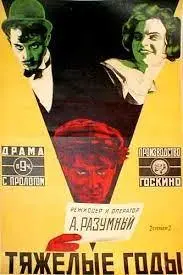
Is 'Tyazheliye gody' a film that demands your attention in the crowded landscape of modern cinema? Short answer: yes, absolutely, but with significant caveats. This is not a film for passive viewing; it’s a demanding, often bleak, yet ultimately profoundly rewarding experience for those willing to lean into its historical gravity and emotional depth.
This film is unequivocally for viewers who appreciate historical dramas with a strong social realist bent, those who seek out character studies steeped in struggle, and anyone fascinated by early 20th-century Russian cinema. It is decidedly NOT for audiences looking for light entertainment, fast-paced action, or clear-cut heroic narratives. Its deliberate pace and somber tone will challenge many, but its rewards are substantial for the patient.
This film works because of its unflinching commitment to depicting human struggle with stark authenticity, elevated by truly remarkable performances that breathe life into its grim realities.
This film fails because its pacing can be excruciatingly slow at times, bordering on didactic, which might alienate viewers not already invested in its historical context.
You should watch it if you are prepared for a challenging, emotionally resonant historical drama that prioritizes character and atmosphere over plot-driven excitement.
'Tyazheliye gody,' or 'Hard Years,' is precisely what its title suggests: a cinematic exploration of an era defined by struggle, scarcity, and the unyielding human spirit. Directed with a meticulous, almost anthropological eye, the film plunges us into a period of immense societal upheaval, where the personal battles of a single family mirror the broader seismic shifts occurring around them. It’s a powerful, if at times arduous, viewing experience that leaves an indelible mark.
The ensemble cast, led by Anatoli Nelidov as Ivan and Olga Lebedeva as Maria, delivers performances that are nothing short of revelatory. Nelidov, in particular, embodies the quiet desperation and stoic resolve of a man caught between his principles and the primal need to protect his family. His portrayal is a masterclass in subtlety; a flicker in his eyes, a slight tremor in his hands, or the way he carries himself after a particularly grueling day speaks volumes where dialogue is sparse. Consider the scene where Ivan barters a cherished family heirloom for a meager sack of flour. Nelidov’s face, etched with a mixture of shame and grim determination, communicates the profound personal cost of survival far more effectively than any monologue could.
Olga Lebedeva’s Maria is the film’s beating heart, a beacon of resilience in a world determined to extinguish hope. Her performance is less about grand gestures and more about the quiet strength of everyday endurance. The moments she shares with her child, singing a lullaby amidst the clatter of a sparse apartment, or meticulously patching worn clothing, are imbued with a tender authenticity that grounds the film's grimmer aspects. Lebedeva manages to convey Maria’s inner fortitude without ever resorting to saccharine sentimentality, a difficult balance to strike in such a bleak narrative. Her silent reproach of Pyotr's (Evgeny Zhbankov) more extreme suggestions, conveyed purely through a look, is a standout moment of understated power.
Evgeny Zhbankov as Pyotr, Ivan's disillusioned friend, provides a crucial counterpoint. His character represents the volatile undercurrents of the era, the temptation of radicalism born from despair. Zhbankov plays Pyotr with a simmering intensity, a man constantly on the verge of eruption, but also capable of surprising vulnerability. His scenes with Nelidov are charged with an unspoken tension, reflecting the ideological struggles of the time. Mark Dobrynin and Fyodor Bogdanov, in their supporting roles, add further texture to this meticulously crafted world, often embodying the faceless bureaucratic indifference or the shared suffering of the populace. Their brief, impactful appearances serve to broaden the film’s scope, reminding us that Ivan and Maria’s struggle is but one thread in a larger tapestry of national hardship.
Aleksandr Razumnyj, working from a script by Nikolai Misheyev and himself, directs 'Tyazheliye gody' with an almost documentary-like precision. There’s a palpable sense of authenticity to every frame, a commitment to portraying the harsh realities of the period without romanticization. Razumnyj’s direction is characterized by long takes and a preference for natural lighting, immersing the viewer deeply into the characters' lived experiences. This approach fosters a profound sense of empathy, forcing us to bear witness to their plight.
The film’s visual language is sparse but incredibly effective. Razumnyj often uses wide shots to emphasize the isolation of his characters against vast, desolate landscapes or cramped, oppressive urban environments. A particularly memorable sequence involves Ivan’s solitary walk through a snow-laden, deserted street, his silhouette dwarfed by towering, crumbling buildings. This shot perfectly encapsulates the individual’s insignificance against the backdrop of monumental social forces, yet simultaneously highlights their enduring spirit. It’s a classic example of how The Scottish Covenanters and other historical dramas use environment to reflect internal states.
Razumnyj’s control over the film’s tone is absolute. He maintains a consistent sense of melancholic realism, punctuated by brief, almost fragile moments of human connection or small victories. This tonal consistency, while challenging, is also one of the film’s greatest strengths, preventing it from ever veering into melodrama or false hope. It's a testament to his directorial prowess that he can sustain such an atmosphere for the film's considerable runtime without it becoming monotonous.
The cinematography of 'Tyazheliye gody' is a masterclass in creating atmosphere through austerity. The black-and-white palette is utilized not merely as a historical convention, but as a deliberate artistic choice, enhancing the film’s stark realism. Shadows are deep, contrasts are sharp, and textures are rendered with a tactile quality that makes the cold, hunger, and grime almost palpable. This visual style is reminiscent of the starkness found in films like The Hidden Truth, where the absence of color amplifies the emotional weight.
The camera often lingers on faces, capturing every nuance of emotion, every wrinkle of worry or flicker of hope. Close-ups are used sparingly but to devastating effect, drawing the viewer into the characters' inner worlds. Consider the scene where Maria finds a single, forgotten potato; the camera’s tight focus on her hands, gently brushing away the dirt, transforms a mundane object into a symbol of profound sustenance and momentary triumph. It’s a shot that embodies the film’s philosophy: finding beauty and meaning in the smallest, most desperate acts.
Beyond the intimate shots, the film also employs powerful wide compositions that emphasize the bleakness of the urban landscape or the vastness of the Russian plains. These shots are not just establishing; they are thematic, constantly reminding the viewer of the overwhelming forces at play against the individual. The interplay between these intimate and expansive frames is a cornerstone of the film’s visual storytelling, ensuring that the personal and the political are always intertwined.
The pacing of 'Tyazheliye gody' is undeniably slow. This is not a film that rushes its narrative; instead, it allows scenes to unfold in real-time, demanding patience and contemplation from its audience. This deliberate pace, however, is crucial to the film’s immersive quality. It allows the viewer to truly inhabit the characters’ world, to feel the weight of their daily struggles, and to understand the psychological toll of prolonged hardship. It’s a pace that can feel challenging, almost meditative, but it ultimately serves the film’s artistic intent.
The tone is consistently somber, almost elegiac, yet it never fully descends into nihilism. There’s always a thread of human dignity, a spark of resilience, or a quiet act of kindness that prevents the film from becoming unbearable. The film's ability to maintain this delicate balance, to portray immense suffering without succumbing to despair, is one of its most impressive achievements. It works. But it’s flawed. Some might argue that the film could have achieved its thematic goals with slightly tighter editing, especially in its middle act, where some sequences feel protracted.
This measured pace, while a potential barrier for some, is precisely what allows the film’s emotional impact to build gradually and profoundly. It’s a slow burn that culminates in a powerful, lingering resonance, much like the slow, inevitable march of history itself. The film doesn't offer easy answers or quick resolutions; it offers a reflection, a moment to ponder the enduring strength of the human spirit in the face of overwhelming adversity. This is a film that asks you to sit with its characters, to walk in their worn shoes, and to feel the weight of their 'hard years'.
Yes, 'Tyazheliye gody' is absolutely worth watching, especially for serious cinephiles and students of history. It offers a rare, stark glimpse into a pivotal era.
Its themes of resilience, sacrifice, and the search for dignity remain incredibly relevant. The performances are timeless in their power.
However, be prepared for a slow, demanding experience. This film requires your full attention and a willingness to engage with its somber subject matter.
It’s a film that doesn't just entertain; it educates and challenges. It’s a piece of living history, captured with remarkable artistry.
'Tyazheliye gody' is a challenging yet ultimately profound cinematic experience. It's a film that doesn't just depict history; it immerses you in it, forcing you to confront the harsh realities of a bygone era through the deeply human struggles of its characters. While its deliberate pacing and somber tone will undoubtedly test the patience of some, those who commit to its journey will be rewarded with a rich, emotionally resonant narrative and performances that linger long after the credits roll.
This is not a film to be enjoyed casually, but to be studied, discussed, and felt. It’s a vital piece of cinema that, despite its age and austere aesthetic, speaks volumes about human endurance and the enduring quest for dignity. It earns its place as a significant work, reminding us that even in the 'hard years,' the human spirit finds ways to persist. Highly recommended for the discerning viewer who values substance over spectacle, and who isn't afraid of a film that makes them think and feel deeply.
IMDb 7
1915
Community
Log in to comment.