DbcultAccessing Vault...
5.6/10
Senior Film Conservator
A definitive 5.6/10 rating for a film that redefined the boundaries of cult cinema. Usagi to kame remains a cornerstone of transgressive art.
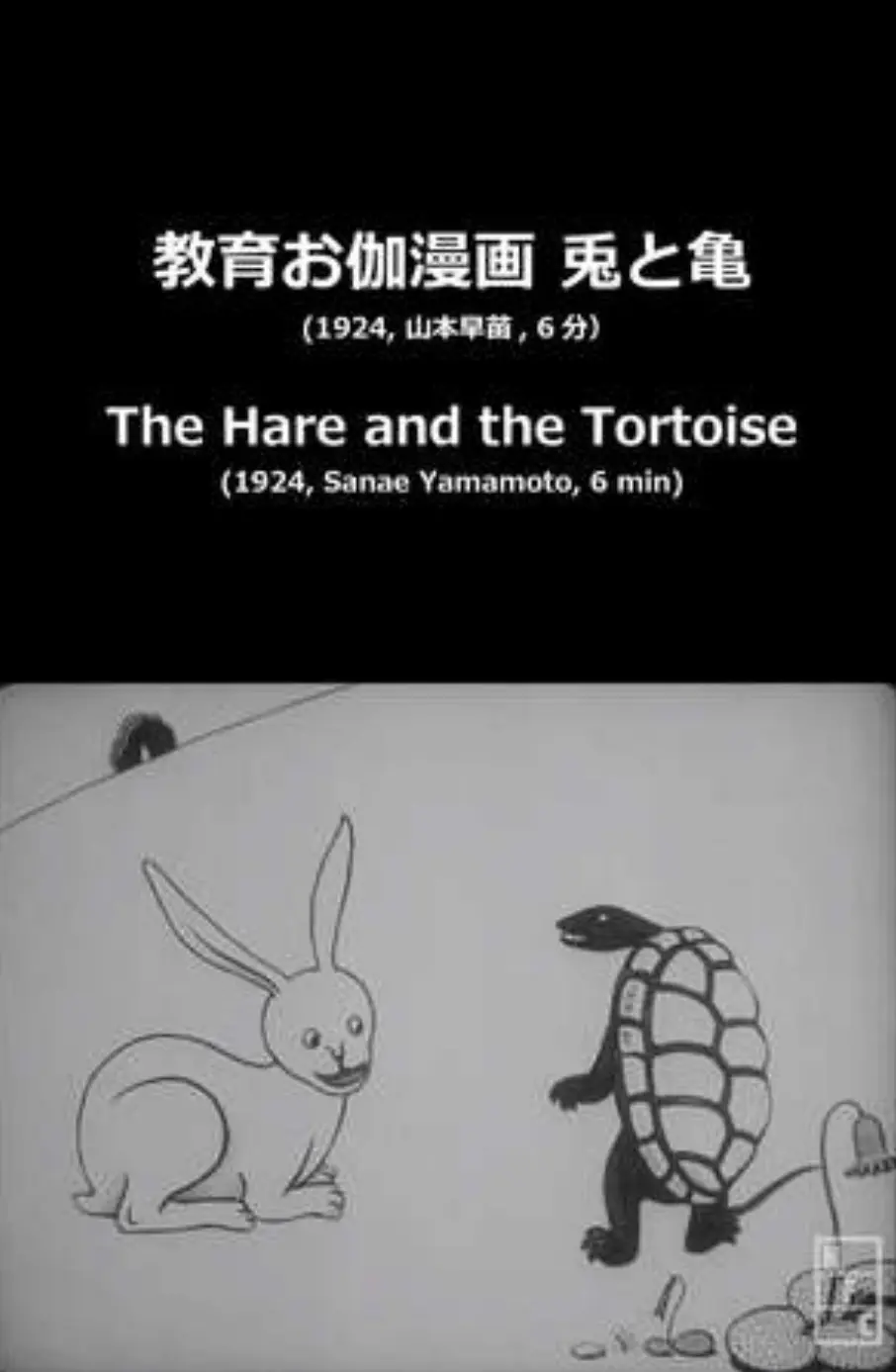
To gaze upon the flickering frames of Usagi to kame is to witness the very heartbeat of a medium in its infancy. Released in 1924, this Japanese animation is not merely a retelling of the tortoise and the hare; it is a foundational pillar of what we now recognize as the global phenomenon of anime. While the West was preoccupied with the slapstick antics of Felix the Cat, the artisans in Japan were experimenting with a visual language that blended traditional woodblock aesthetics with the burgeoning technology of the cinematograph. This film represents a moment where cultural heritage collided with technological curiosity, resulting in a work that feels both ancient and startlingly modern.
The visual composition of Usagi to kame relies on a deceptive simplicity. The rabbit, characterized by elongated ears and a skeletal frame, moves with a jittery, nervous energy that reflects the anxieties of a nation transitioning into a modern power. In contrast, the tortoise is a rounded, stable entity, grounded in the earth. This dichotomy of shape and motion creates a visual tension that transcends the need for dialogue. When we look at the thematic weight of ego presented here, one cannot help but recall the moral complexities in The Man Who Played God. Both films deal with the catastrophic fallout of self-perceived superiority, though the animation does so through the purity of the line rather than the weight of the stage.
The backgrounds are sparse, almost Zen-like in their refusal to distract from the central conflict. This minimalism allows the viewer to focus on the rhythmic pacing of the race. The rabbit’s nap is not just a plot point; it is a cinematic pause, a breath in the middle of a frantic sentence. This use of negative space and timing suggests a sophisticated understanding of audience psychology that was rare for the era. It shares a certain atmospheric kinship with the moody, shadowed frames of Lulù (1923), where the environment serves as a mirror to the character’s internal state.
Technically, the film is a masterclass in the constraints of the time. The animators of the 1920s did not have the luxury of digital layers or even high-quality celluloid. Every movement was a labor of love, often involving intricate paper cutouts or frame-by-frame ink drawings on paper. This tactile quality gives the film a soul that is often missing from modern, polished productions. The slight imperfections—the occasional jitter of the frame, the varying thickness of the ink—act as a reminder of the human hand behind the lens. This raw, unvarnished honesty is reminiscent of the naturalistic struggles depicted in La montagne infidèle, where the elements themselves dictate the flow of the narrative.
The way the light interacts with the paper surfaces in Usagi to kame creates a shimmering effect that feels almost like a dream sequence. It is a primitive form of the 'twinkling' effect that would later be perfected in live-action cinematography, such as in The Twinkler. In both cases, the manipulation of light serves to elevate the mundane into the realm of the mythic. The race is no longer just a contest between two animals; it is a cosmic event played out on a strip of nitrate film.
To understand the impact of this film, one must consider the year of its release. 1924 was a period of intense reconstruction following the Great Kanto Earthquake. The themes of persistence and the eventual triumph of the slow, steady worker resonated deeply with a public that was rebuilding their world from the ashes. The tortoise’s victory was a cultural balm, a narrative of hope that suggested that through unyielding effort, even the most monumental challenges could be overcome. This didacticism is handled with a lighter touch than the heavy-handed moralizing found in The Sin of Martha Queed, yet the impact is no less profound.
Furthermore, the film’s structure—a series of escalating challenges leading to a climactic realization—mirrors the serial nature of early cinema like Lucille Love: The Girl of Mystery. However, while Lucille Love relied on external melodrama, Usagi to kame finds its drama in the internal failings of its protagonist. The rabbit’s failure is a moral one, a sin of pride that feels as heavy as the themes explored in The Devil's Garden. It is a cautionary tale that warns against the seduction of early success and the lethargy that follows it.
While Usagi to kame is distinctly Japanese, its DNA is shared with the global cinematic movements of the 1920s. The playfulness of the characters bears a resemblance to the comedic timing found in Toonerville's Fire Brigade, yet there is an underlying melancholy here that is absent from American shorts. This is not just entertainment; it is an exploration of the human condition through the lens of animal archetypes. The rabbit’s frantic speed is a precursor to the modern obsession with efficiency, a theme that would be explored with more cynicism in Egyenlöség.
The film also touches upon the concept of destiny. Is the tortoise destined to win because of his character, or is the rabbit destined to fail because of his nature? This fatalistic streak is a common thread in the literature of the time, often seen in the works that inspired Paradise Lost. In the animation, this destiny is rendered through the literal path the characters follow—a single, unwavering line towards the finish. There are no deviations, no subplots; just the inexorable march towards a predetermined end. This focus on the singular path is a stark contrast to the sprawling, multi-character narratives of films like Lena Rivers.
The enduring power of Usagi to kame lies in its ability to be reinterpreted by every generation. To a child, it is a simple story about a race. To an art historian, it is a crucial link in the chain of animation history. To a philosopher, it is a meditation on the nature of time and effort. It lacks the romantic sentimentality of The Bashful Lover, opting instead for a pragmatic, almost cold observation of cause and effect. This lack of sentimentality is what makes it so enduringly modern.
Even when compared to the sports-centric narratives of the era, such as Play Ball with Babe Ruth, the animation holds its own by focusing on the psychology of the athlete rather than the spectacle of the sport. The rabbit is the star who burns out too quickly; the tortoise is the veteran who knows how to pace himself. It is a lesson in endurance that is as relevant in the boardroom as it is on the racetrack. The film’s brevity—running only a few minutes—is its greatest strength. It does not overstay its welcome, much like the brief, intense experiences depicted in Back from the Front.
In the vast desert of lost silent films, Usagi to kame stands as a vibrant oasis. It is a testament to the power of the image to convey universal truths. While other films of the period, like Sands of the Desert, relied on exoticism and grand sets, this animation proves that all you need is a line, a curve, and a story worth telling. It is a humble masterpiece that continues to cast a long shadow over the world of cinema, reminding us that the race is not always to the swift, but to those who keep moving, one frame at a time.
Final Thought: If you seek the origins of the kinetic brilliance that defines modern Japanese art, look no further. This 1924 gem is the blueprint, the spark, and the steady heartbeat of an entire industry.

IMDb 5.6
1931
Community
Log in to comment.