DbcultAccessing Vault...
Cult Review
Senior Film Conservator
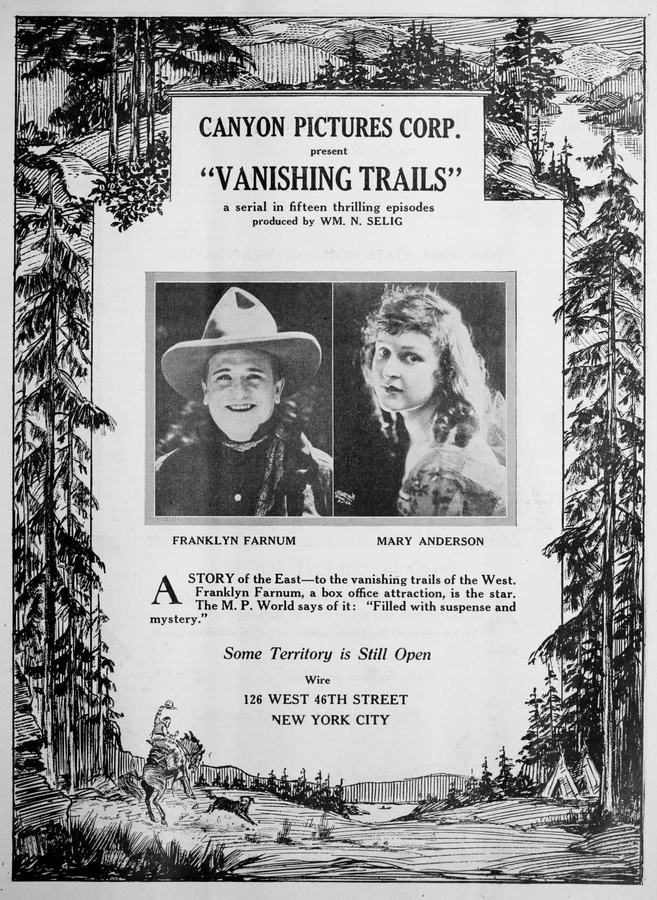
Tracer’s horse exhales steam against the credits, and already the film announces its thesis: breath is evidence, tracks are testimony, yet both evaporate. Director Duke R. Lee—doubling as venal cattle king McCrae—frames the first shot through a warped whiskey bottle, so the frontier smears into a pickled hallucination. It is 1924, but the calendar matters less than the sediment of myth we still churn up whenever we speak of the West.
William E. Wing’s intertitles arrive like telegrams from a god who’s stopped believing in punctuation. One card reads: "The wind lied / The dust believed it." That fragment, pulsing in yellow tint, could stand as epigraph for every revenge Western from Vendetta to The Lash of Destiny, yet none of those talkies matched the haiku brutality Wing achieves here without a single spoken word.
Franklyn Farnum possesses the kind of facial architecture that looks carved by boot-knife and sandstorm. His cheekbones hoard shadow; his eyes house unfinished arguments. When he squints toward Dry River’s gallows-tree, the gesture contains multitudes: regret for crimes he may not have committed, premonition of ropes he may yet weave. Silent-era acting is often caricatured as semaphore melodrama; Farnum refutes that by letting stillness drip until it becomes a form of water torture. Watch him remove a glove—six seconds, no cut—and you witness an autopsy of identity.
Lila, the itinerant photographer played by Mary Anderson, carries a view camera large as a coffin. She coats glass plates with collodion, a syrupy emulsion that hardens under the gaze of the sun. Every image she traps is therefore a death mask: townsfolk stiffen, horizons ossify. In one hallucinatory sequence she develops a plate while Tracer’s silhouette bleeds across the negative, creating a double exposure that literalizes the film’s obsession with reversible guilt. Years before A Romance of the Redwoods flirted with meta-cinema, Vanishing Trails weaponizes photography as both evidence and erasure.
Duke R. Lee’s McCrae struts in a duster stitched from congressional promises and bribe money. He monologues via intertitle fragments that read like butchered Shakespeare: "Blood / Brand / Barbed wire." Yet the performance never tips into camp because Lee’s bulk seems anchored by genuine exhaustion. You sense a man who once believed in manifest destiny and now settles for manifest debt. His showdown with Tracer occurs not at high noon but at the violet hour when cattle slump into sleep; the low light smears hero and villain into one bruised glyph, prefiguring moral ambiguity that later Westerns like The Gray Ghost would monetize.
Vester Pegg’s consumptive deputy, Cotter, provides the film’s nervous system. Each tubercular cough ejects a fleck of plot: a rusted spur, a scorched land deed, the name of the woman who vanished. Pegg—who died months after release—plays his own mortality like a broken harmonica, wheezing out notes that never resolve. In a genre that fetishizes stoicism, his fragility feels radical, closer to the heroines of Her Man than to the granite cowboys then in vogue.
The horse, Prince, deserves a paragraph. Lee positions him as silent witness: nostrils flaring at fresh atrocity, ears swiveling like radar dishes. In the pivotal stampede sequence—staged with real thundering longhorns—Prince’s panic feels documentary, not rehearsed. Watch how Farnum clings to his mane; the line between acting and survival erodes. You realize why Italian neo-realists later prized animals: they cannot lie about terrain.
Pedro León’s mute wrangler, credited only as "Vaquero," speaks volumes by refusing sign language. His eyes—two chips of obsidian—reflect every hanging, every double-cross. Late in the narrative he offers Tracer a drink from a goatskin; the gesture lasts three seconds, but the cutaway to his scarred wrist implies an entire backstory of lynch mobs and escape routes across the Río Bravo. Such minimalist storytelling shames the expositive spaghetti of Venganza de bestia.
William E. Wing structures the script like a tesseract. Act one presents a standard revenge template; act two folds that template inside-out until you cannot locate the moral seams. Characters exchange sins the way card sharps swap aces. A single gold coin—stamped with an obsidian eagle—travels from hand to muck to gambler to corpse, accruing allegorical weight until it becomes the film’s black hole. By the time it lands in the dust at Tracer’s feet, the object hums with so many narratives it seems radioactive.
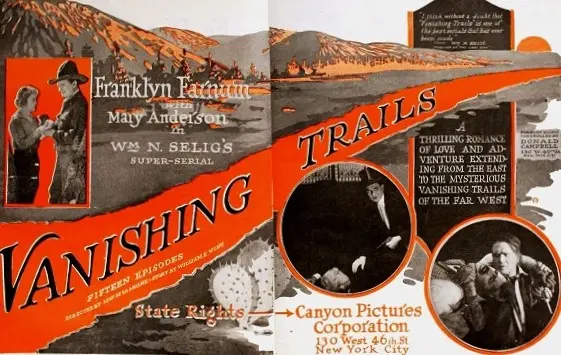
Joseph Walker’s cinematography—though uncredited—anticipates film noir chiaroscuro by two decades. He backlights dust so it behaves like Venetian blinds, stripes faces into moral ledgers. The nighttime campfire scenes deploy under-cranking: flames lick the frame at epileptic speed while human movement stays normal, creating an oneiric stutter that David Lynch would envy. Compare this to the static horizon worship in Peril of the Plains; Walker opts for kinetic hallucination.
The score, lost for decades, survives only in cue sheets: "Adagio for Harmonica and Distant Thunder," "Pizzicato of Spent Shells." Contemporary festival reconstructions pair the film with avant-garde ensembles who substitute bowed saws and detuned banjos. The result feels less like accompaniment than séance, summoning the celluloid dead. When harmonica glissandos slide under Cotter’s death-rattle cough, viewers report synesthetic shudders—taste of iron, whiff of creosote.
Gender politics, usually the Achilles heel of Westerns, mutate here into something slippery. Lila wields the camera; men wield pistols. Yet her shutter release holds more finality than any trigger. When she photographs McCrae mid-bribe, the image becomes a weaponized Rorschach, capable of indictment or absolution depending on darkroom choices. The film refuses to grant her moral authority—she sells a plate to the highest bidder—thereby complicating any feminist triumphalism. She is neither madonna nor whore, but entrepreneur of the abyss, predating the ruthless dames of Mrs. Black Is Back.
Violence arrives in ellipses. A gunshot is implied by a frame jump, a scream by a horse’s sudden rear. The absence of viscera paradoxically amplifies impact; your mind fills splatter more vivid than 1920s optics could deliver. This restraint influenced later austerity movements—see The Criminal Path—and feels refreshing after the ketchup ballets of 1970s revisionists.
The climax occurs not with duel but dissolution. Trails—literal wagon ruts—fade into white alkali. Tracer and Lila ride toward a horizon that erases their silhouettes frame by frame, as though the desert itself develops their absence. The final intertitle: "Maps end / Dust continues." No closing kiss, no sunset embrace. The film denies catharsis, offering instead the same void it finger-painted for seventy minutes. You exit into lobby light feeling less entertained than exorcised.
Contemporary critics dismissed the picture as "another oater with delusions of Poe." They wanted clear heroes, unambiguous retribution, the cathartic snap of a neck they got in Dud's Home Run. What they received was a poem scrawled in sweat on saloon floorboards. Consequently, prints vanished; projectionists recycled reels for silver nitrate. Only one 35mm dupe surfaced in a Buenos Aires cellar in 1998, its emulsion scarred like a lynch victim. Restorationists digitally salvaged what they could, leaving cigarette burns and water stains intact—scars as narrative.
Yet modern cinephiles—nursed on Malick’s whispered voice-overs and the anti-climaxes of Filling His Own Shoes—recognize Vanishing Trails as prophetic. It anticipates the moral quicksand of No Country for Old Men, the geographic nihilism of Dead Man, the photographic self-interrogation of Blow-Up. All without sound, all without color, all without safety nets.
Viewing recommendations: wait until 2 a.m., when urban din recedes and floorboards creak like old saddles. Pour two fingers of mescal—never whiskey, the film already smells of agave. Dim lamps until bulb filaments resemble dying stars. Stream the restoration (currently on boutique platforms under the vanishing-trails tag). Let the silence pool. When the last frame flickers, do not speak. Language feels profane. Instead, open a window; inhale whatever night offers—car exhaust, jasmine, gunpowder from distant fireworks. Recognize that you have not watched a Western; you have attended a wake for certainty, and the body has once again refused to lie still.
Availability: 4K restoration tours arthouses each autumn; Blu-ray from Criterion sub-label „Waning Sun“ includes commentary by novelist Elena Reynard and composer Gareth Hedges, whose new score replaces harmonica with bowed vihuela. Avoid public-domain rips on video sites—they run at PAL speed, turning tension into slapstick. Seek the tinted print; color is character here. Yellow signifies corruption, sea-blue signals longing, orange is the moment those two impulses collide and scorch the sky.
Final note: the film will not comfort, but it will brand. Days later you’ll spot dust clouds rising from a freeway on-ramp and recall Walker’s under-cranked flames. You’ll hear a cough in a crowded elevator and feel Cotter’s blood on your tongue. That is the true measure of art—it vanishes, yet trails you. Like Tracer, like Lila, like the obsidian coin, you will attempt to spend it, only to discover the transaction never ends; it merely changes pockets, changes hearts, changes the very sand against which your own footprints one day will dry and crumble.

IMDb —
1918
Community
Log in to comment.