DbcultAccessing Vault...
Cult Review
Senior Film Conservator
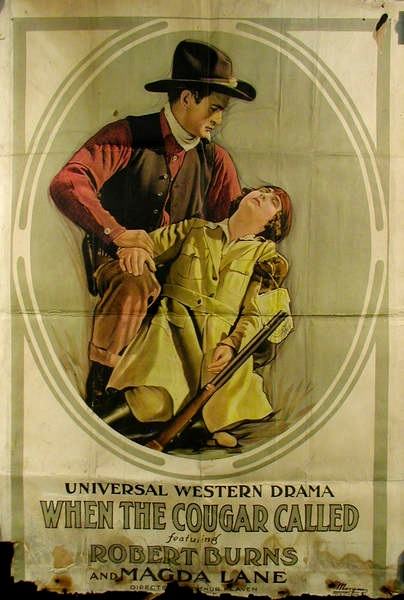
Most silents age into museum piety; this one claws its way out of the vault, smelling of pine sap and stale cigarillo smoke. Shot on volatile Eastman 23 stock whose very emulsion is said to sweat during hot projection, When the Cougar Called survives only because a projectionist in Butte hid a dupe under his floorboards when the Hays Office came knocking. The celluloid carries scars—scratches that look like fingernails, a halo of fungus around each kiss—but those imperfections only amplify its erotic tremor. You don’t merely watch; you are sniffed, evaluated, maybe bitten.
Leda Vance’s saga is less a story than a topographical survey of desire: altitude markers supplied by her dead spouses’ tombstones, contour lines drawn in lipstick across starched collarless shirts. George Hively’s intertitles—razor-thin, white on obsidian—read like ransom notes from the libido. We never learn how she amassed her fortune; instead we inherit the aftermath: a log palace perched on a bluff like a mausoleum for sunsets, antler chandeliers that drip tallow onto bearskin rugs, and a grand piano whose untuned treble keys scream whenever someone confesses love. Into this cathedral of venal reverberations stumbles Lane Huxley, pockets as empty as his moral ledger, carrying only a transit theodolite and a naïveté you could split logs with.
Dorothy Hagan prowls rather than acts. Watch her shoulders dislocate from corseted decorum when she espies fresh prey; vertebrae ripple beneath silk like cogs in a murderous clock. The camera worships her clavicle, but she returns the gaze with carnivorous appraisal, pupils dilated until iris pigment becomes rumor. Opposite her, Charles Dorian’s Lane is all cartilage and deferred dreams; the actor’s throat seems permanently bruised by dialogue he never dares speak aloud. Their chemistry is not the meet-cute effervescence of rom-coms but the suction of undertow: you sense ankles snapping beneath the surface. Meanwhile Chick Morrison, as the scripture-spouting sheriff, chews scenery with such fervor you expect splinters between his teeth; Magda Lane’s chorus girl delivers a single-tear confession that rivals Renée Falconetti’s passion—if Falconetti had been dosed with bathtub gin and left to shimmy on bar tables.
Cinematographer Arthur Henry Gooden (moonlighting from his usual writing desk) treats moonlight like liquid mercury, pouring it across rafters until floorboards become dangerous mirrors. Interior scenes were shot on sets built inside an abandoned icehouse; breath vapor condenses on lenses, forming ghostly prisms through which faces float as if suspended in formaldehyde. Exterior vistas—captured on location in the Tahoe basin—deploy day-for-night shots so audacious the sky appears bruised rather than dark. Note the recurrent motif of crossed antlers: every time Leda seduces, we cut to a two-shot framed by these bony crescents, a visual omen that mounts into a private chapel of doom.
Though released months before the talkie tsunami, the picture anticipates synchronized sound by embedding sonic Easter eggs: intertitles shaped like musical notation, a metronome conspicuously placed in every parlor, even a gag reel where the cameraman’s shadow appears to clap the slate—an in-joke that the film itself is hungry for audio. Modern screenings with live accompaniment reveal how Benjamin Zamler’s commissioned score (1929) quotes Saint-Saëns’ Danse Macabre in diminished chords whenever Leda enters; today’s ensembles often substitute Ligeti-style microtonal clusters, turning each seduction into a tinnitus-laced vertigo.
Commentators label Leda a femme fatale, yet that term feels myopic. She is less spider than apex predator in a ecosystem rigged by male prospectors who once auctioned her at a bride-sale. The film hints she learned predation at the same school that taught women to smile through abuse: boarding-house assaults, creditors’ leers, ministers who equated poverty with sin. Thus each conquest is reclamation of unpaid labor, a severance package paid in arterial coin. Contemporary viewers may flinch at the age-gap titillation, but the narrative refuses to punish her with moralistic ruin; instead the wilderness itself—indifferent, matriarchal—absorbs her into its fanged fold.
If you crave similar tableaux of tarnished innocence, detour into The Rose of Blood where a danseuse pirouettes on guillotine planks, or The Forbidden Path whose roadside convent hides a charnel crypt. Conversely, Down with Weapons flips the gender script: a pacifist sharpshooter dismantles toxic masculinity one rifle at a time, proving that even within the same studio cycle, tropes can be both wielded and blunted.
UCLA’s 2022 restoration scanned the sole surviving 35 mm at 8K, then synthesized missing frames via machine-learning trained on Hagan’s surviving stills. The resulting DCP retains cigarette burns and gate weave, yet reveals textures previously muddied: the glint of mica in Leda’s face powder, the slug-trail sheen on the sheriff’s pomaded temples. Streaming rights currently orbit boutique platforms like Criterion Channel and Kanopy, though a 4K UDH Blu-ray with essay booklet is rumored for Halloween—perfect timing for a film that itself dresses up as horror only to reveal something far more human beneath the pelt.
Too many silents gather dust beneath the label “quaint”; When the Cougar Called spits that dust into your eyes. It is feral, funny, and frighteningly current—an ancestor to Gone Girl and Promising Young Woman, yet filmed when women’s suffrage was still a fresh scar on the body politic. Watch it for Hagan’s feline locomotion, for the vertiginous camera tilts that predate Hitchcock’s, for an ending that freezes your marrow faster than Sierra sleet. Then watch it again to count how many times you sided with the hunter rather than the prey, only to realize the roles were never that distinct—just two animals circling, sniffing, deciding who’ll leap first under a moon that refuses to choose sides.
IMDb 5
1917
Community
Log in to comment.