DbcultAccessing Vault...
Cult Review
Senior Film Conservator
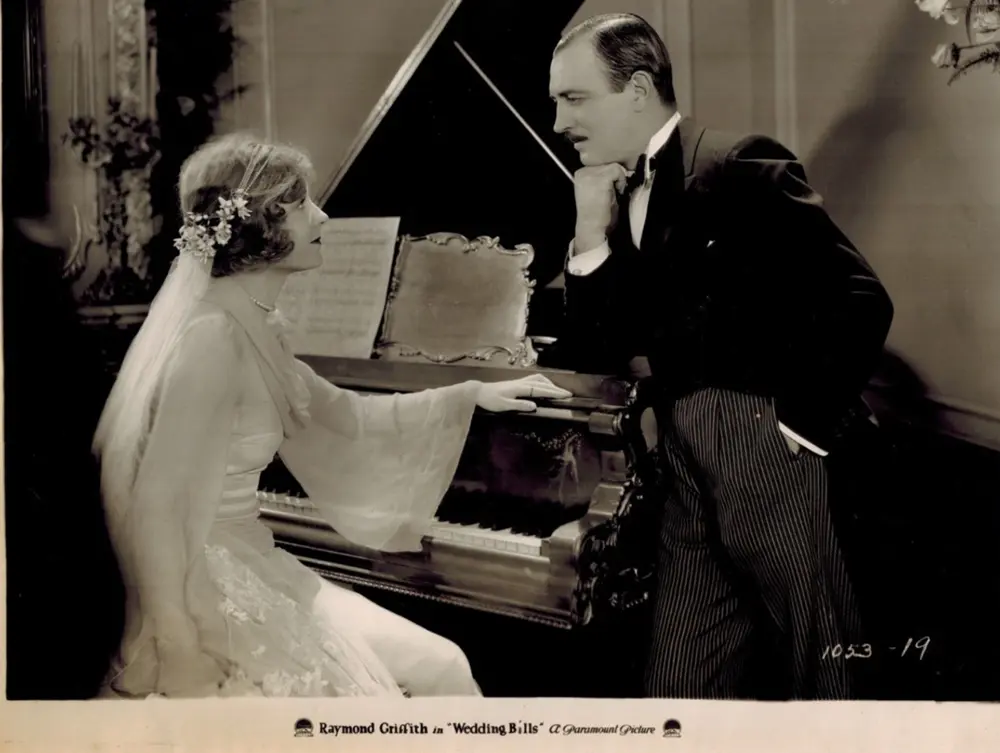
Is Wedding Bill$ a forgotten masterpiece of the silent era? Short answer: Yes, but only if you appreciate the mechanical precision of 1920s slapstick over narrative depth.
This film is specifically for fans of the 'Silk Hat' brand of comedy—those who enjoy seeing a dapper protagonist maintain his cool while the world collapses around him. It is absolutely not for viewers who demand logic or character-driven drama, as the entire plot hinges on the impossible behavior of a single pigeon.
1) This film works because Raymond Griffith’s unflappable persona provides a perfect comedic foil to the sheer absurdity of the premise, creating a unique 'dandified' tension.
2) This film fails because the central conceit—a bird stealing a bracelet—is stretched to its absolute breaking point, resulting in a middle act that feels slightly repetitive despite its short runtime.
3) You should watch it if you want to see a masterclass in situational geometry and physical timing that rivals the best work of Buster Keaton or Harold Lloyd.
Raymond Griffith is often the forgotten fourth man in the silent comedy pantheon, trailing behind Chaplin, Keaton, and Lloyd. In Wedding Bill$, it becomes abundantly clear why he deserves a seat at that table. Unlike the tramp or the stone-faced acrobat, Griffith is the sophisticated everyman. He wears a tuxedo not as a costume, but as a skin. His performance here is a study in restrained panic. When the pigeon first snatches the $25,000 bracelet, Griffith doesn't descend into wild flailing. Instead, he reacts with a calculated, high-society desperation that is infinitely funnier.
One specific scene highlights this perfectly: the moment in the jewelry shop where he is coerced into taking the bracelet. The way Griffith eyes the jewelry—not with greed, but with a premonition of doom—sets the stage for everything that follows. It is a subtle piece of acting that anchors the later, more bombastic stunts. Compared to the broader humor found in Three Wise Goofs, Griffith’s approach is surgical. He doesn't just fall; he falls with style.
The use of an animal as the primary antagonist is a bold choice that pays off in Wedding Bill$. Most comedies of the era relied on a 'heavy' or a rival suitor to provide conflict. Here, the antagonist is nature itself—unpredictable, flighty, and entirely indifferent to human social structures. The pigeon isn't a villain; it’s a chaotic force. This elevates the film from a standard chase movie to something almost existential. How does a man in a top hat negotiate with a bird?
The chase sequences are choreographed with a geometric precision that defines the best of 1920s cinema. There is a moment where Griffith is navigating a series of rooftops that feels like a precursor to the high-altitude thrills of modern action cinema. The cinematography, while standard for the time, makes excellent use of verticality. We see the city not as a collection of streets, but as a playground of levels. The bird is always just out of reach, a literal MacGuffin with wings.
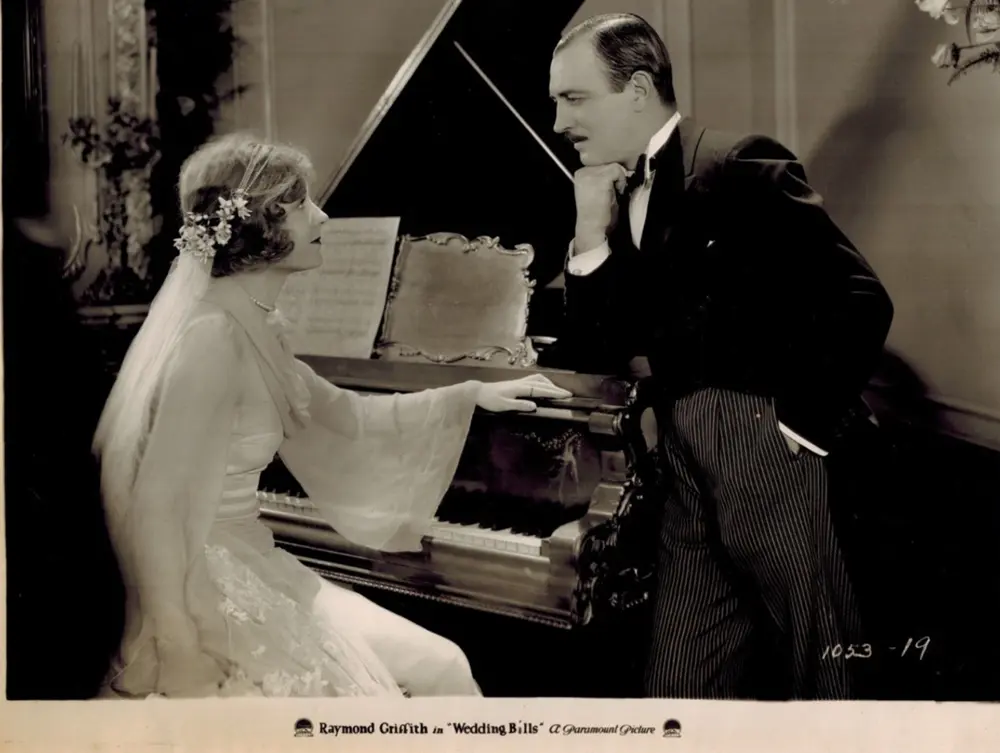
While Griffith is the star, the supporting cast is a 'who's who' of silent era character actors. Edgar Kennedy, the master of the 'slow burn,' is utilized here with devastating effect. His frustration acts as the audience's surrogate, providing a grounded contrast to Griffith's kinetic energy. Vivien Oakland and Anne Sheridan provide the necessary high-society window dressing, but it is the interaction between Griffith and the various authority figures—like the skeptical jeweler played by Paul Porcasi—that provides the film's funniest beats.
The writing team, including the prolific Grover Jones and George Marion Jr., understood that the key to a good gag is the setup. Every obstacle Griffith faces is a direct result of his attempt to remain 'proper.' If he had just shouted for help, the movie would be over in ten minutes. But his need to keep the loss a secret—to protect his best man status—is what fuels the comedy. It’s a classic trope, but executed here with a freshness that modern comedies often lack. It reminds me of the social pressures explored in The Marriage Speculation, though Wedding Bill$ trades social commentary for pure adrenaline.
Is Wedding Bill$ worth watching today? Yes. If you are looking for a fast-paced, 60-minute burst of creative energy, this film delivers. It serves as a perfect entry point for those curious about Raymond Griffith’s work. The film manages to be both a relic of its time and a timeless example of visual storytelling. You don't need intertitles to understand the stakes; the sight of a man chasing a bird for a fortune is a universal language.
However, it is not a 'deep' film. If you are looking for the emotional resonance of Ingeborg Holm or the epic scope of The Fighting Trail, you will be disappointed. This is a popcorn movie from a time before popcorn was a cinema staple. It is light, airy, and occasionally brilliant. It works. But it’s flawed in its simplicity.
The pacing of Wedding Bill$ is its greatest asset. From the moment the pigeon appears, the film rarely stops to catch its breath. This is a stark contrast to many silents that suffer from 'middle-reel sag.' The directors (and writers) keep the stakes escalating. First, it’s just about the bracelet. Then it’s about the wedding. Then it’s about his reputation. By the final act, it feels like the fate of the world rests on that bird.
The cinematography captures the urban landscape of 1927 with a clarity that is often lost in surviving prints of this era. The use of real locations adds a grit to the comedy that studio sets can't replicate. When Griffith is dangling or climbing, you feel the height. It’s a visceral experience that complements the humor. It lacks the stylized beauty of Paradise Garden, but it replaces it with a raw, kinetic energy that is infectious.
Pros:
- Incredible physical performance by Raymond Griffith.
- Short, punchy runtime with no wasted frames.
- Genuinely creative use of a non-human antagonist.
- High production values for a 1920s comedy.
Cons:
- The plot is paper-thin and relies heavily on coincidence.
- Some of the 'society' scenes at the start feel slow compared to the chase.
- Secondary characters are mostly archetypes with little development.
Wedding Bill$ is a gem that deserves to be polished and shown more often. While it may not have the heart of Chaplin or the philosophical depth of Keaton, it possesses a unique, sophisticated wit that is entirely its own. Raymond Griffith is a revelation, a comedian who understood that the funniest thing in the world is a man trying to look dignified while his life is being ruined by a pigeon. It is a loud, silent riot. It is fast. It is funny. It is a reminder that sometimes, the best movies are the ones that simply try to make you laugh for an hour and succeed with flying colors.
IMDb 5.2
1914
Community
Log in to comment.