DbcultAccessing Vault...
Cult Review
Senior Film Conservator
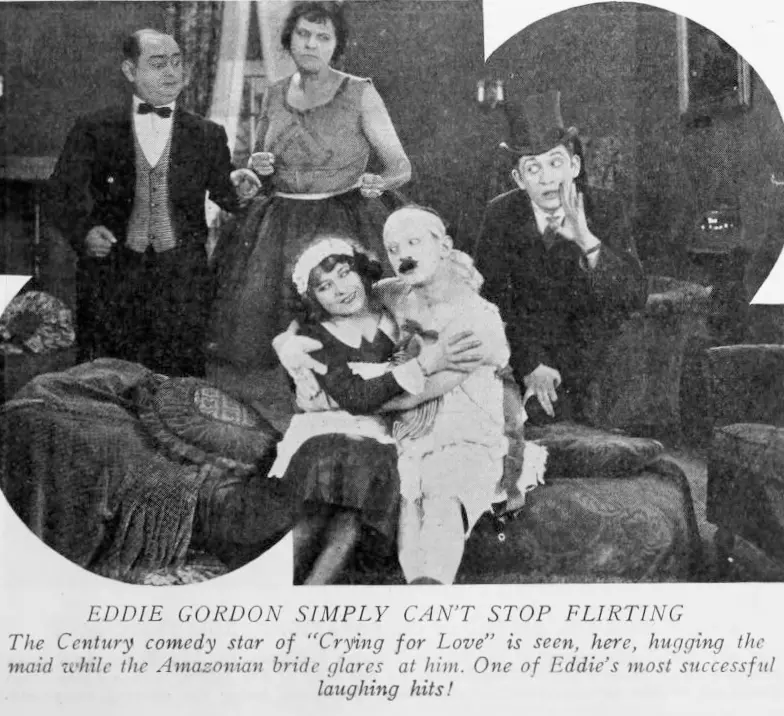
In the pantheon of silent-era slapstick, few films capture the raw, unadulterated chaos of domestic negotiation quite like Noel M. Smith’s 1923 curiosity, Crying for Love. This isn't merely a comedy of errors; it is a kinetic exploration of power, stature, and the absurdity of the early 20th-century marriage market. At the heart of this storm is Blanche Payson, a performer whose physical presence alone dictates the gravity of every scene she inhabits. Unlike the delicate heroines found in Youth's Endearing Charm, Payson’s Amazonian bride is a force of nature, a woman who doesn't just enter a room—she colonizes it.
The film opens with Eddie, played with a frantic, wiry energy by Pete Gordon, navigating a series of rejections that would break a lesser man. His persistence is framed not as romantic nobility, but as a desperate gambit in a world where men are frequently dwarfed by the circumstances of their own making. When the wedding finally occurs, it is not born of a mutual meeting of souls, but of a vengeful impulse. The bride’s discovery of her previous fiancé’s dalliance with a flapper—that quintessential symbol of 1920s rebellion—sets the stage for a matrimonial union forged in the fires of spite. This narrative pivot is handled with a sharpness that recalls the darker undertones of Don't Tell Everything, yet Smith opts for the visceral over the psychological.
Once the vows are exchanged, the film descends into a masterclass of slapstick choreography. The wedding reception becomes a battlefield where the bride flattens everyone in sight. There is no moral justification for her violence; it is a pure expression of her physical superiority. This sequence serves as a stark contrast to the more structured melodrama of Fesseln, where the constraints are social rather than physical. Here, the constraints are literal—arms, legs, and bodies being tossed aside like chaff. The use of space in these scenes is claustrophobic, heightening the impact of every blow and tumble.
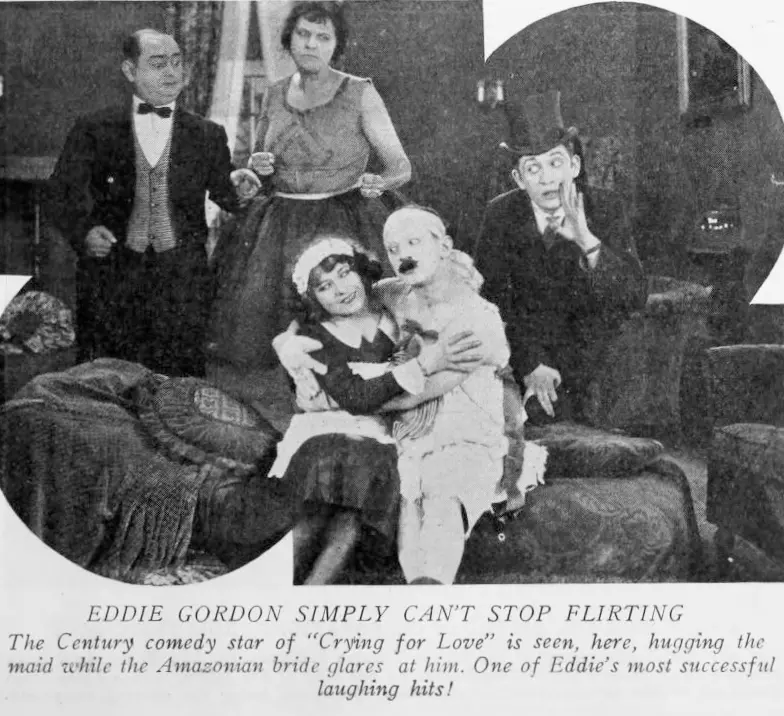
The honeymoon sequence, involving the iconic 'flivver,' is perhaps the film’s most enduring image. As the vehicle rattles along, the bride’s 'playful' ejection of her husband onto the dusty road serves as a metaphor for Eddie’s entire existence. He is a passenger in his own life, subject to the whims of a woman who operates outside the traditional feminine tropes of the era. This subversion of the 'dainty bride' archetype is handled with a comedic brutality that feels surprisingly modern. While The Colleen Bawn might lean into the romanticized struggle of the Irish maiden, Crying for Love leans into the sheer terror of a husband who has realized he is no longer the master of his domain.
The second act shifts the setting to a housewarming party, a social ritual designed to display domestic bliss. Instead, it becomes a theater of humiliation for Eddie. The social pressure of the gathering amplifies his inadequacy, a theme explored with more gravitas in A Man of Sorrow, but here it is played for laughs that have a distinctly sharp edge. The bride’s public belittling of her husband is relentless, creating a tension that demands a spectacular release.
That release comes in the form of 'strength-giving pills.' This plot device is a fascinating artifact of the 1920s obsession with tonics, elixirs, and the burgeoning science of self-improvement. When Eddie swallows these pills, the film undergoes a tonal shift. He is no longer the victim; he becomes a caricature of hyper-masculinity. The ensuing confrontation is not a reconciliation but a counter-revolution. The 'real boss' of the household is established through a display of force that culminates in the bride taking a three-story dive through a window. This ending is jarring, even by the standards of 1920s slapstick. It lacks the whimsical resolution of In the Knicker Time, opting instead for a definitive, violent reassertion of the status quo.
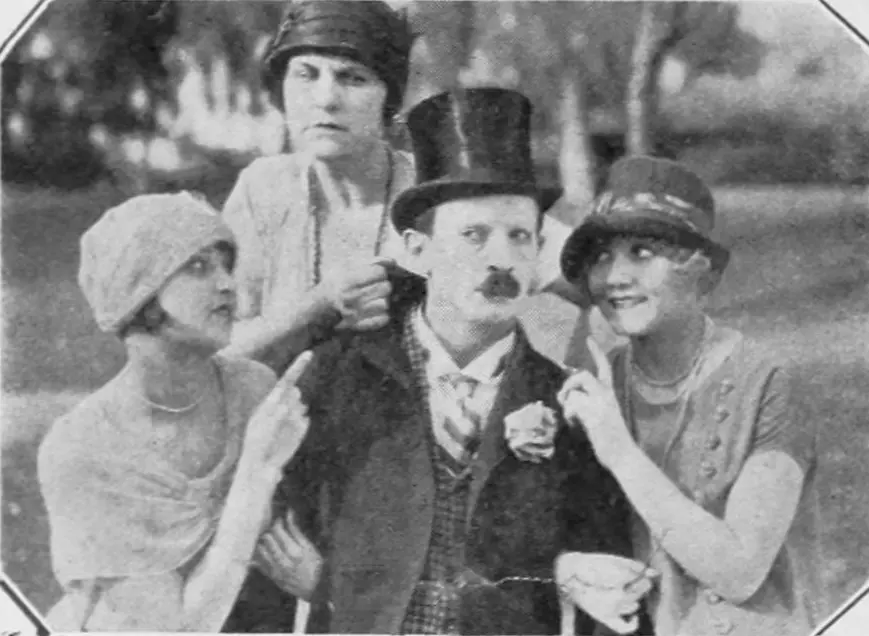
Analyzing Crying for Love requires us to look at the broader landscape of silent cinema. The physicality of Pete Gordon and Blanche Payson shares a DNA with the performers in King of the Circus, where the body is the primary tool of storytelling. However, while the circus film uses the body for spectacle, Smith uses it for social commentary—however crude that commentary might be. There is a sense of urban anxiety here that is absent from the pastoral settings of As a Woman Sows or the rugged landscapes of The Love Brand.
The film’s pacing is relentless, a hallmark of Noel M. Smith’s direction. He doesn't linger on the pathos of the situation. Instead, he maintains a rhythmic intensity that mirrors the mechanical vibrations of the flivver itself. This speed is what prevents the film from becoming a domestic tragedy. The audience is never given enough time to empathize with the characters' bruises; they are too busy anticipating the next collision. This approach is diametrically opposed to the mystery and slow-burn tension found in The Infamous Miss Revell or the shadowy atmosphere of The Doom of Darkness.
Visually, Crying for Love is a product of its time, but it utilizes the limitations of the medium to its advantage. The cinematography focuses on wide shots that allow the full scale of Blanche Payson’s stature to be felt. When she stands over Pete Gordon, the height difference is framed to emphasize a total power imbalance. The intertitles are sparse, allowing the physical performances to carry the narrative weight—a necessity when dealing with such a visceral plot. This reliance on visual storytelling is reminiscent of the efficiency seen in The Book Agent or the frantic chases of Blue Blazes.
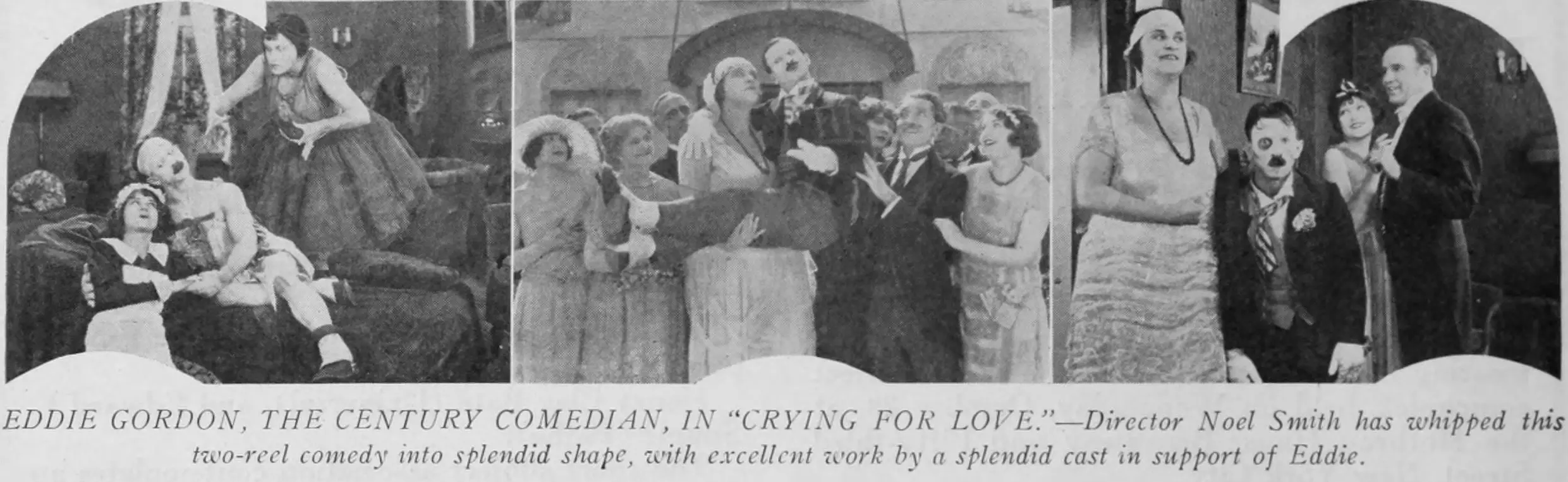
The set design of the housewarming party is particularly noteworthy. It provides a structured, multi-level environment that Smith exploits for vertical comedy. The three-story dive is not just a stunt; it is the logical conclusion of a film that has spent its entire runtime building a hierarchy of physical space. The fall represents the ultimate displacement. In the world of It Happened in Paris, such a fall might be a moment of high drama, but here, it is the punchline to a long, violent joke.
To understand the impact of Crying for Love, one must consider the cultural climate of 1923. The 'New Woman' was emerging, and with her came a wave of male anxiety that permeated popular media. Blanche Payson’s character is a grotesque exaggeration of this shift—a woman who doesn't just want the vote, but wants to physically dominate the household. The resolution of the film, where Eddie uses a pill to reclaim his authority, is a revealing look at how the era attempted to 'fix' the perceived imbalance of gender power. It is as much a social document as it is a comedy, echoing the themes of identity and theft found in Der Mann ohne Namen - 1. Der Millionendieb, albeit in a much more literal and bone-crunching fashion.
The performance of Pete Gordon should not be overlooked. While Payson provides the power, Gordon provides the elasticity. His ability to take a fall and sell the physical impact of his wife’s 'playfulness' is what makes the comedy work. Without his vulnerability, Payson would simply be a bully; with it, they become a comedic duo of mismatched proportions. Their chemistry is a dark reflection of the romantic pairings of the era, offering a cynical but hilarious take on the 'happily ever after' trope.
Crying for Love remains a fascinating, if somewhat brutal, relic of the silent era. It is a film that refuses to play by the rules of polite society, opting instead for a raw, slapstick energy that is both exhausting and exhilarating. Noel M. Smith’s direction ensures that the film never loses its momentum, even as it navigates the treacherous waters of domestic conflict. For fans of silent comedy, it offers a unique opportunity to see Blanche Payson at the height of her powers, delivering a performance that is as imposing as it is unforgettable. It is a loud, chaotic, and ultimately triumphant piece of cinema that proves that sometimes, the only way to resolve a matrimonial dispute is through a well-timed pharmaceutical boost and a very high window.
In the end, we are left with a film that is as much about the fragility of the ego as it is about the strength of the body. Whether Eddie is truly the 'boss' at the end is up for debate, but the journey to that window is one of the most entertaining rides in 1920s slapstick. It stands as a testament to the power of physical comedy to explore our deepest anxieties and most absurd desires, all while keeping us laughing at the sheer, beautiful violence of it all.
IMDb 6
1916
Community
Log in to comment.