DbcultAccessing Vault...
Cult Review
Senior Film Conservator
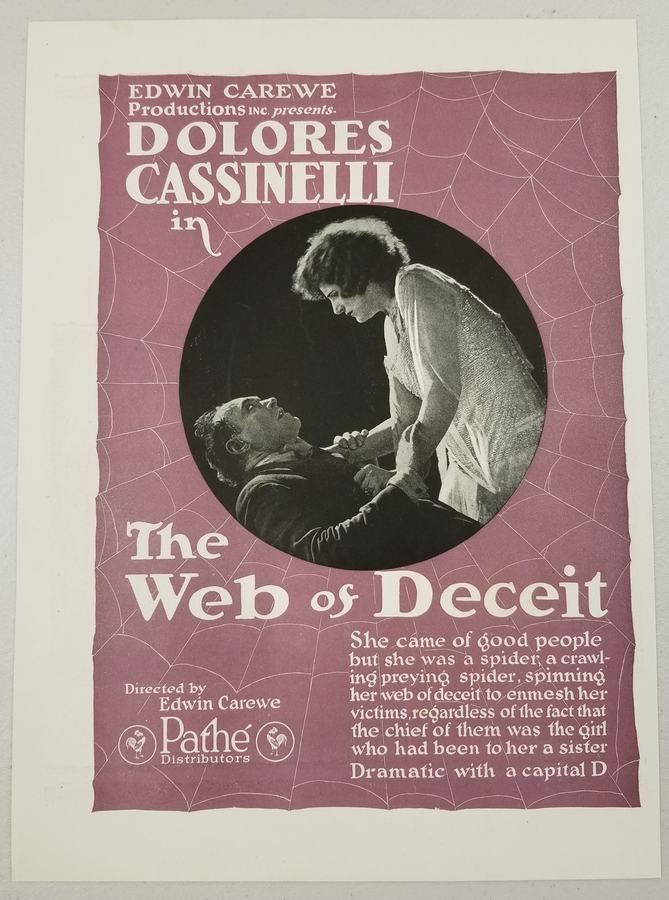
Coolidge Streeter and Finis Fox weave The Web of Deceit like a fever dream stitched from gun-smoke and genealogy. From the first amber-tinted frame, Wanda Hubbard’s silhouette—fedora tilted, jaw clenched—cuts through urban fog as though the city itself were an accomplice to her larceny. The directors refuse exposition; instead, they let the metallic scrape of a safe’s tumblers narrate her résumé. It’s 1917, but the moral grime feels centuries older, predating even the gaslamps that flicker in the rear-window of her escape cab.
When the law clamps down during the Clark heist, cinematographer Hugh Cameron pivots his boxy Bell & Howell into the getaway carriage, staging the chase through reflections in a brass mirror. The result is a double-image—Wanda both inside and outside the law’s gaze—foreshadowing the doppelgänger motif that will soon metastasize into full-blown identity piracy. Red Smith’s lanky frame intrudes like a specter of frontier justice; his promise to wed Wanda upon return from Arizona sounds less like betrothal than a death warrant, sealed under distant mesas.
The rural interlude arrives with a sonic vacuum—even without spoken dialogue, the absence of city din is deafening. The Hubbard homestead, all clapboard and faded calico, is filmed at magic-hour so that every splinter glows like a cautionary ember. Mother Hubbard’s fatal tumble down the staircase is rendered in an unbroken take; the camera looms at the landing while her body folds against gravity, a paper doll in a cruel child’s fist. Her deathbed confession—whispered through a veil of arterial red—detonates the plot: Lucille is not daughter but niece, sired by none other than Major Clark, the very man Wanda tried to rob. The irony is Shakespearean, yet delivered with the blunt force of a pulp novelette.
What follows is a transmutation of guilt into ambition. Wanda sheds her city-plumage, dons virginal white, and descends upon New York’s elite under the forged halo of Clark’s lost progeny. Streeter’s script barrels forward with the momentum of a runaway hearse, yet Fox’s intertitles—laconic, sardonic—inject an acidic humor. “A daughter restored is a fortune doubled,” one card reads, as Wanda glides into a drawing room where chandeliers drip like stalactites of assumed privilege.
Roger Burney, Clark’s porcelain protégé, enters as both love interest and unwitting audit of Wanda’s con. Portrayed by an impeccably pomaded Mitchell Harris, Roger is less a man than a barometer of social temperature; when he shifts affection from Wanda to the newly arrived Lucille, the emotional barometric drop chills the film’s tone from tawdry melodrama to ice-pick noir. Lucille herself—Lettie Ford channeling Lillian Gish by way of prairie sainthood—glides through the narrative like a corrective moral agent, yet the camera refuses to sanctify her entirely; a subtle smirk at the corner of her mouth hints she understands the power vested by legitimacy.
Jealousy combusts in a bravura sequence inside Clark’s portrait gallery. Oil likenesses of ancestors glare down like inquisitors while Wanda, draped in jet-black taffeta, slashes the canvas of Clark’s late wife. The rupture is both vandalism and exorcism; the tear spews centuries of ancestral dust that swirls through the projector beam like malevolent spores. Critics often cite A Mother’s Ordeal for maternal angst, but none of its domestic skirmets match the savage intimacy of this moment—an act that annihilates matriarchal memory to secure fraudulent lineage.
Red’s reappearance, bandanna soaked in sweat and vengeance, tightens the narrative garrote. The showdown transpires not on a dusty street but within a mirrored corridor—each muzzle-flash multiplies into infinity, a mise-en-abyme of guilt. Wanda’s death throe is captured in silhouette: her body folds, knees kissing parquet, while Red’s confession gushes forth like lanced infection. “She ain’t your blood,” he rasps to Clark, and the line lands with the thud of a notary’s stamp on a forged deed. Red survives just long enough to witness Lucille’s tearful embrace with her true father, a tableau recalling the closing pietà of Helene of the North, though here redemption is purchased not through Arctic sacrifice but urban bloodletting.
Visually, the film’s palette oscillates between two registers: umber gaslight for the city sequences, bleached cerulean for rural vistas—a chromatic shorthand for moral temperature. The tinting is hand-done, occasionally misaligned, producing halos around lanterns that feel spectral rather than slipshod. Compare this to the monochrome austerity of As a Man Thinks; where that film trusts shadow, The Web of Deceit weaponizes color as emotional semaphore.
Performances operate at an exquisitely calibrated hysteria. Dolores Cassinelli’s Wanda never tips into moustache-twirling villainy; her gaze carries the weary knowledge that every theft is merely a loan from fate’s repo man. Opposite her, Franklyn Hanna’s Clark is a study in imperial fatigue—epaulettes immaculate, eyes bagged with the sleeplessness of empire. Their final clinch, once truth outs, is filmed in medium-close-up, the camera lingering until the embrace slackens from rapture into something resembling resignation, a nod to the cyclical ache of family.
The screenplay’s narrative density rivals that of Syndig Kærlighed, yet its pacing is more agile, sprinting across reels like a pickpocket threading a marketplace. Intertitles eschew Victorian prolixity for hardboiled zingers. “Blood tells—sometimes it screams,” flashes across a black screen seconds before Red’s confession, a line that could swagger into a Chandler novel without apology.
Fox’s editorial grammar deserves special mention. He favors axial cuts rather than cross-cutting, creating a staccato pressure that makes 58 minutes feel like a binge of serialized cliffhangers. The funeral sequence, for instance, interlaces casket-side hymns with Red’s nocturnal approach to the homestead; instead of parallel rhythm generating suspense, the alternation produces a contrapuntal grief, as though mourning and menace were harmonics of the same chord.
Scholars often slot The Web of Deceit alongside other proto-noirs of the late teens, yet its DNA splices strands from disparate lineages: the domestic gothic of Alias Mary Brown, the frontier fatalism of The Spell of the Yukon, even the ethnographic curiosity of The Capture of a Sea Elephant. The resultant hybrid is a film that feels both hermetically sealed in its era and eerily predictive of 1940s woman’s-picture tropes—identity masquerades, murder as social mobility, the punitive erasure of sexually transgressive women.
Yet modern viewers, weaned on twist-crazy neo-noirs, might sniff out the “twist” of Lucille’s parentage early. What surprises is not the revelation but the film’s refusal to indulge in restorative fantasy. Clark’s acceptance of Lucille is tinged with melancholy rather than triumph; the final iris-in closes on her tear-streaked smile, not on a wedding veil. Love wins, but only after accounting for the corpse on the parquet. This ethical bookkeeping aligns the film with the bitter arithmetic of Up from the Depths, where survival often demands collateral souls.
Contemporary resonance? Identity theft now transpires in silicon rather than salons, yet the hunger for pedigree—blue-check verification, ancestral DNA kits—makes Wanda’s scam feel prophetic. Her willingness to murder memory for status prefigures today’s curated Instagram bloodlines. Meanwhile, the film’s interrogation of maternity—biological vs. nurtural—presages debates over surrogacy, CRISPR babies, and the commodification of lineage.
Restoration efforts by the Library of Congress in 2019 salvaged a 35mm nitrate print from a Montana barn, its emulsion blistered like burnt toast. Digital 4K scanning revealed textures previously smothered: the serifed emboss on Clark’s military commissions, the frayed cuff of Wanda’s glove twitching mid-escape. Such minutiae enrich the class critique; fraud, the film whispers, is stitched from details—one misaligned cuff can unravel an empire of lies.
In the end, The Web of Deceit endures because it understands that family is the original shell game: now you see your kin, now you don’t. Its cautionary pulse beats beneath every modern parable of reinvention, from Wo ein Wille, ist ein Weg to the tabloid sagas of faux-heiresses. To watch it is to confront the uncomfortable calculus that identity—like cash in a cracked safe—belongs to whoever has the nerve to claim it, at least until the bullets find their mark and the mirrors shatter into inconvenient truths.

IMDb —
1927
Community
Log in to comment.