DbcultAccessing Vault...
4.7/10
Senior Film Conservator
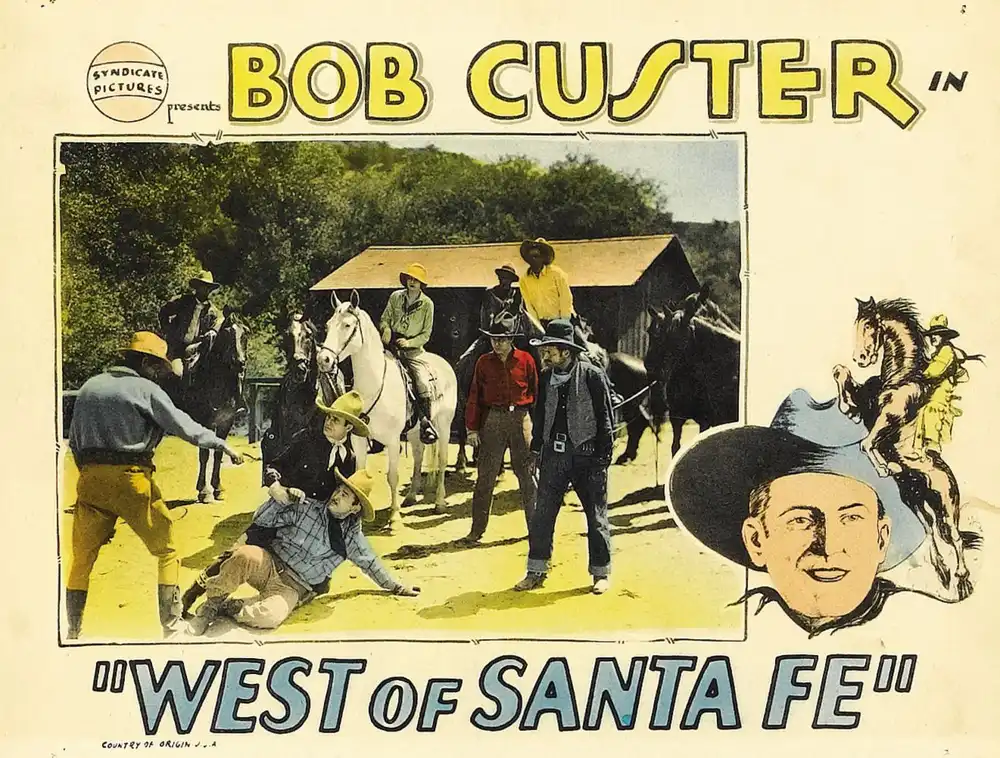
A definitive 4.7/10 rating for a film that redefined the boundaries of cult cinema. West of Santa Fe remains a cornerstone of transgressive art.
If you are looking for a lost masterpiece of the silent era, West of Santa Fe is not it. However, if you have an hour to kill and a specific craving for the unpolished, rough-and-tumble energy of 1920s Poverty Row Westerns, this film is a perfectly functional artifact. It is worth watching for silent film completists and those who enjoy seeing the evolution of the American stuntman, but general audiences will likely find its plotting paper-thin and its performances varying between wooden and wildly over-the-top.
The film operates on a classic B-movie trope: the imposter. We are introduced to a man claiming to be Major Seabury, an Army official tasked with buying horses. He’s a suspicious character from the jump, mostly because he looks far too comfortable whispering in corners with the ranch foreman, Bull (Bud Osborne). The plot doesn't try to play this as a mystery for the audience; we know these guys are up to no good within the first ten minutes. The real tension—if you can call it that—comes from Jack (Bob Custer), a neighboring rancher who manages to stumble upon the actual Major being held in a shack.
The narrative moves with a brisk, almost impatient rhythm. There isn't much time for character development. We don't really learn why Jack is so invested in the ranch's affairs beyond the fact that he’s the hero and Helen (Peggy Montgomery) is the damsel. Compared to more sophisticated silents of the era, like the later The Cowboy and the Lady, the storytelling here is primitive. It relies heavily on intertitles to explain complex financial fraud that the visuals can't quite convey.
Bob Custer was never known for his range as an actor, and West of Santa Fe doesn't ask him to do much more than look stern and ride fast. There is a certain stiffness to his posture in the dialogue scenes—he often stands with his chest puffed out like he’s posing for a lobby card. But once he’s on a horse, he becomes a different performer. The stunt work is the film's strongest suit. There is a specific chase sequence through a rocky ravine where the camera is mounted low to the ground, capturing the genuine danger of the terrain. You can see the dust kicking up into the actors' eyes; there is no artifice here, just men and horses moving at high speeds over uneven ground.
Bud Osborne, playing the villainous Bull, is the most entertaining person on screen. He has a way of sneering that feels genuinely menacing, even without sound. His chemistry with the imposter Major is one of the few highlights; they share a few moments of conspiratorial whispering that feel more lived-in than the romantic subplots. Peggy Montgomery, as Helen, is unfortunately given very little to do. She spends most of her screen time looking concerned or pouring coffee, a victim of the era’s limited writing for female leads in action shorts.
The cinematography is utilitarian. Most of the film is shot in broad daylight with very little use of shadow or composition to create mood. However, there are a few interesting choices. The director, Mack V. Wright, seems to have a fondness for long shots that show the vastness of the landscape, making the ranch feel isolated and vulnerable.
One specific detail that stands out—and not necessarily in a good way—is the editing during the final confrontation. There is a moment where Jack is fighting one of Bull’s henchmen, and the cut between the wide shot and the close-up is so jarring it feels like a frame is missing. It’s a reminder of the low-budget nature of these productions. The interiors are also clearly sets built with three walls and no ceilings, as the lighting is unnaturally flat and consistent regardless of where the windows are supposed to be.
The film’s climax is a predictable scramble of hooves and fists, but it’s executed with a sincerity that modern CGI-laden action lacks. There is something tactile about seeing a man actually fall off a moving horse into a pile of real dirt.
At roughly an hour, the film shouldn't feel long, but it occasionally drags during the middle act. There are several sequences of men riding from Point A to Point B that go on for about thirty seconds too long. It feels like padding to hit a specific reel length. If you’ve seen other B-Westerns like Crooked Alley, you’ll recognize the same pacing issues: a hot start, a sluggish middle filled with redundant conversations, and a frantic finish.
The "revelation" of the real Major is handled with zero subtlety. Jack finds him, they exchange a few exaggerated gestures, and suddenly they are best friends. It’s a leap in logic that you just have to accept to enjoy the ride. The film doesn't care about the psychological impact of being kidnapped; it just wants to get back to the horse vouchers.
West of Santa Fe is a blue-collar Western. It was made to entertain rural audiences in 1928 for a nickel, and it wears its low-budget origins on its sleeve. It lacks the visual poetry of a John Ford silent or the charisma of a Tom Mix picture, but it possesses a certain grit.
Who is it for? Silent film historians, fans of early 20th-century stunt work, and anyone who finds comfort in the predictable tropes of the Old West.
Who will dislike it? Anyone expecting a deep plot, nuanced acting, or high production values. If you can't stand the flickering, unrefined look of 1920s B-movies, this will be a chore.
Ultimately, it’s a forgettable but pleasant diversion. It’s the cinematic equivalent of a dusty paperback found in a ranch house—worn at the edges, simple in its morality, but capable of delivering a few genuine thrills before the final fade-out.
IMDb —
1924
Community
Log in to comment.