DbcultAccessing Vault...
Cult Review
Senior Film Conservator

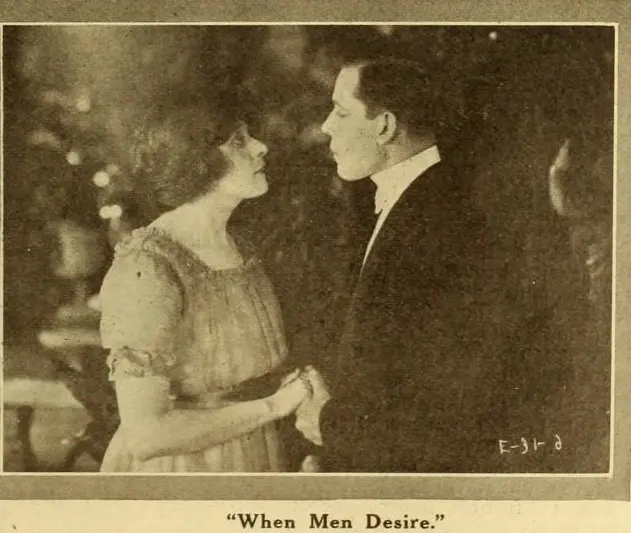
Ah, the silent era! A time when emotions were writ large across the screen, a canvas for grand gestures, melodramatic plights, and the undeniable magnetism of its stars. And among them, few shone with the incandescent, enigmatic glow of Theda Bara. In 'When Men Desire,' a title that itself whispers of intrigue and intense human longing, Bara takes center stage, delivering a performance that, even without the benefit of spoken dialogue, resonates with a potent, almost visceral energy. This isn't just a film; it's a window into a specific moment in cinematic history, a mirror reflecting the anxieties and romantic ideals of a world still reeling from conflict.
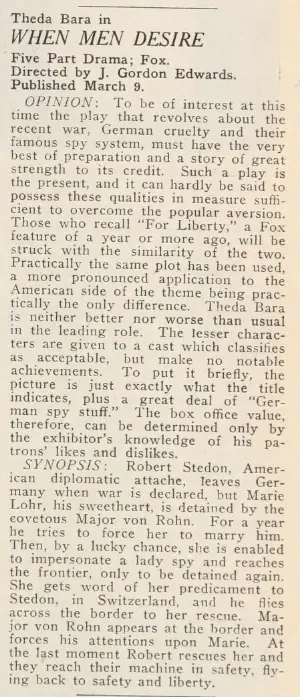
The premise, at its heart, is a timeless one: a desperate quest for reunion. Our protagonist, portrayed with captivating intensity by Bara, finds herself in the unenviable position of being detained in Germany during a period of international strife. Her freedom, her very existence, is overshadowed by the looming specter of war, but her spirit remains stubbornly fixed on a single, compelling objective: to escape the confines of her captivity and return to the arms of her American lover. It’s a narrative steeped in the kind of high-stakes romanticism that silent cinema excelled at, transforming a simple plot point into an epic struggle for love and liberty.
The genius of 'When Men Desire' lies not just in its dramatic tension but in its subtle exploration of the human psyche under duress. The writers, J. Searle Dawley, E. Lloyd Sheldon, and Adrian Johnson, craft a world where personal desires collide violently with geopolitical realities. It’s a testament to their storytelling prowess that they manage to imbue this seemingly straightforward escape plot with layers of emotional complexity. Bara’s character isn’t just a damsel in distress; she’s a woman of agency, driven by an inner fire that refuses to be extinguished by the grim circumstances surrounding her. Her determination becomes the engine of the film, pulling the audience along on a perilous journey where every shadow holds a potential threat, and every whispered hope is a fragile beacon.

Consider the socio-political backdrop of the time. The film was released in 1919, a period immediately following the Great War. The scars of conflict were fresh, and the notion of a woman, an American sympathizer perhaps, trapped in Germany, would have resonated profoundly with contemporary audiences. This context elevates the film from a mere melodrama to a commentary on the individual's struggle against the impersonal forces of war. The 'desire' in the title isn't solely romantic; it's also a desire for peace, for normalcy, for a world where love isn't complicated by national borders and political animosity. It’s a sentiment that echoes in other films of the era, like The Supreme Sacrifice, where personal devotion often becomes a casualty or a defiant act in the face of larger conflicts.
Theda Bara, of course, is the magnetic core around which this narrative orbits. Known as the original 'Vamp,' her screen persona was one of exotic allure, dangerous sensuality, and captivating mystique. Here, she channels that inherent power into a portrayal of resilience and vulnerability. Her eyes, often emphasized in silent film close-ups, would have conveyed volumes – the fear of capture, the steely resolve to escape, the ache of longing for her distant lover. It's a performance that transcends the theatricality often associated with silent acting, reaching for something deeper, more authentically human. She doesn’t just act; she embodies the very essence of desperate hope.
The supporting cast, G. Raymond Nye, Maude Hill, Florence Martin, Fleming Ward, and Edward Elkas, would have played crucial roles in building the world around Bara's character. Nye, likely portraying a German official or antagonist, would have provided the necessary foil to Bara's defiant spirit, his stern demeanor amplifying her plight. The others, perhaps fellow detainees, sympathetic figures, or agents of the state, would have filled out the intricate tapestry of her journey, each interaction a potential turning point in her fate. In silent films, every gesture, every facial expression, every subtle shift in posture was vital in conveying character and intent, and it's easy to imagine these actors contributing to the palpable tension and emotional depth of the story.

The escape itself, a central pillar of the plot, would have been a masterclass in silent film suspense. Imagine the dimly lit corridors, the furtive glances, the heart-pounding moments of near-discovery. The director, J. Searle Dawley, known for his work on numerous early films, would have employed all the visual tricks of the trade – cross-cutting between Bara's desperate attempts and perhaps the watchful eyes of her captors, using dramatic lighting to heighten the sense of danger, and employing a careful rhythm of quick cuts and lingering shots to control the audience's emotional response. This kind of cinematic craftsmanship is what made films like The Secret of the Storm Country so compelling, where environmental and human obstacles converge to create a powerful sense of impending doom and ultimate triumph.
The thematic resonance of 'When Men Desire' extends beyond mere romance. It delves into the nature of freedom itself. What does it mean to be truly free when the world is in chaos? Is freedom merely the absence of physical chains, or is it the ability to pursue one's deepest desires, unhindered by external forces? Bara’s character is a living embodiment of this philosophical struggle. Her desire for her American lover is inextricably linked to her desire for liberation, for a return to a life where personal happiness is not dictated by political borders. This intertwining of personal and political freedom makes the film surprisingly relevant even today, reminding us that even in the grandest conflicts, individual human stories of love and longing persist.
One cannot discuss silent film without acknowledging the crucial role of the audience's imagination. Without dialogue, viewers were invited to project their own understanding and emotional depth onto the screen. The intertitles provided the narrative framework, but the true emotional impact came from the actors' expressions, the director's visual storytelling, and the audience's active participation. In 'When Men Desire,' this imaginative engagement would have been particularly potent. Viewers would have felt the cold of the German detention, the fear of discovery, the warmth of the promised reunion, all through the powerful, non-verbal cues on screen. It's a unique form of storytelling, demanding a different kind of immersion, one that rewards keen observation and emotional empathy.
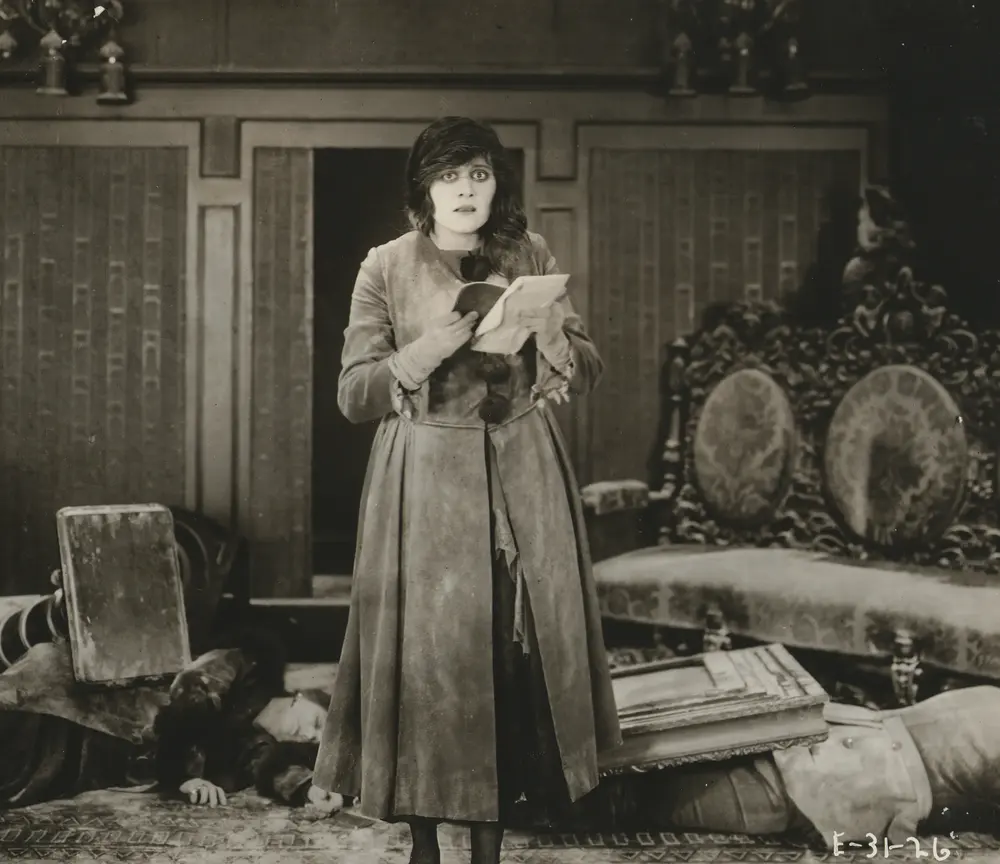
The title itself, 'When Men Desire,' is intriguing. It hints at the powerful, often dangerous, forces that drive human actions. Is it referring to the desire of the American lover for his beloved? Or perhaps the 'men' who desire to control, to wage war, thereby creating the very predicament our heroine finds herself in? Or does it speak to a more universal, almost primal urge – the desire for connection, for belonging, for a sense of purpose? The ambiguity adds a layer of intellectual richness to the film, inviting contemplation long after the final frame has flickered away. It reminds me of the complex motivations explored in films like A Million Bid, where the 'desire' for wealth or status often overshadows genuine human connection, leading to intricate dramatic entanglements.
The aesthetic of silent film, particularly in a dramatic piece like this, would have relied heavily on visual metaphors and symbolic imagery. A flickering candle in a dark room could represent fragile hope; a vast, empty landscape could symbolize isolation; a stormy sky, impending danger. These visual cues, combined with the emotive acting of Bara, would have painted a vivid picture of her internal and external struggles. The craftsmanship of the cinematographers and set designers, even if uncredited or forgotten by time, would have been paramount in creating this immersive, emotionally charged world. The attention to detail in conveying mood and atmosphere was a hallmark of the era, much like the intricate sets and costumes in Snow White, which, despite being a fantasy, still relied on visual storytelling to convey its emotional core.
Ultimately, 'When Men Desire' is more than just a historical artifact; it's a testament to the enduring power of human will and the unbreakable bonds of love. It’s a story that speaks to the universal yearning for freedom and connection, themes that resonate across generations and cinematic movements. Theda Bara, in her role, embodies this struggle with a fierce grace, her silent performance speaking volumes about courage, sacrifice, and the relentless pursuit of happiness against all odds. It's a reminder that even in an era of nascent filmmaking, the capacity for profound storytelling was already well-established, paving the way for the cinematic language we understand today.
The journey of our protagonist, from the oppressive confines of detention to the imagined embrace of her American lover, is a narrative arc that taps into fundamental human experiences. It’s a story of hope against despair, of individual agency against systemic oppression, and of the profound impact of personal relationships on our will to survive. The film doesn't shy away from the dangers inherent in her situation; indeed, it likely revels in them, building suspense through near-misses and desperate gambits. This tension, expertly crafted, would have kept audiences on the edge of their seats, rooting for Bara’s character with every silent, desperate breath.
Thinking about the craft of the film, one must consider the editing. In the silent era, editing was a rapidly evolving art form. J. Searle Dawley, as director, would have utilized techniques like parallel editing to show simultaneous events – perhaps the lover’s anxiety in America juxtaposed with the woman’s perilous escape in Germany. This would have amplified the emotional stakes, creating a sense of urgency and shared experience across continents. The pacing of these sequences would have been critical, accelerating during moments of high action and slowing down for poignant emotional beats, allowing Bara’s powerful expressions to land with maximum impact. Such techniques were crucial in building narratives in films like The Tidal Wave, where the impending disaster is often intercut with personal dramas to heighten the tension.
The influence of the 'vamp' persona on Bara's portrayal here is also worth noting. While her character is driven by love and a desire for freedom, her inherent screen charisma likely lent an air of dangerous allure to her escape. She wouldn't have been a meek victim but a resourceful, captivating figure, perhaps even using her charm or intelligence to outwit her captors. This blend of vulnerability and strength is what made Bara such a compelling star, and it's easy to imagine how 'When Men Desire' would have capitalized on this unique duality. Her performance likely transcended simple melodrama, elevating the character to an icon of feminine resilience in a turbulent world.
The ending, whether a triumphant reunion or a bittersweet sacrifice, would have cemented the film’s message. Given the era’s penchant for dramatic resolution, a reunion, hard-won and emotionally charged, seems probable. However, even if the escape were to end in tragedy, the film's core message – the indomitable power of human desire – would remain intact. It’s the journey, the struggle, the sheer force of will that truly defines the narrative, not just the destination. This focus on the journey and the internal battles is a hallmark of strong storytelling, whether in silent films or modern blockbusters.
In retrospect, 'When Men Desire' stands as a powerful example of silent cinema’s ability to weave intricate tales of human emotion against grand backdrops. It leverages the star power of Theda Bara, the writing talents of Dawley, Sheldon, and Johnson, and the universal appeal of love and freedom to create a memorable cinematic experience. Its relevance, even a century later, speaks to the timeless nature of its themes and the enduring human spirit it portrays. It’s a compelling reminder that the desire for connection, for liberty, and for a life unburdened by conflict, is a force that truly moves mountains, or in this case, helps a woman escape a wartime prison to find her way back to love.
The film, though perhaps not as widely remembered as some of Bara's other works, offers a fascinating glimpse into the nascent stages of cinematic storytelling and the profound impact it could achieve even without synchronized sound. It's a testament to the power of visual narrative, the eloquence of silent acting, and the universal resonance of themes like love, war, and the human will to survive. For those who appreciate the artistry of early cinema, 'When Men Desire' presents a compelling case study in the construction of high-stakes drama driven by deep personal yearning. It underscores that true desire, when potent enough, can indeed move the impossible.
And so, we are left with the lingering image of a woman, defiant and determined, navigating a world intent on crushing her spirit, all for the sake of a love that transcends borders and conflicts. It’s a narrative that continues to echo in our collective consciousness, reminding us that even in the darkest of times, the human heart, with its capacity for immense desire, remains an unyielding force. The film, in its silent grandeur, speaks volumes about the enduring strength of the individual against the tides of history, a theme beautifully explored in other period dramas like The Flower of No Man's Land, which also uses a wartime setting to amplify personal struggles and emotional stakes.
The meticulous planning required for such an escape, the subterfuge, the fear of discovery, the moments of sheer courage – all these elements would have been meticulously crafted to maximize audience engagement. The director would have utilized every tool in the silent film arsenal to convey the urgency and danger. From subtle hand gestures to wide, sweeping shots of the German landscape (or studio interpretations thereof), every visual choice would have been made to immerse the viewer in the character's desperate plight. It’s this attention to detail in conveying emotion and narrative through purely visual means that marks the true artistry of films like 'When Men Desire.'
The film's exploration of 'desire' is multifaceted. It's not just the woman's desire for her lover, but perhaps the lover's desire to rescue her, the captors' desire to maintain control, and even the broader societal desire for peace or victory. This interplay of various desires creates a rich tapestry of motivations, making the narrative more than just a simple love story. It becomes a commentary on the forces that drive human behavior, both noble and ignoble, in times of crisis. This complexity is what elevates silent films beyond mere entertainment, turning them into profound artistic statements that continue to resonate with modern audiences, much like the enduring appeal of stories involving profound longing and intricate relationships, even in fantastical settings such as The Patchwork Girl of Oz, where characters are driven by unique aspirations.
In every frame, one can almost feel the weight of the protagonist's longing, the palpable tension of her confinement, and the burning hope of her eventual freedom. 'When Men Desire' is a testament to the fact that even without spoken words, cinema possesses an unparalleled ability to communicate the deepest human emotions and the most thrilling narratives. It's a film that, through its compelling story and powerful performances, reminds us of the enduring human spirit and the timeless pursuit of love and liberty, making it a significant piece in the mosaic of early cinematic history.
IMDb 6.8
1927
Community
Log in to comment.