DbcultAccessing Vault...
Cult Review
Senior Film Conservator
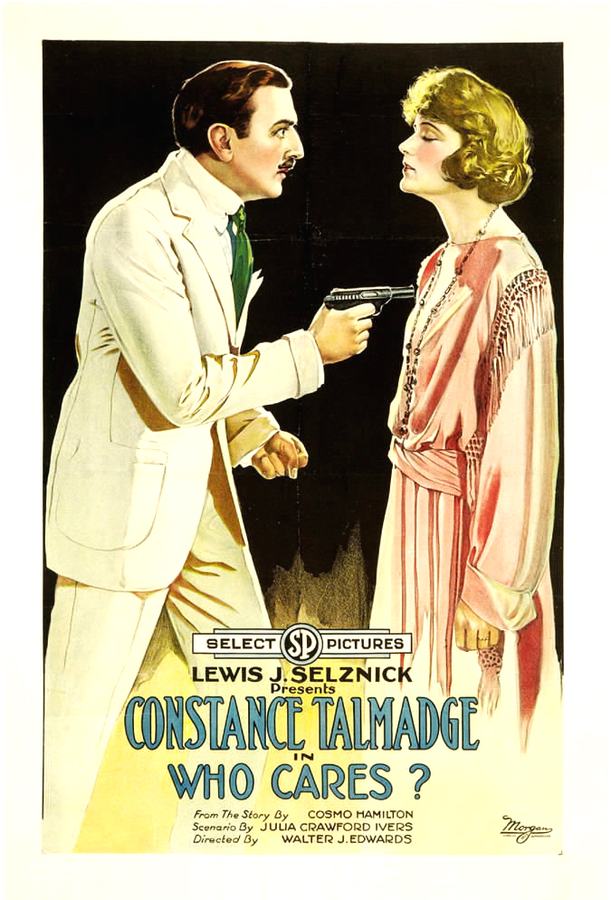
The year 1919 stood at a precipice, a temporal bridge between the scorched-earth trauma of the Great War and the impending, frenetic liberation of the Roaring Twenties. In this volatile cultural climate, the release of Who Cares? offered more than mere celluloid escapism; it functioned as a sociological mirror. Directed by the often-understated Julia Crawford Ivers, the film serves as a vehicle for the luminous Constance Talmadge, whose performance here transcends the typical melodrama of the era to touch upon something far more modern, far more cynical, and ultimately, far more human.
Joan Ludlow is not merely a character; she is a harbinger. When we first encounter her, she is trapped within the sepia-toned rigidity of her grandparents' home—a space that feels less like a sanctuary and more like a mausoleum of 19th-century morality. Her decision to elope with Martin Grey (Harrison Ford, the silent screen's stalwart leading man) is presented not as a grand romantic gesture, but as a tactical maneuver for autonomy. This distinction is vital. Unlike the protagonists in A Woman of Impulse, Joan’s motivations are grounded in a desperate need for environmental change rather than a sudden surge of passion.
The brilliance of Ivers’ screenplay lies in its refusal to punish Joan immediately for her pursuit of pleasure. Once liberated from her domestic cage, Joan adopts the slogan 'Who Cares?' as a shield against the expectations of her new social class. She immerses herself in a world of late-night revelry and superficial connections, a 'fast society' that predates the Gatsby-esque opulence by several years. Here, the film takes on a texture similar to The Primrose Path, exploring the seductive dangers of a life lived without consequence or anchor.
Martin Grey, portrayed with a quiet, simmering intensity by Harrison Ford, represents the transitional masculine ideal. He is the provider and the protector, yet he is rendered impotent by Joan’s emotional unavailability. His marriage is a hollow shell, a contract of convenience that he desperately wishes to transform into a communion of souls. When he turns to Toodles, the chorus girl, the film avoids the easy trap of villainizing him. Instead, it portrays his infidelity as a symptom of profound loneliness—a theme explored with varying degrees of success in films like Love and Hate.
The scene where Joan discovers Toodles in Martin’s arms is a masterclass in silent film composition. The lighting, stark and unforgiving, highlights the fracture in their relationship. It is not a moment of explosive rage, but one of cold realization. The 'Who Cares?' philosophy is finally put to the test. Does she truly not care, or is the facade finally crumbling? The interplay between Talmadge and Ford in these sequences provides a psychological depth that was often missing from contemporaneous works like Treat 'Em Rough.
Every Jazz Age narrative requires a serpent in the garden, and in Who Cares?, that role is filled by Gilbert Palgrave. He is the antithesis of Martin Grey—a man who uses the 'fast society' not as an escape, but as a hunting ground. His pursuit of Joan is framed with a disturbing persistence that borders on the gothic. While films like The Lily and the Rose often dealt with the corruption of innocence, Who Cares? presents a more complex scenario where the 'innocent' party is willfully dancing on the edge of the abyss.
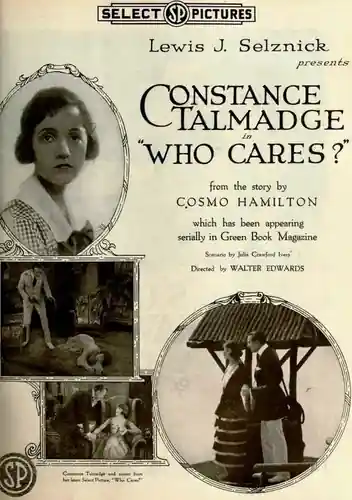
The climax, involving Palgrave’s desperate use of a firearm, shifts the film’s tone from a social comedy of manners into a high-stakes thriller. This tonal shift is handled with surprising grace. The rescue by Martin is not just a physical salvation but a symbolic one; he is reclaiming Joan from the nihilistic void she had embraced. It echoes the redemptive arcs found in The Island of Regeneration, albeit in a much more urban and sophisticated setting.
Julia Crawford Ivers, working within the constraints of the 1919 studio system, manages to infuse the film with a distinct visual identity. The use of space is particularly noteworthy. The grandparents' home is shot with a claustrophobic tightness, while the social gatherings are expansive, almost overwhelming in their movement. This visual dichotomy reinforces Joan’s internal struggle. The cinematography captures the ephemeral nature of the 'Who Cares?' lifestyle—glittering, loud, and ultimately hollow.
Comparing this to the stylistic choices in Kultur or Somewhere in France, one can see a clear move toward a more character-driven visual narrative. Ivers focuses on Talmadge’s face—her expressive eyes and the subtle shifts in her mouth—to tell the story of a woman who is slowly realizing that her rebellion has become its own kind of prison. The technical proficiency is on par with international contemporaries like Der gestreifte Domino or the Hungarian Zoárd mester, proving that American silent cinema was reaching a pinnacle of expressive power.
What remains most striking about Who Cares? is its refusal to offer a simplistic moralizing conclusion. While Joan and Martin find 'happiness together at last,' the film leaves us with the haunting memory of Joan’s slogan. The 'Who Cares?' attitude didn't just disappear; it would go on to define an entire generation. In many ways, this film is a precursor to the flapper films of the mid-20s, yet it possesses a grit and a proximity to Victorian pain that makes it more poignant than its successors.
It lacks the overt religious didacticism of Magdalene or the sensationalist melodrama of The Life Story of John Lee. Instead, it operates in the gray areas of human motivation. Why do we hurt the ones we love? Why do we seek escape in the arms of strangers? Why do we pretend not to care when our worlds are falling apart? These are the questions Ivers and Talmadge pose, and while they provide a 'happy' ending, the questions themselves remain unanswered, echoing through the decades.
In the broader context of 1919 cinema, alongside works like When Fate Leads Trump or the serialized thrills of The Iron Claw, Who Cares? stands out as a sophisticated exploration of the female psyche. It is a film that understands the intoxicating power of rebellion and the sobering weight of responsibility. Constance Talmadge, with her unique blend of comedic timing and dramatic pathos, ensures that Joan Ludlow remains a character of enduring relevance. Even in the high-altitude escapades of Höhenluft, one rarely finds a performance so grounded in the messy reality of social transition.
Ultimately, Who Cares? is a vital artifact of a world in flux. It captures the moment when the 'old ways' were being discarded but the 'new ways' had yet to find their moral compass. It is a film about the cost of freedom and the necessity of connection. For the modern viewer, it offers a window into a past that feels surprisingly familiar—a world where the easiest thing to say is 'Who Cares?', but the hardest thing to do is mean it.
IMDb —
1926
Community
Log in to comment.