DbcultAccessing Vault...
8.8/10
Senior Film Conservator
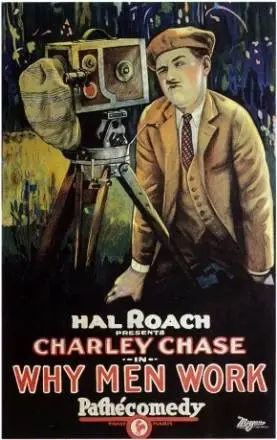
A definitive 8.8/10 rating for a film that redefined the boundaries of cult cinema. Why Men Work remains a cornerstone of transgressive art.
The silent era, frequently mischaracterized as a monolithic epoch of simplistic pantomime, found one of its most sophisticated architects in Charley Chase. In the 1924 short Why Men Work, Chase transcends the typical knockabout tropes of his contemporaries to deliver a meta-textual exploration of the cinematic medium itself. Playing a cameraman on an obsessive quest for novel imagery, Chase provides a lens into the burgeoning anxiety of the professional class. Unlike the blue-collar struggles depicted in An Overall Hero, Chase’s conflict is fundamentally intellectual and proprietary. He is not merely fighting for a wage; he is fighting for the sanctity of his vision against a parasitic rival who seeks to bypass the labor of discovery by simply mimicking the result.
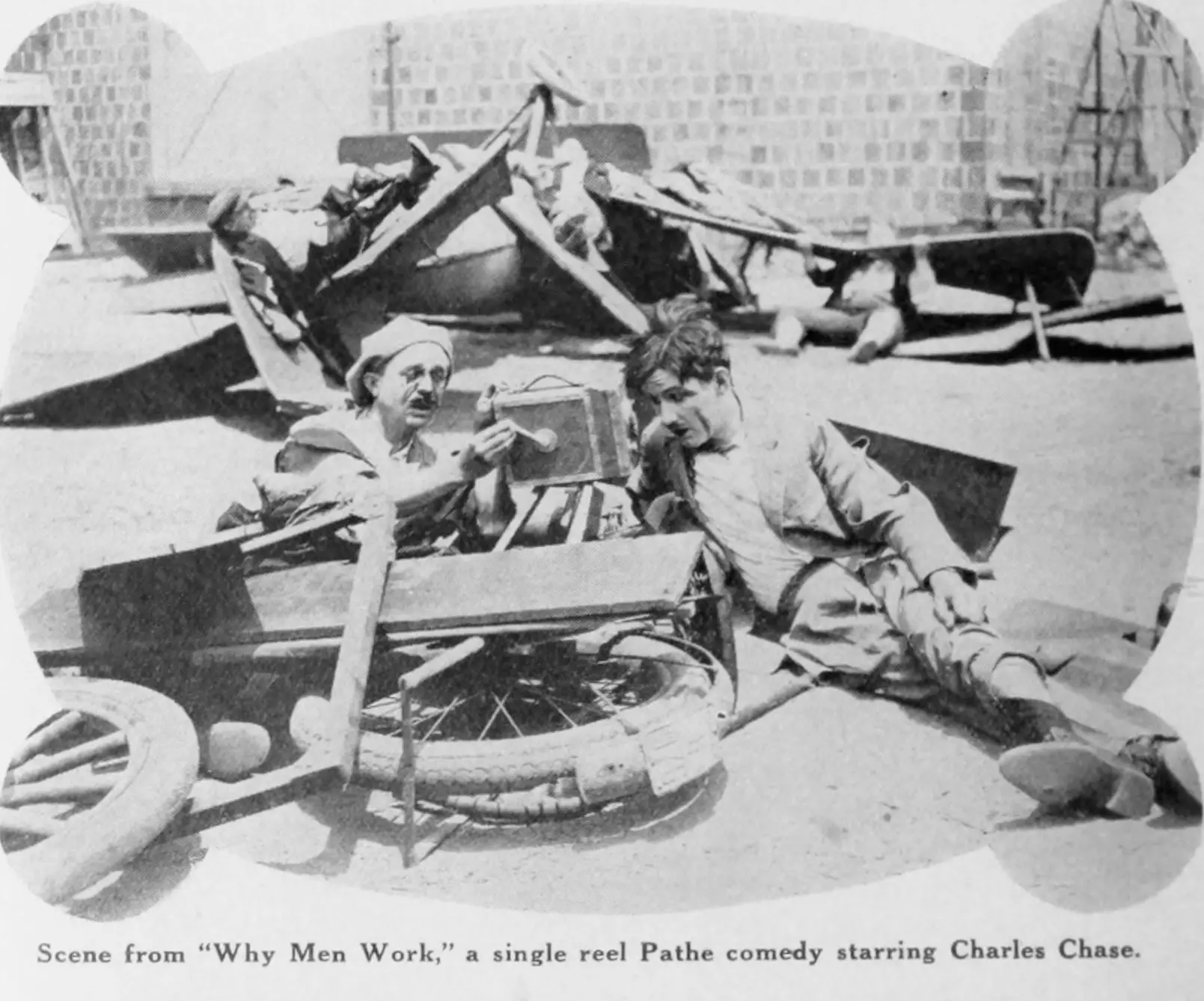
The structural integrity of Why Men Work relies on a rhythmic escalation of frustration. Chase, with his characteristic dapper appearance and refined physicality, navigates the urban sprawl as a hunter of moments. His rival, played with a delightful oily persistence by William Gillespie, represents the industrial shadow—the entity that produces nothing but consumes everything. This dynamic creates a tension that is far more cerebral than the juvenile antics found in Playmates. Here, the humor is derived from the violation of the creative process. Every time Chase finds a unique angle or a compelling subject, Gillespie’s character is there, hand-cranking his own camera in a mockery of artistic effort.
The film’s pacing is a testament to Leo McCarey’s emerging directorial sensibilities. The sequences are not merely strings of coincidences but are carefully orchestrated ballets of mechanical interference. The camera becomes both a tool and a burden, a physical manifestation of the protagonist's career. This preoccupation with the tools of the trade echoes the thematic depth of The Door Between, though Chase pivots toward the absurd rather than the melodramatic. The cinematography within the film—the act of filming the act of filming—creates a recursive loop that invites the audience to consider the artifice of their own entertainment.
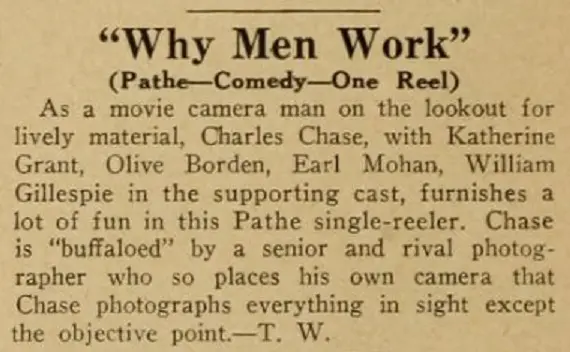
The supporting cast provides a robust framework for Chase’s idiosyncratic performance. Olive Borden brings a luminous presence that serves as a necessary counterbalance to the frantic industrial competition. Her role, while ostensibly the romantic interest, provides the emotional stakes that differentiate this short from a mere technical exercise. The presence of stalwarts like Billy Engle and Earl Mohan ensures that the Hal Roach 'house style' is maintained—a style characterized by a certain breezy naturalism that was often absent from the more theatrical productions of the time, such as The Little Church Around the Corner.
Joseph Forte’s contribution to the narrative tension cannot be overstated. As the rival’s accomplice or the various obstacles in Chase’s path, the ensemble functions as a collective antagonist—the world itself conspiring against the individual worker. This theme of the individual versus the machine of society is a recurring motif in 1920s cinema, yet Why Men Work approaches it with a lightness of touch that belies its cynical undercurrents. It lacks the somber gravity of His House in Order, opting instead for a kineticism that mirrors the frantic expansion of the American city.
Technically, the film is a marvel of location shooting and timing. The use of the hand-cranked camera as a central prop allows for a variety of visual gags that play with the audience's understanding of frame rates and perspective. When Chase attempts to capture 'real life,' he is constantly thwarted by the performative nature of his rival. This suggests a profound realization: that the presence of the camera alters the reality it seeks to record. It is a concept explored with far more gravity in international works like Le nabab, but Chase makes the epistemological crisis accessible through the medium of laughter.
The film also serves as a fascinating historical document of the newsreel era. Before the advent of television, the newsreel was the primary source of visual information for the masses. The cutthroat competition depicted in Why Men Work is a heightened version of the 'scoop' culture that defined early 20th-century journalism. This drive for the 'exclusive' is what fuels the protagonist’s mania, a drive that we see echoed in the desperate attempts for social mobility in Youthful Cheaters. Chase, however, remains an optimist, his resilience serving as the film's moral compass.
Chase’s comedy is uniquely 'verbal' for a silent medium. His expressions and gestures convey a complex internal monologue that suggests a man constantly negotiating with his own dignity. In Why Men Work, this negotiation is at the forefront. He is a man who wants to do a 'good job,' a sentiment that feels both quaint and profoundly relatable. The film avoids the surrealism of Trompe-la-Mort, staying grounded in the recognizable frustrations of the workplace. Whether he is dealing with uncooperative subjects or the literal theft of his footage, Chase maintains a level of decorum that makes his eventual outbursts all the more hilarious.
The physical comedy is executed with surgical precision. There is a sequence involving a precarious vantage point that rivals the high-altitude thrills of Harold Lloyd, yet Chase imbues it with a specific brand of 'embarrassment comedy.' He isn't just afraid of falling; he's afraid of looking foolish while doing so. This preoccupation with social standing is a hallmark of his persona, distinguishing him from the more anarchic spirits of the era. It is a performance of high lexical diversity in movement, where a twitch of the mustache or a subtle adjustment of the hat speaks volumes more than the intertitles ever could.
When placed alongside other films of the period, Why Men Work stands out for its lack of sentimentality. It does not possess the sweeping historical aspirations of the National Red Cross Pageant, nor the exoticism of A Prisoner in the Harem. Instead, it finds the epic in the mundane. The struggle to get the shot is presented as a Herculean task, a modern odyssey through the streets of Los Angeles. This focus on the logistics of labor anticipates the workplace comedies of the later sound era, yet it retains a purity of visual storytelling that is unique to the silent short form.
The film also touches upon the theme of domestic responsibility, albeit indirectly. The title itself—Why Men Work—suggests a broader sociological inquiry. Is it for love? For status? Or simply to stay one step ahead of the man trying to steal your camera? This inquiry into the male psyche is handled with more nuance than the overt domesticity of Wanted: A Baby or the pastoral simplicity of Miyama no otome. Chase suggests that work is a performance, a game of wits where the prize is the right to keep playing.
The editing in Why Men Work is particularly noteworthy. The cross-cutting between Chase’s innovative setups and Gillespie’s opportunistic mimicry creates a sense of inevitable collision. This tension is released in bursts of physical action that are as graceful as they are chaotic. The film’s climax, a frantic pursuit that utilizes the urban environment with gymnastic flair, is a masterclass in spatial awareness. It lacks the cloying sweetness of The Princess of Patches, opting instead for a gritty, soot-covered realism that feels remarkably modern.
In the pantheon of Charley Chase’s work, Why Men Work remains a vital entry. It encapsulates the transition from the crude slapstick of the 1910s to the sophisticated character-driven comedy of the late 1920s. It is a film about the dignity of the grind, the frustration of the copycat, and the enduring power of the image. For those accustomed to the frantic pace of modern life, Chase’s 1924 struggles feel surprisingly contemporary. Whether you are dodging a rival cameraman or a corporate competitor, the fundamental question remains: how do we maintain our originality in a world that is always watching? Why Men Work doesn’t provide an easy answer, but it makes the search for one incredibly entertaining. Much like the frantic transit depicted in Taxi Please, the film is a journey that is its own reward, a kinetic explosion of silent era genius that demands to be revisited by any serious student of cinema.
IMDb 4.3
1921
Community
Log in to comment.