DbcultAccessing Vault...
6.4/10
Senior Film Conservator
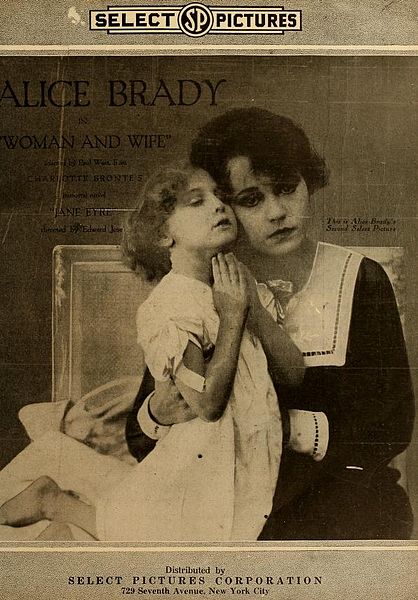
A definitive 6.4/10 rating for a film that redefined the boundaries of cult cinema. Woman and Wife remains a cornerstone of transgressive art.
The first time I watched Woman and Wife, I kept thinking of fire—not the crackling hearth that Hollywood usually gives governesses, but the chemical blaze that eats varnish, memory, and skin. The 1918 film, exhumed from brittle nitrate and now streaming in a 2K scan, translates Charlotte Brontë’s thunderous interior monologue into the vocabulary of shadows: Alice Brady’s Jane enters frame left as a white wedge of collar and implication, the iris-in tightening like a Victorian corset.
Director Edward José and cinematographer Harry Fischbeck treat Thornfield as a palimpsest: every hallway is double-exposed so that previous centuries of patriarchal footprints ghost across current action. When Rochester (Elliott Dexter) descends the grand staircase, the camera tilts upward to make the balustrade loom like a judgment seat; his cigarette ember becomes the sole chromatic deviation, a bead of red that anticipates the conflagration to come. Silent-era audiences, marinated in Dickensian sentiment, would have recognized this crimson punctuation as both seduction and damnation.

Alice Brady’s Jane is not the meek mouse of many early adaptations; her nostril flare alone could indict an empire. Because intertitles prune Brontë’s verbiage, Brady weaponizes micro-gesture: she clips Rochester’s roses while crushing a thorn into her palm—blood bead winks like a ruby, and we understand that pain is her dowry. Elliott Dexter, saddled with the impossible brief of “tragic sex symbol,” sidesteps Valentino swagger for something more feral: eyes that have already seen the cane fields of Spanish Town curdle into remorse. Their chemistry is a slow fuse; when he rests his hand on her shoulder in the garden sequence, the moment is framed in profile so that the horizon line bisects them—sky above, earth below, desire atomized.
What elevates Woman and Wife above contemporaneous romances like The Rosary or The Lady of the Photograph is its refusal to domesticate Empire. Bertha Mason appears only twice—once as a twitching curtain, once as a feet-first tangle of limbs dragged across the roofline—yet her off-screen laughter, scratched onto the accompaniment track, perforates every genteel declaration. The film understands that the attic is not a discrete chamber but the rafters of Britain itself, propped up by sugar, slavery, and the silence of “proper” women.
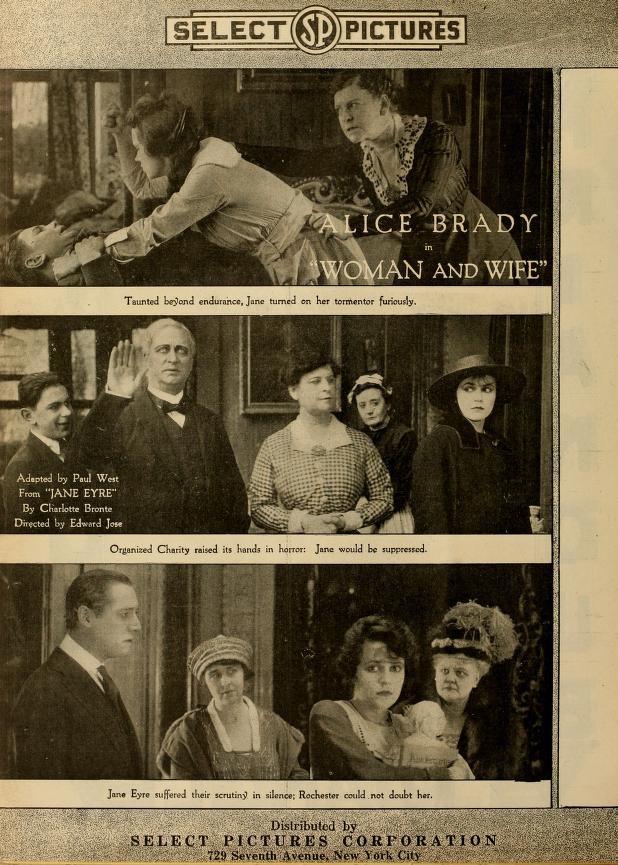
Adapter Paul West jettisons the novel’s third-generation redemption arc, ending instead on a smoldering ruin and a handshake that feels eerily contractual. Some viewers—especially those weaned on 1847’s moral bookkeeping—may decry the excision of St. John Rivers. Yet the deletion sharpens the ideological blade: Jane’s only viable alternative to patriarchal wedlock is not missionary asceticism but financial self-possession. When she inherits her uncle’s fortune midway through a single intertitle, the cut is so abrupt it feels like a coup. Suddenly the power grid inverts; the governess who once folded her hands now grips the reins of narrative.
Compare this with Via Wireless, where technology mediates desire across oceanic distance, or with What Happened at 22, whose chamber-mystery claustrophobia shrinks sociology into clockwork suspense. Woman and Wife hybridizes both impulses: telegraphed letters and delayed revelations crackle like Morse code, yet the final conflagration is pure Grand Guignol spectacle, prefiguring the attic blaze of The Gown of Destiny by six years.

The restoration’s score, composed by Judith Rosenberg for the 2022 San Francisco Silent Film Festival, weaponizes dynamics. She interpolates Afro-Caribbean drums underneath Bertha’s laughter, a sonic coup that re-centers Empire’s repressed periphery. When Jane utters the famous “I am no bird; and no net ensnares me,” the orchestra drops to a single viola sul ponticello, the bow scratching like a trapped soul against wire. You feel the phrase not as aphorism but as insurgency.
If you tally the film’s economic transactions, bodies become promissory notes. Rochester buys Jane’s labour with pounds sterling; Jane later purchases Rochester’s moral bankruptcy with her inherited capital. Their ultimate marriage is less sacrament than hostile takeover: she enters the ashes of Thornfield as majority shareholder, his blindness the collateral damage she is willing to underwrite. The film’s title, altered from the novel’s Jane Eyre, cynically advertises the only two social categories available to women—either “wife” (property transferred from father to husband) or “woman” (a solitary entity whose liquidity still depends on male legacies).
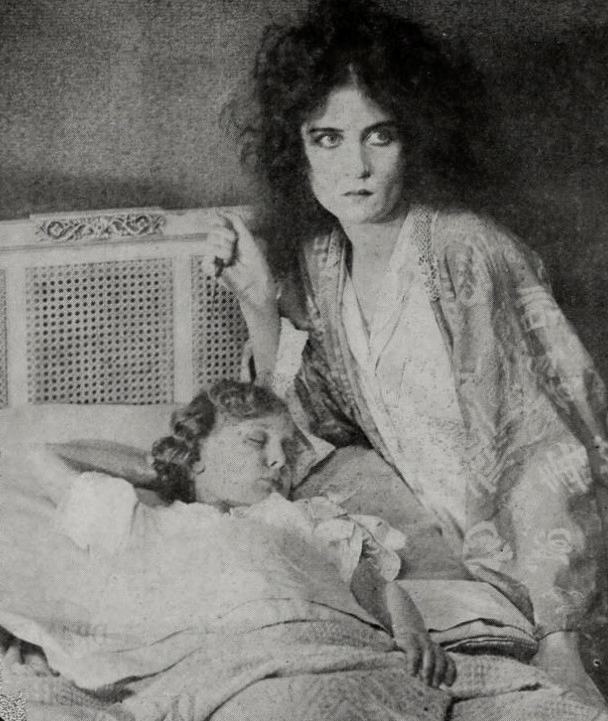
Candlelight sequences flirt with overexposure; faces bleach into masks while backgrounds sink into obsidian. The aesthetic posits ethics as a function of luminance: the closer a character edges toward candor, the harsher the glare that annihilates them. When Jane prays in the red-room of her childhood trauma, the camera dollies until her eye occupies the entire frame—an iris within an iris—suggesting surveillance both divine and patriarchal.
Post-#MeToo audiences will flinch at Rochester’s gaslighting, yet the film’s historical remove allows us to witness predation unmitigated by modern platitudes. Jane’s refusal to become femme entretenue feels more radical than many twenty-first-century heroines who capitulate to “consensual” power imbalances. In an era when Betty and the Buccaneers markets female autonomy through pirate cosplay, Woman and Wife exposes the raw ledger beneath every bodice.
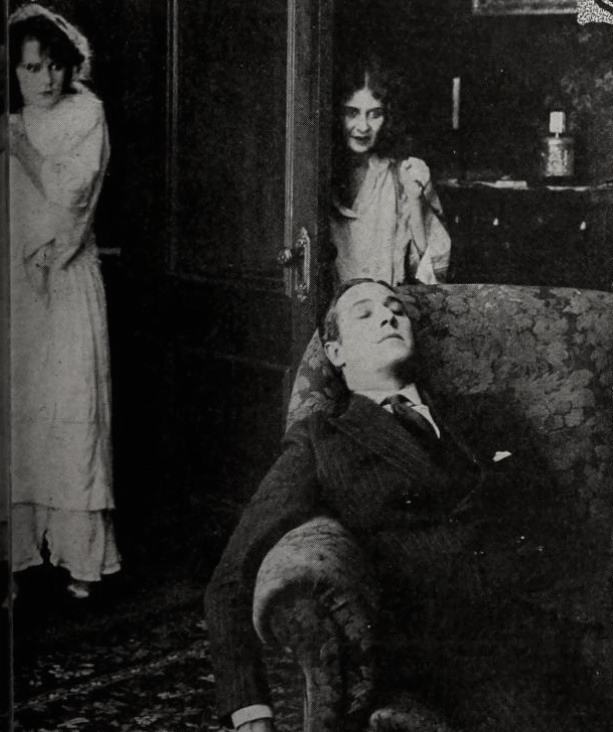
Because every frame vibrates with what cannot be said—the surplus value extracted from colonies, the unpaid reproductive labour of wives, the madness manufactured by silence—Woman and Wife transcends nostalgia. It is not a quaint literary artifact but a forensic document of how capital, gender, and race conflagrated long before our algorithms commodified attention. Watch it once for the Gothic thrills; revisit it to discover that the attic was never in Jamaica or Yorkshire—it is the architecture of now.
Stream the restoration on Criterion Channel, Kino Cult, or your local cinematheque. Pair with Die toten Augen for a double bill of ocular anxiety, or counter-program with In the Stretch if you crave jockey melodrama to cleanse the palate.
IMDb 4.8
1934
Community
Log in to comment.