DbcultAccessing Vault...
Cult Review
Senior Film Conservator
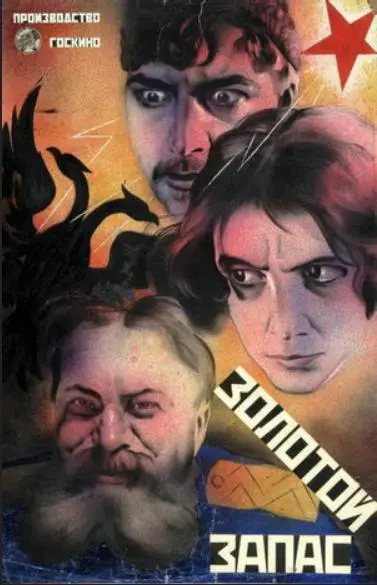
Short answer: yes, but with significant caveats. Zolotoy zapas is absolutely worth watching today if you approach it as a crucial historical document and a fascinating artifact of early Soviet propaganda filmmaking, rather than a purely entertainment-driven narrative. This film is unequivocally for those with a keen interest in Russian history, the silent film era, political cinema, or the foundational aesthetics of Soviet montage. It is emphatically NOT for viewers seeking modern pacing, nuanced character development, or a casual Sunday afternoon watch.
To truly appreciate Zolotoy zapas, one must first understand the context of its creation. Released during the burgeoning years of the Soviet Union, this film is less a neutral historical account and more a powerful piece of state-sanctioned art, designed to galvanize a populace and cement a new ideology. It’s a vivid illustration of how cinema was immediately recognized as a potent tool for mass communication and political education.
The film’s narrative, focusing on the Bolshevik underground’s struggle against Kolchak’s White Army, is inherently steeped in the revolutionary fervor of its time. It’s a story of good versus evil, with the 'Red' partisans embodying heroism and self-sacrifice, and Kolchak’s forces representing the oppressive old guard. This clear ideological division dictates much of the film's artistic choices, from character portrayal to narrative structure.
This film works because it offers an unvarnished look at the birth of a cinematic language tailored for political messaging. It captures the raw energy and conviction of a nation in flux, translating complex historical events into a digestible, emotionally resonant form for a broad audience. The sheer ambition to tell such a sweeping story with the limited technical capabilities of the era is itself commendable.
The direction in Zolotoy zapas, while perhaps appearing rudimentary by today's standards, is a masterclass in early Soviet film aesthetics. The pacing is a fascinating blend of deliberate, almost tableau-like scenes giving way to bursts of frenetic action. We see moments of quiet tension as the Bolshevik agents plan their moves, juxtaposed with the rapid-fire editing characteristic of the Soviet montage school, particularly during the climactic train attack.
Consider, for instance, the sequences depicting the partisans in their hidden lairs. Director Yevgeni Chervyakov (or whoever was primarily responsible for shaping the narrative flow, as early directorial credits could be fluid) allows for long takes, letting the audience absorb the grim determination on the faces of characters like Aleksandra Kartseva's resolute partisan leader. This builds a sense of camaraderie and shared purpose, essential for the film's ideological message.
Then, when the action shifts to the attack on Kolchak’s train, the editing becomes markedly sharper. Quick cuts between the advancing partisans, the frantic defenders, and the powerful locomotive itself create a visceral, almost breathless energy. This shift in tempo isn't accidental; it's a deliberate choice to heighten the dramatic impact and underscore the urgency and danger of the mission. It's a precursor to the dynamic editing that would define later Soviet masterpieces.
The film fails because its pacing can feel uneven to a modern audience, with lengthy expository scenes punctuated by sudden, almost jarring action sequences. The lack of a sophisticated score (as silent films relied on live accompaniment) means that the rhythmic shifts in visual storytelling needed to carry an even heavier burden, which doesn't always translate perfectly to contemporary viewing without that intended aural context.
The cinematography, though black and white and limited by early 20th-century technology, manages to convey a stark beauty and a palpable sense of the vast, unforgiving Russian landscape. There's a raw, almost documentary-like quality to some of the exterior shots, particularly those depicting the partisans moving through snow-covered plains or dense forests. This grounds the narrative in a harsh reality, emphasizing the physical challenges faced by the revolutionaries.
The use of natural light, or its clever simulation, adds a layer of authenticity. Think of the shadowy interiors where the underground meetings take place, lit perhaps by a single lantern, creating deep contrasts that highlight the conspiratorial atmosphere. Or the stark, almost silhouetted figures of the partisans against a bleak sky, which visually reinforces their heroic struggle against overwhelming odds.
One particularly memorable visual element, and an unexpected observation, is the way the train itself is filmed. It's not just a vehicle; it's an almost monstrous entity, a symbol of Kolchak's power and the industrial might of the old regime. The low-angle shots of the locomotive steaming across the landscape imbue it with an imposing, almost mythical quality, making its eventual capture all the more significant. This anthropomorphization of an inanimate object is a subtle but effective cinematic flourish.
The performances in Zolotoy zapas are, as expected for the silent era, often broad and theatrical, relying heavily on exaggerated facial expressions and body language to convey emotion and intent. However, within this stylistic framework, several actors deliver compelling portrayals that transcend mere pantomime.
Aleksandra Kartseva, as one of the key partisan figures, exudes a quiet strength and unwavering conviction. Her gaze, even in the absence of dialogue, communicates a profound sense of purpose and sacrifice. There's a scene where she confronts a wavering comrade, and her stern, unwavering expression speaks volumes about the ideological purity demanded by the cause. It’s a performance that, despite its theatricality, feels deeply committed.
Conversely, the actors portraying Kolchak’s officers, such as Andrey Fayt, often lean into more villainous archetypes. Their sneering expressions and arrogant postures are designed to elicit a clear sense of disdain from the audience. This isn't nuanced acting in the modern sense, but it’s incredibly effective in serving the film's propaganda goals. The performances are less about individual character arcs and more about embodying the ideological forces at play.
My debatable opinion here is that while these performances are often dismissed as 'primitive' by those accustomed to contemporary naturalism, they possess a raw, almost operatic power. They communicate directly to the viewer's emotions, unburdened by the subtleties of spoken dialogue, and in doing so, they tap into a more universal language of human struggle and triumph. It's a different kind of acting, not necessarily inferior, just distinct.
The tone of Zolotoy zapas is overwhelmingly one of heroic struggle and eventual triumph, imbued with a powerful sense of revolutionary optimism. Despite the dangers and sacrifices depicted, there's an underlying current of inevitability regarding the Bolshevik victory. This isn't a film about moral ambiguity; it's about the righteous march of history.
Key themes include class struggle, the heroism of the common people (the partisans), the corruption of the old regime, and the ultimate victory of the revolution. The discovery of Kolchak's gold reserve isn't just a plot device; it's a symbolic act, representing the seizure of the old order's wealth for the benefit of the new, socialist society. It's a powerful visual metaphor for economic redistribution and the dismantling of capitalist structures.
The film’s propaganda aspect is undeniable, but to dismiss it solely on that basis would be a disservice. It's propaganda crafted with artistic intent, utilizing the nascent power of cinema to shape a national identity. The film doesn't shy away from depicting the brutality of the conflict, but always through the lens of justified struggle and ultimate liberation.
You should watch it if you are a film scholar, a historian, or someone fascinated by the origins of political cinema. This film offers invaluable insights into the early Soviet film industry, its aesthetic choices, and its role in nation-building. It's a challenging watch, certainly, but a rewarding one for the right audience.
For those accustomed to modern blockbusters or even classic Hollywood dramas, the silent film conventions, the lack of dialogue, and the overtly ideological narrative might prove difficult to engage with. It requires a certain patience and a willingness to contextualize what you're seeing within its historical and cinematic era.
However, for students of cinema, there’s a treasure trove here. Observing the early attempts at visual storytelling, the use of intertitles, and the development of techniques that would later become standard, is a truly enriching experience. It’s a foundational text, much like reading an early novel to understand the evolution of literature.
In the grand tapestry of world cinema, Zolotoy zapas occupies a crucial, if often overlooked, position. It's not a film that will sweep you off your feet with dazzling special effects or complex psychological drama. Instead, it offers something arguably more profound: a direct line to a pivotal moment in history, viewed through the lens of a revolutionary art form still finding its voice. It's a raw, fervent declaration of purpose, an artistic weapon in a real-world struggle.
While its overt propaganda might rub some the wrong way, to ignore Zolotoy zapas is to miss a vital piece of cinematic history. It's a film that demands contextualization, but rewards it with a unique insight into the birth of a nation and the power of the moving image. It's a challenging watch, yes, but one that enriches your understanding of film's capacity to shape, influence, and inspire.
For those willing to engage with its historical and artistic peculiarities, Zolotoy zapas is more than just an old film; it’s a vibrant, if politically charged, window into a bygone era. It stands as a testament to cinema's enduring power to reflect, and indeed, to forge reality. Its cultural value far outweighs any perceived antiquated pacing. For a deeper dive into early cinema, consider exploring other films of the era like Pettigrew's Girl or The Price of Pleasure to understand the diverse global landscape of silent film.
IMDb 6.9
1933
Community
Log in to comment.