DbcultAccessing Vault...
Cult Review
Senior Film Conservator
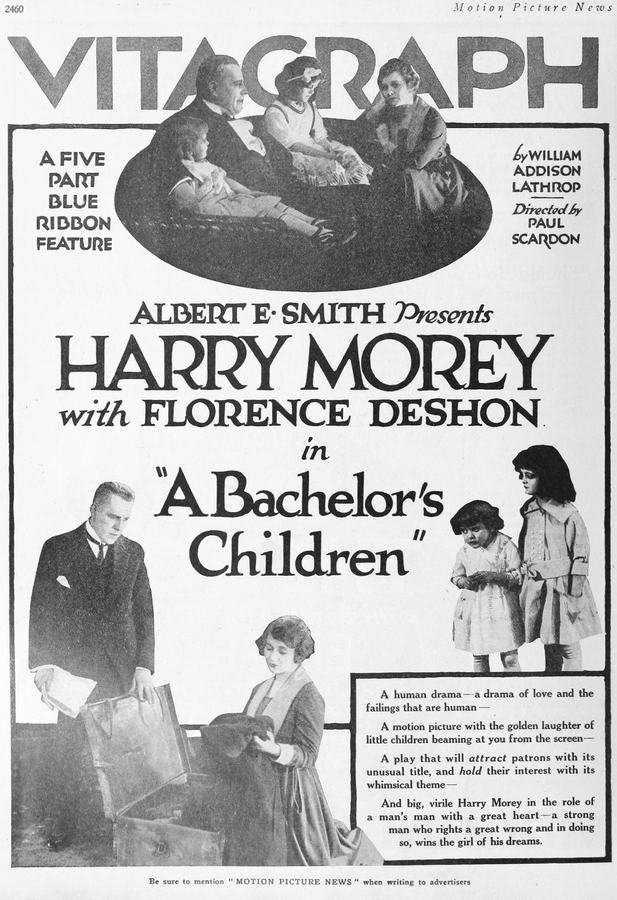
In the flicker of 1920 celluloid, A Bachelor's Children arrives like a half-remembered dream soaked in bourbon and desert dust: a morality play that refuses to preach, a love story that tastes of iron ore and rusted guilt.
William Addison Lathrop’s scenario—deceptively tidy on paper—unfurls onscreen as a chiaroscuro fever. From the first iris-in on Hugh Jordan’s sun-cracked boots to the final clinch beneath electric candelabra, the picture interrogates the very marrow of American aspiration: can stolen money ever be laundered clean by affection?
Director William Shea shoots the West as if it were a mythic negative: alkali flats bleach the frame to parchment, while night scenes in Hugh’s East-coast manor drown in pools of aquamarine shadow. The palette is limited yet hallucinatory—tinted amber for the cowboy interludes, cyanotype blue for the Atlantic soirées—recalling the hand-pasted hues of Judith of Bethulia but trading biblical bombast for intimate transgression.
Jessie Stevens’ Penelope sports a wardrobe that mutates from calico drab to silk lamé without a diegetic seamstress in sight; each sartorial leap marks a silent assertion that destiny can be tailored overnight if the heart is bold enough. The effect is as disorienting as it is seductive—scopophilia in moral drag.
William Shea’s Hugh Jordan exemplifies the era’s understated virility. Watch the way his shoulders slacken when Penelope produces her father’s letter: a whole cattle ranch of arrogance collapses into a single exhalation. Compare that to Denton Vane’s predatory dandy in the subplot—every waxed mustache twitch screams fin-de-siècle vampirism. Meanwhile, Alice Terry’s scheming widow slinks through drawing rooms like smoke looking for a curtain to cling to; her eyes perform a Morse code of seduction that the camera, hungry, reads perfectly.
Florence Deshon, as the middle Winthrop sister, earns the film’s biggest laugh merely by lifting an eyebrow when Hugh’s butler over-pronounces mademoiselle. In an industry that often treated supporting women as decorative urns, Deshon’s micro-gestures feel proto-feminist—an ancestor to the spitfire heroines later celebrated in The Spitfire.
Lathrop’s script weaponizes the concept of patrimony—here, money is not neutral lucre but a haunted object that must pass through female hands to be exorcised. Penelope’s legal claim is less a MacGuffin than a sacramental conduit; only by surrendering dominion does Hugh obtain the thing inheritance can’t buy: ethical personhood. It’s a narrative inversion that makes the film a spiritual cousin to The Other's Sins, yet where that title wallows in Protestant guilt, A Bachelor's Children flirts with restitutive grace.
The subplot’s predatory widow and stock-market wolf serve as fun-house reflections of Hugh’s potential futures: one a sybarite hollowed by leisure, the other a robber baron cannibalizing the innocent. Our hero’s ultimate choice—matrimony and philanthropy—reads today as conservative, but in 1920 it must have felt like a dare: to reject the era’s turbo-capitalist orgy and embrace a social contract stitched by conscience.
The first reel luxuriates in tableau compositions—cowboys silhouetted against an ochre horizon, the camera immobile as if afraid to breathe. Yet once Hugh enters Fifth Avenue, the cutting accelerates into staccato bursts: a champagne cork, a saxophone riff, a monocle dropping in slow-motion. This metrical shift foreshadows the Soviet montage that Eisenstein would soon canonize; it’s as though the film itself has inherited too much money and doesn’t know how to spend it all at once.
Scholars hunting for proto-modernist DNA could do worse than juxtapose these urban whiplash cuts with the serene longueurs of Camille. One aches with Romantic languor, the other vibrates with Jazz Age neurasthenia—together they map the bipolar psyche of early silent aesthetics.
Surviving cue sheets recommend pairing reels with Zamecnik’s “Indian War-Dance” for the prairie scenes and “Hearts and Flowers” for the proposal. The cognitive dissonance—savage drums under a capitalist parable, saccharin strings over class restitution—mirrors the film’s tonal amphibiousness. Exhibitors in rural Kansas allegedly swapped the cues, scoring Hugh’s bacchanal with a church organ; reports claim parishioners fainted at the synesthetic heresy. Such anecdotal alchemy testifies to the era’s radical openness: every projection booth was a remix lab.
Penelope’s triumph is not merely marital but fiduciary; by film’s end she controls voting shares in a transcontinental railroad. That a 1920 screenplay allows a woman such agency—without branding her a villainess—feels quietly revolutionary. Compare this to The Princess of Park Row, where reportorial pluck is rewarded with betrothal and nothing more. Lathrop’s decision to let Penelope retain economic sovereignty retroactively queers the heteronormative closure, hinting at a partnership model where affection and assets coexist without masculine subsumption.
Unlike its contemporaries—The Running Fight, say, or Vera, the Medium—A Bachelor's Children never received a 16mm safety print campaign. The original nitrate negative allegedly smoldered in a New Jersey warehouse during the summer of ’67, leaving only a battered 9.5mm Pathé compendium for European collectors. Most reference books omit it entirely, misfiled under “Jordan, Hugh—misc.” Yet the fragments that circulate on digital forums reveal a sophistication worthy of canonical resurrection.
So, is A Bachelor's Children a masterpiece? Perhaps not in the hieratic sense we reserve for Judith or Carpet from Bagdad. But it is something rarer: a perfectly calibrated moral fable that trusts audiences to decode ambiguity without the semaphore of intertitles. It is a film where the camera courts character, where redemption is not preached but practiced, and where the most radical act is to share power rather than hoard it.
Seek it out, should a festival programmer dare to project the fragmentary print. Bring friends, a hip-flask, and your most unguarded nostalgia for an America that never quite existed. Then argue, loudly, over whether Penelope’s final smile is triumph or trap. Know that in that flickering argument, the film lives again—an orphaned artifact claiming its rightful share of our collective cultural inheritance.
—reviewed by Celluloid Squire
IMDb —
1931
Community
Log in to comment.