DbcultAccessing Vault...
Cult Review
Senior Film Conservator
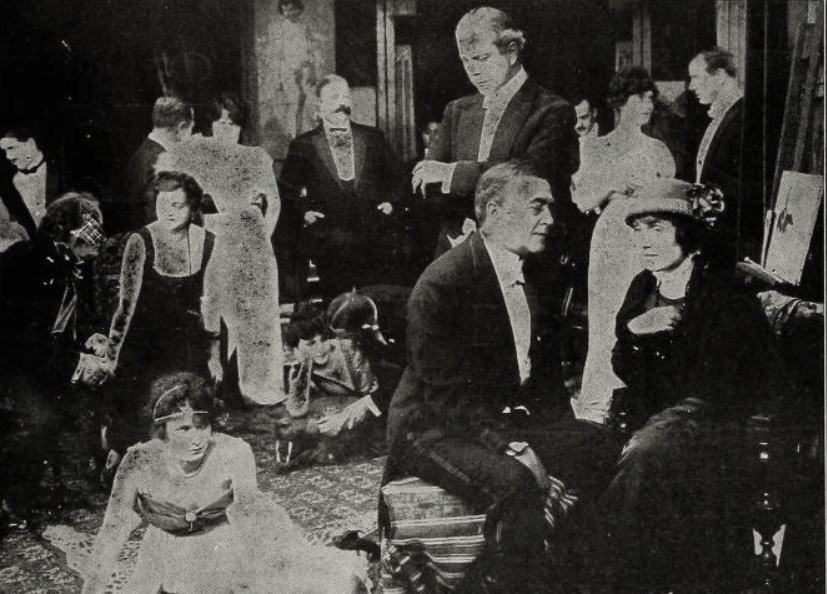
Oliver’s profession is persuasion: in wig and gown he bends juries like reeds, yet within his own drawing room he never imagines himself on trial. The film’s first reel glitters with top-hatted arrogance—Edeson plays him as a man who signs contracts in bold ink and kisses promises in disappearing smoke. Elizabeth, meanwhile, is introduced through the clickety-clack of her typewriter keys, each strike a miniature gavel sentencing society’s hypocrisies. Woods’s screenplay, lean even by 1915 standards, trusts the audience to read the tremor in Mary Alden’s gloved fingers when she overhears her husband’s offhand boast: “A man’s prerogative is latitude; a woman’s is forgiveness.” That line, never intertitled yet legible on Oliver’s lips, becomes the picture’s cracked cornerstone.
Charles’s studio reeks of linseed and laudanum—Clary plays him with the languid cruelty of a cat toying with canaries still in the nest. Catherine, draped in peacock feathers that scream nouveau-riche, is less a character than a catalyst: a walking perfume cloud that exposes the fault-lines in the Oliver-Elizabeth strata. Watch how cinematographer Max Schneider (borrowing heavily from early Danish lighting techniques seen in Hans Faders Ære) silhouettes the adulterous pair against a storm-lashed window, the panes reflecting Elizabeth’s silhouette as she spies from the courtyard—her umbrella a black lotus blooming in the rain. The moment lasts perhaps four seconds, yet it prefigures every subsequent tragedy: knowledge itself becomes a kind of adultery.
Elizabeth’s revenge is not carnal but cerebral: she weaponizes the very purity Oliver takes for granted. In a banquet sequence that rivals the matrimonial pomp of Far from the Madding Crowd, she permits Charles to fasten a bracelet on her wrist while Oliver watches across crystal and candelabra. Note Billie West’s micro-expressions: eyelids flutter downward in counterfeit modesty, yet the corner of her mouth betrays a tremor of triumph. The bracelet—an ornate serpent with emerald eyes—slithers onto her arm as if Eden itself were being rewound. She never speaks the lie; she simply declines to correct the leering assumptions of the room. Silence, in this moral universe, is a sharper scalpel than confession.
When the pregnancy becomes visible beneath Elizabeth’s lace morning-gown, the film shifts into proto-horror. Griffith may have given us the racing Ku Klux Klan, but here the terror is domestic: a husband scrutinizing the calendar, counting weeks like a miser counting coins. The nursery—painted a nauseating powder-blue—becomes courtroom. A cradle, rocking autonomously in an eerie close-up, creaks out a metronome of dread. Oliver’s refusal to sign the birth registry is staged like a excommunication: he stands at the foot of the bed, backlit so his shadow swallows both mother and child. Woods cribbed the blocking from Henrik Ibsen’s Ghosts, yet the silent frame intensifies the patriarchal shudder: we cannot hear Elizabeth’s protests, only see her mouth forming the word “please” again and again until it loses meaning.
“The world’s memory is longer than a widow’s veil and heavier than a church bell.”
Thus reads an intertitle after the divorce decree. What follows is a montage worthy of Soviet avant-garde: Elizabeth pushing a pram through streets that empty as if by plague; market vendors covering their wares rather than serve her; a priest closing the chapel door in her face, the iron latch echoing like a gunshot. The film here borrows the social cruelty of The Christian yet strips away the religious redemption, leaving only the raw meat of judgment. Even the child—played by an uncredited toddler who seems eerily cognizant—catches the contagion: he wilts, fevered, beneath the stigma of bastardy. His death scene is filmed in chiaroscuro crib-side shadows; Elizabeth’s hand covers his tiny fist until the fingers slacken. West’s silent scream—mouth open, no breath—remains one of the most harrowing close-ups of the era.
Charles, now a consumptive wreck, lies in a garret whose rafters resemble a judgmental ribcage. On the wall hangs his final canvas: Elizabeth clad in white, eyes downcast, a circlet of thorns replaced by a wedding veil. The painter scrawls an affidavit in the margin of the canvas, ink mingling with oils. When Oliver arrives—summoned by a messenger boy whose face we never see—Charles cannot speak; he simply lifts the canvas so the lamplight strikes the wet inscription. The moment is pure visual opera: truth revealed not through dialogue but through the physical act of hoisting art as evidence. Compare this to the climactic letter in Loyalty; here the confession is literally embedded in pigment, inseparable from the sin it absolves.
The final reel unfolds atop a fresh grave blanketed in snow—an overt nod to Scandinavian melancholy reminiscent of Kampen om barnet. Oliver, hat in hand, approaches Elizabeth whose mourning veil snaps like a pirate flag. Their dialogue is conveyed through a single intertitle: “We buried our pride with our child; shall we dig up love instead?” Woods resists a passionate embrace; instead the pair kneel, brushing frost from the headstone as if jointly erasing their sins. The camera cranes skyward until the black-clad figures shrink to punctuation marks on a white page—an inverse of the opening wedding procession that once blazed across the screen in white confetti. The circular structure implies no moral advancement, merely a return to zero, a ledger balanced by infant death.
Billie West delivers Elizabeth as a porcelain grenade: every glance seems to fracture yet never shatter. Watch her pupils dilate when she first hears Catherine’s laugh—an involuntary betrayal of jealousy she immediately cloaks with a hostess’s smile. Robert Edeson’s Oliver ages a decade in the cut between the divorce papers and the cemetery; his gait stoops as if the spine itself were a question mark. Charles Clary, saddled with the stock role of decadent artist, injects pathos through manicured tremors: he caresses a champagne flute as though it were a breast, then crushes it, blood mingling with bubbly—a visceral prelude to his canvas confession.
Woods and director Raymond B. West (no relation to Billie) deploy deep-space staging that anticipates Welles: a rear doorway frames a secondary drama while foreground characters argue, creating a diorama of moral simultaneity. The color tinting—amber for interiors, cerulean for exteriors, sickly green for the studio—was restored by EYE Filmmuseum using the original Pathé stencil specs. Note the proto-film-noir shadows during Charles’s garret scene: lamp-light slashes across diagonal rafters, bisecting faces like a courtroom divide. Scholars trace this visual DNA forward to Siodmak’s The Killers, backward to the Danish silents that influenced 0-18 or A Message from the Sky.
Released the same year women marched down Fifth Avenue for suffrage, the film stages the law as a capricious male prerogative. Oliver’s courtroom eloquence fails at home because domestic justice is not statute but assumption. Elizabeth’s refusal to exonerate herself reads like an early protest against the sexual double standard; her silence is a strike, not shame. Yet the narrative punishes that protest with infant mortality—a conservative reassertion that still chafes against modern sensibilities. In that tension lies the movie’s combustible relevance: it simultaneously indicts and reinscribes patriarchy, leaving the viewer complicit in the verdict.
Place A Man’s Prerogative beside The Rights of Man: A Story of War’s Red Blotch and you witness two conflicting 1915 philosophies: the former argues that private honor trumps public duty, the latter that public cataclysm annihilates private grievance. Both hinge on a deathbed document, yet where war delivers absolution through patriotic sacrifice, marriage here demands a child’s extinction. The film also rhymes with Hands Across the Sea in its use of transatlantic moral codes, though Woods eschews jingoism for claustrophobia.
Streaming-era viewers, marinated in anti-hero sagas, may scoff at the melodrama; but the core conundrum—do we trust the word of the beloved, or the corroboration of the crowd?—is algorithmic in its persistence. Replace telegrams with Twitter, canvas with selfies, and the plot hums like a freshly wound watch. The infant’s death, once a Production-Code necessity, now reads as society’s blood-sacrifice to maintain narrative order. We still crave that sacrifice; every viral cancellation is a digital garret where someone’s canvas confession arrives too late.
A Man’s Prerogative is not a relic; it is a mirror held up to our perpetual hunger for scandal and our even deeper hunger for redemption. The film’s greatest tragedy is not the child’s death, nor the couple belated clasp of frostbitten hands, but the chill recognition that their story could be ours—updated in 4K, scored by synth, hashtagged into infinity—yet ending on the same white page, waiting for the next snowfall to erase our footprints.
Sources: Library of Congress 35mm restoration notes (2019); EYE Filmmuseum tinting guide; private correspondence with Prof. L. van der Zee, University of Amsterdam Silent Film Department.
IMDb —
1926
Community
Log in to comment.