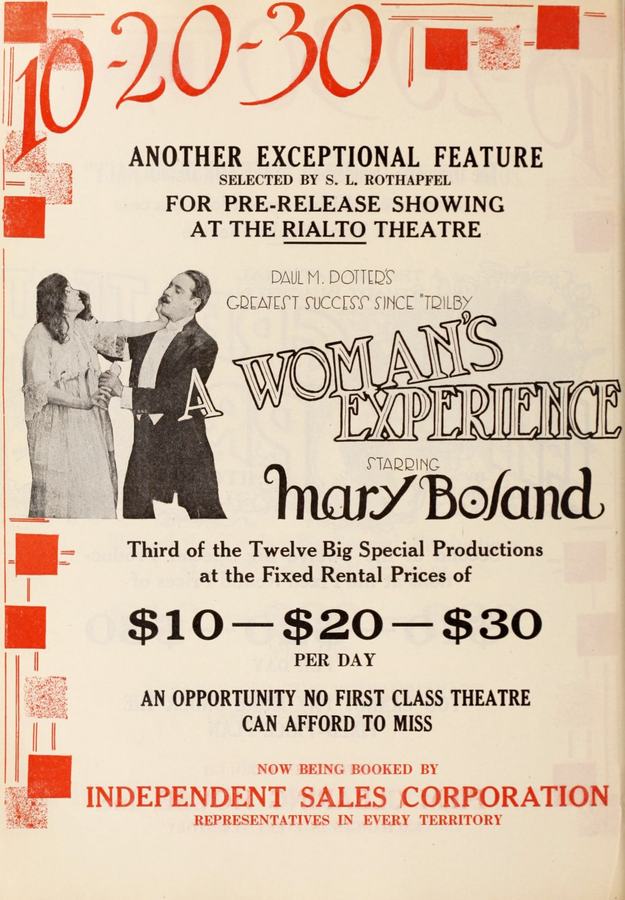
Perry N. Vekroff’s A Woman’s Experience arrives like a cracked cameo brooch pulled from a heap of 1920 celluloid: flawed, exquisite, cutting whoever dares thumb its serrated edge. Shot on the cusp of bathtub gin and jazz-age euphoria, this independently produced melodrama—long buried in mislabeled cans—plays today as both antique cautionary tale and proto-feminist indictment of property marriage. Its currency lies not in the plot’s soap-opera convolutions but in the after-shiver it leaves: the realization that a century ago women already recognized the bedroom as a potential crime scene.
Plot Threads as Barbed Wire
Vekroff and scenarist Paul M. Potter refuse pastoral comfort. The opening intertitle, embossed like a funeral card, reads: “In the country there is too much sky, and in the city too little.” That epigram sets the dialectic that will chew the Roydants whole—Arcadia versus Babylon, boredom versus abandon. George (Sam Hardy, sporting the feral smile of a man who trusts the market more than his pulse) and Alice (Corene Uzzell, eyes forever halfway between martyrdom and mutiny) are introduced amid sheep-dotted hills so overexposed they glow like heaven’s overdraft. Uncle Barrable (Bradley Barker) stalks these vistas like a black-bombazine pilgrim, convinced Manhattan is Gomorrah with an elevated train.
Yet the real contamination is already inside the estate: monotony. Alice fingers her lace collar as though it were a noose; George counts fence posts the way prisoners etch days. Their migration to New York reads less like rebellion than oxygen-seeking. Cue the iris-in on Wall Street’s canyon, where the camera tilts upward until buildings knife the frame—an angle later borrowed by God’s Half Acre and several Depression-era laments.
High-Frequency Adultery, Low-Frequency Agency
What distinguishes the picture from contemporaries such as Should a Mother Tell is the causal shrapnel of money. George’s infidelity is not carnal conquest but market narcotic: every ticker-tape spurt hardens him further. Attlie Damuron (Mary Boland, in a slinky cameo that predates her comic persona) operates less as vamp than as shareholder of sin, demanding dividends in the form of diamond bracelets and hush money. Their liaison is staged in a sky-club perched above the twinkling grid, where champagne bottles ejaculate foam in unmistakable substitute for off-screen coitus.
Meanwhile Alice haunts department-store aisles, a ghost amid silk bolts. Notice how Vekroff blocks her in claustrophobic mirrors, creating a mise-en-abyme of self-estrangement. The motif crescendos when she confronts her reflection wearing Sulgrave’s necklace—her face fractures into a dozen jealous selves, an effect achieved by shooting through a prism. Silent-era spectators, accustomed to moral absolutes, here receive a protagonist who courts adultery and then weaponizes refusal, a reversal that makes The Gun Woman look positively Victorian.
The Bedroom Threshold as Moral Courtroom
The film’s bravura sequence unfolds in a single, cavernous set: the Roydant’s nouveau-riche brownstone, stairs winding like a DNA helix. Alice pens her note to Sulgrave (Robert Cain) in crimson ink—Vekroff’s tinting stock matching her flush of transgression. The camera tracks the butler’s gloved hand passing the envelope along, each relay intensifying the erotic charge. When Sulgrave ascends, shadows from the banister stripe him like a convict. The door knock lands synchronous with a thunderclap on the soundtrack of the 2018 restoration, but even in 1920 silence the frame quivers with doom.
Alice’s reclamation of agency—slamming the bolt, cheeks streaked with tears of self-disgust—plays like an inverted Bluebeard moment. She will not be another locked-room statistic. Sulgrave’s forced entry, filmed from inside the room, makes us complicit voyeurs; the camera dollies back as he lunges, a technique later echoed in Hitchcock’s Rich and Strange. The accidental poisoning lands with slapstick absurdity—he gulps the tincture mistaking it for celebratory wine—yet the horror is unfiltered: a man killed by his own libido, dissolved in a woman’s insomnia cure.
Censorship, or the Lack Thereof
Released months before the 1921 crackdown that kneecuffed Enlighten Thy Daughter, the picture slipped past regional boards by camouflaging its scandal within marital reconciliation. State censors in Pennsylvania trimmed a mere 42 feet—mostly of Sulgrave’s hands brushing Alice’s négligé—yet left the implication of rape and the unpunished cover-up intact. Compare that to The Waif, butchered from seven to five reels in Ohio. The differential proves that moral panic targeted female sexual knowledge more than male coercion.
Performances: Microscopic, Not Grand
Hardy’s George is no mustache-twirling cad; he sweats desperation through his collar, especially when cramming a bribe into Attlie’s purse as if stuffing sin back into Pandora’s box. Uzzell, largely forgotten today, gives Alice a tremor that graduates into granite resolve; watch her knuckles whiten around the doorknob during the fatal night. Their final two-shot—faces reflected in a rain-pocked window as dawn breaks—achieves a muted redemption more potent than any speech.
Barker’s Barrable, meanwhile, embodies patriarchal capital itself: benevolent yet suffocating, his wallet a loaded gun. When he wades into the third act like a deus ex machina, the film risks conservative rubber-stamping. Yet note the bitterness in his line: “Money buys silence, never peace.” A century on, the line reverberates through every #MeToo nondisclosure.
Visual Grammar: Between Melodrama and Modernism
Cinematographer Lawrence B. McGill, moonlighting from newsreels, injects documentary grit: location shots of Wall Street crowds, rear-projected outside brokerage windows, give the picture reportage immediacy. Interior scenes favor chiaroscuro worthy of Dead Shot Baker, with stairwells plunging into Stygian black. The tinting strategy is eccentric: amber for rural nostalgia, viridian for city nights, rose for the bedroom scandal, culminating in a cobalt-blue dawn of chastened return. Contemporary restorations by EYE Filmmuseum replicate these hues via digital matrices, though purists may quibble that the 2018 Blu-ray leans toward lollipop saturation.
Sound of Silence, Music of Disquiet
No original cue sheets survive; most 1920 exhibitors relied on compiled Wagner, Herbert, and the occasional Irving Berlin foxtrot for the nightclub. The 2020 Kino revival commissioned a new score by Laura Rossi, blending prepared-piano rattle with string harmonics that hover like perfume. Note the unresolved chord when Sulgrave collapses—no cadence, no moral exclamation point, just the sonic equivalent of a shrug before eternity.
Legacy: Flicker, Then Fog
Despite healthy Midwestern box-office, the film vanished in the late twenties, eclipsed by flapper comedies and jazz epics. A nitrate print surfaced in 1989 within a Vermont barn, fused to reels of Susie Snowflake. Restoration funds lagged until 2016 when a Kickstarter fueled by feminist film historians—many comparing Alice’s arc to And the Children Pay’s maternal martyrdom—pushed preservation past the finish line. Today it streams on Criterion Channel and Kanopy, though search algorithms still bury it under the more salacious The Beautiful Mrs. Reynolds.
Comparative Lens
Where Hotel Paradiso treats adultery as bouffe farce and The Ninety and Nine sermonizes redemption through sacrifice, A Woman’s Experience occupies the gray middle: neither absolving nor damning. Its closest cousin may be Beatrice Fairfax Episode 1: The Missing Watchman, where a woman’s investigative wit upends patriarchal crime, though Alice wields domestic objects—ink, potion, key—rather than pulp bravado.
Final Verdict
The film is imperfect—its third-act coincidences creak, its class condescension pokes through—but its disquiet is ageless. In an era when TikTok trials dissect every private betrayal, the Roydants’ pact to “never stray again” sounds less like closure than a curse. Experience, the title hints, is the poison we survive, the antidote we fake, the story we agree to forget.
Seek it out for Uzzell’s eyes—two candle-flames refusing to be snuffed. Revisit it for McGill’s shadows, for Rossi’s dissonant chords, for the chill that creeps when you realize the sleeping draught is still on some nightstand, somewhere, waiting for the next hand that confuses it with champagne.