DbcultAccessing Vault...
2.1/10
Senior Film Conservator
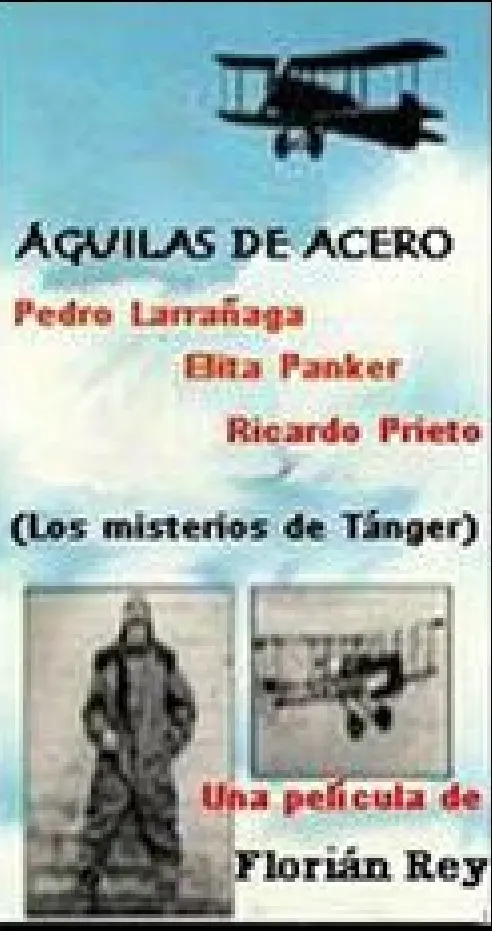
A definitive 2.1/10 rating for a film that redefined the boundaries of cult cinema. Águilas de acero o los misterios de Tánger remains a cornerstone of transgressive art.
Is Águilas de acero o los misterios de Tánger worth your time in the 21st century? Short answer: No, unless you are a cinema historian or a flight enthusiast looking for rare footage of the Spanish Air Force’s infancy. For the average viewer, the technical gaps and the heavy-handed colonial narrative will likely prove too taxing for a casual evening.
This film is specifically for those who find beauty in the grain of 35mm nitrate and the historical curiosity of seeing real-life heroes like Julio Ruiz de Alda on screen. It is absolutely not for anyone who requires a fast-paced plot or nuanced political commentary. It is a product of its time—loud, proud, and unapologetically rigid in its worldview.
1) This film works because it captures the visceral, dangerous reality of 1920s aviation without the safety net of modern CGI or green screens.
2) This film fails because its narrative structure is disjointed, often feeling more like a series of loosely connected newsreels than a cohesive feature-length drama.
3) You should watch it if you want to witness one of the earliest examples of Spanish 'super-productions' that attempted to compete with Hollywood's technical scale.
Rafael López Rienda was not just a filmmaker; he was a man deeply embedded in the Spanish Africanist movement. This perspective bleeds into every frame of Águilas de acero. The depiction of Tangier is one of 'Orientalist' mystery—a place of shadows, secrets, and a perceived need for European surveillance. While films like The Tiger Band used exotic locales for pure pulp thrills, Rienda uses Tangier as a political stage.
The city is portrayed as a labyrinth that only the 'Steel Eagles' can see through from their aerial vantage point. There is a specific scene where the camera pans over the rooftops of the Medina. It isn't just a travelogue shot; it is a statement of dominance. The biplane becomes the 'eye in the sky' that brings the 'mysteries' of the title into the harsh light of Spanish military logic. It is uncomfortable to watch today, but it is an essential document of 1920s geopolitical attitudes.
The contrast between the dusty, earthbound streets and the clean, metallic lines of the aircraft is the film’s primary visual engine. Rienda struggles to make the ground-level drama as compelling as the flight sequences. When the characters are walking, the film drags. When they are flying, it soars. It is as simple as that.
Technically, the film is a fascinating mess. In 1927, mounting a camera on a biplane was a feat of engineering and bravery. The vibration of the engine often causes the frame to jitter, giving the aerial sequences a documentary-like grit that feels surprisingly modern. It lacks the polished choreography of William Wellman’s Wings, but it possesses a raw, unedited quality that makes the danger feel real. You can almost smell the castor oil and gasoline.
However, the editing is where the film shows its age. Unlike the fluid transitions seen in The Ghosts of Yesterday, Rienda’s work feels choppy. He often holds on shots for far too long, seemingly enamored with the mere fact that he captured the footage. A sequence involving a landing maneuver is repeated from two different angles, which kills the tension rather than enhancing it. It’s clunky. But it’s pioneer work.
The cinematography on the ground is far more conventional. It utilizes the flat lighting typical of Spanish productions of the era, which lacked the expressionistic depth seen in German or American imports like Hypocrites. Yet, there is a certain charm in its simplicity. The shadows in the Tangier alleyways are deep and pitch-black, likely due to the limitations of the film stock rather than artistic intent, but the result is a noir-ish atmosphere that predates the genre by a decade.
The casting of Julio Ruiz de Alda is the film's biggest selling point and its biggest dramatic hurdle. Ruiz de Alda was a national hero, one of the pilots of the 'Plus Ultra' flight that crossed the Atlantic. Having him on screen was a coup for Rienda. However, a war hero does not always a great actor make. His performance is stiff, bordering on the statuesque. He doesn't move so much as he 'poses' for history.
Contrast this with Pedro Larrañaga, who brings a much-needed professional theatricality to the proceedings. Larrañaga understands the silent film language—the slight tilt of the head, the expressive eyes—that Ruiz de Alda lacks. Every time they share a frame, the gap between 'icon' and 'actor' is painfully obvious. It creates a strange tension where the film feels like it's fighting between being a documentary and a fictional drama.
Then there is Francisco Corrales, known as 'Negro Pancho.' His presence adds a layer of character that is often missing from the stoic leads. The supporting cast, including Elita Panquer, tries to inject some emotional stakes into the 'mysteries' part of the plot, but they are frequently sidelined by the film’s obsession with the aircraft. The planes are the real stars, and the humans are merely their operators.
If you are looking for a masterpiece of silent storytelling, no. If you are looking for a rare, unfiltered look at 1920s aviation and colonial propaganda, yes. The film is a historical artifact more than a piece of entertainment. It provides a window into a specific moment in Spanish history that is rarely discussed in mainstream cinema circles. It is a tough sit for the uninitiated, but a goldmine for the curious.
Pros:
- Incredible historical value regarding early flight technology.
- Rare footage of Tangier before the massive urban developments of the mid-20th century.
- A unique look at the 'Africanist' ideology in Spanish culture.
- The presence of genuine historical figures like Ruiz de Alda.
Cons:
- Glacial pacing that makes its runtime feel twice as long.
- Wooden acting from the non-professional cast members.
- A plot that feels more like an excuse for aerial shots than a story.
- Heavy propaganda that lacks the artistic subversion found in films like Christus.
When we look at other films of the era, such as Nurse Marjorie, we see a focus on social dynamics and character growth. Águilas de acero has none of that. It is a cold film. It is a film about metal, wind, and the 'civilizing' power of the machine. It shares more DNA with the industrial documentaries of the Soviet Union than with the romantic dramas of Hollywood, despite its attempt at a mystery plot.
Even compared to something like Lunnaya krasavitsa, which deals with its own form of exoticism, Rienda's film is remarkably literal. There is no poetry here. There is only the mission. This lack of soul is precisely why the film has been relegated to the footnotes of history, while more 'human' stories of the silent era continue to be celebrated. It is a film that demands respect for its ambition but offers little warmth in return.
Águilas de acero o los misterios de Tánger is a fascinating fossil. It is a testament to the bravery of early filmmakers and pilots who literally risked their lives for a shot. However, as a piece of narrative cinema, it is severely lacking. It is a movie that functions best as a silent museum exhibit. Watch it for the planes, stay for the history, but don't expect to be moved by the story. It is a clunky, rigid, and historically vital piece of junk. It works. But it’s flawed.
Community
Log in to comment.