DbcultAccessing Vault...
6.5/10
Senior Film Conservator
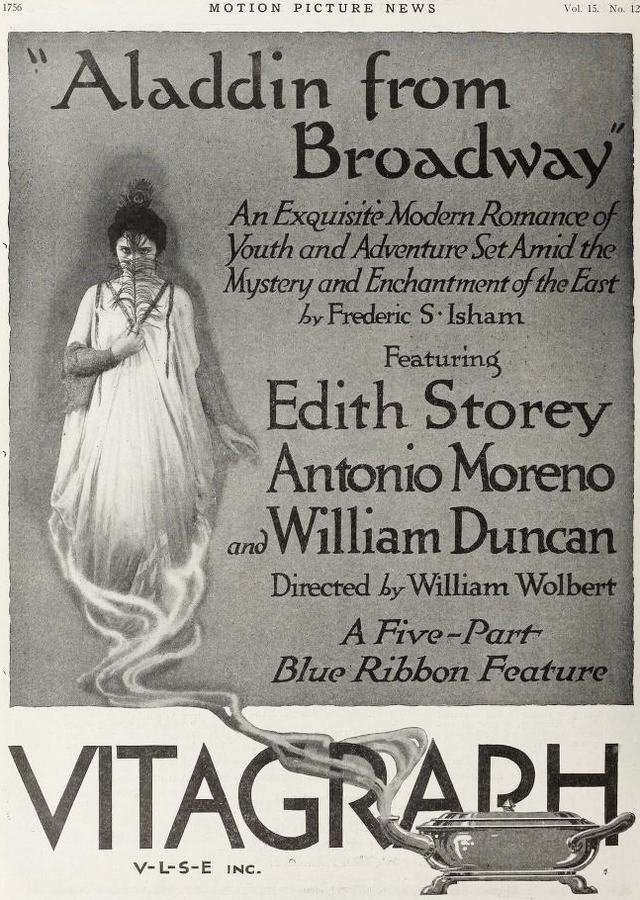
A definitive 6.5/10 rating for a film that redefined the boundaries of cult cinema. Aladdin from Broadway remains a cornerstone of transgressive art.
In the pantheon of early 20th-century cinema, few works attempt the sheer narrative audacity found in Aladdin from Broadway (1917). Directed with a keen eye for spectacle and a somewhat precarious grasp of cultural nuance, this film stands as a fascinating artifact of its era—a bridge between the Victorian melodrama of the past and the burgeoning globetrotting adventures that would eventually define Hollywood’s golden age.
The film’s inciting incident is not one of love or survival, but of ego. When Jack Stanton, portrayed with a kinetic, almost restless energy by Antonio Moreno, accepts a bet to infiltrate Mecca, we are witness to the quintessential American hero of the 1910s: polyglot, fearless, and slightly arrogant. This setup shares a thematic kinship with the high-stakes social maneuvering seen in The Social Highwayman, yet it transplants the stakes into a far more hazardous geopolitical landscape.
Stanton’s journey is not merely a physical traverse across continents but a linguistic and cultural masquerade. His ability to 'pass' in the East, facilitated by his father’s diplomatic history in Damascus, provides the narrative with a layer of suspense that predates the modern espionage thriller. This element of hidden identity and the psychological weight of the 'double life' is a recurring motif in the era, echoed in films like The Mystery of the Double Cross.
Where Aladdin from Broadway truly distinguishes itself is in its obsession with the intricacies of Koranic law—or at least, the Western cinematic interpretation thereof. The plot involving the 'triple divorce' (talaq) is utilized with a precision that borders on the Hitchcockian. When Amad, the wealthy diamond merchant, impulsively divorces Faimeh, he finds himself ensnared by a legal loophole that requires her to be married and divorced by another man before he can reclaim her. This creates a fascinating, if problematic, framework for the central romance.
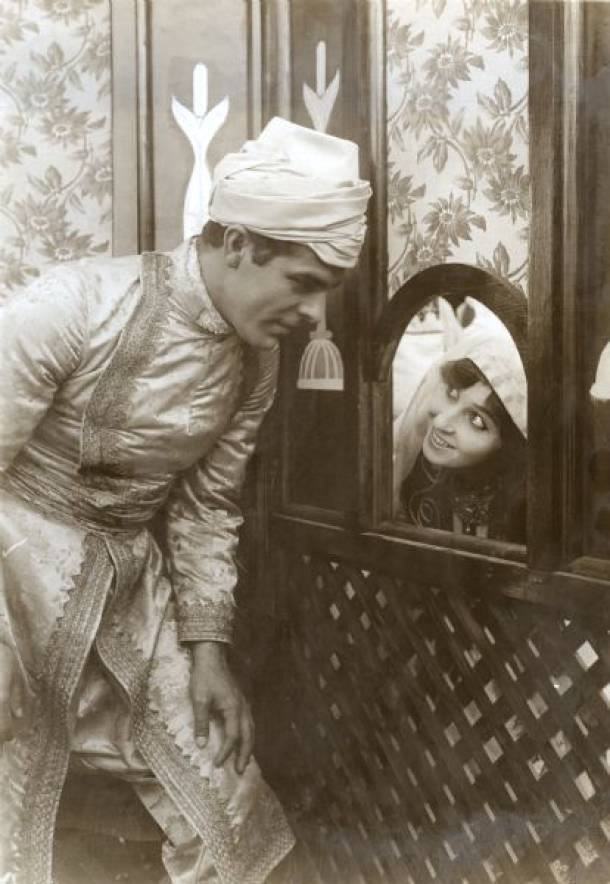
Stanton, ever the opportunist, is 'inveigled' into this temporary marriage, only to be struck by the luminous presence of Edith Storey’s Faimeh. Storey delivers a performance of remarkable pathos, capturing the desperation of a woman traded like a commodity between men. Her plight resonates with the domestic struggles depicted in Infidelity, though here the stakes are amplified by the alien nature of her environment. Her refusal to remain a pawn, and Stanton’s subsequent refusal to utter the divorce decree, transforms a legal comedy of errors into a high-stakes escape drama.
The cinematography, while constrained by the technology of 1917, manages to evoke a sense of scale that is genuinely impressive. The transition from the claustrophobic lattices of Damascus to the infinite, unforgiving horizon of the desert is handled with a sophistication that reminds one of the epic aspirations in Salambo, a $100,000 Spectacle. The use of natural light during the sandstorm sequence is particularly noteworthy; the way the dust obscures the frame creates a sense of visceral claustrophobia that modern CGI often fails to replicate.
"The sandstorm acts as a great equalizer, stripping away the veneers of merchant and adventurer, leaving only two men huddled under a single blanket against the wrath of the elements."
This sequence, where Stanton shows mercy to his pursuer Amad, marks the film’s moral peak. It is a moment of profound humanism that cuts through the Orientalist tropes of the rest of the production. Much like the moral quandaries explored in As a Man Sows, the film suggests that true character is revealed not in victory, but in the exercise of pity when one holds the power of life and death.
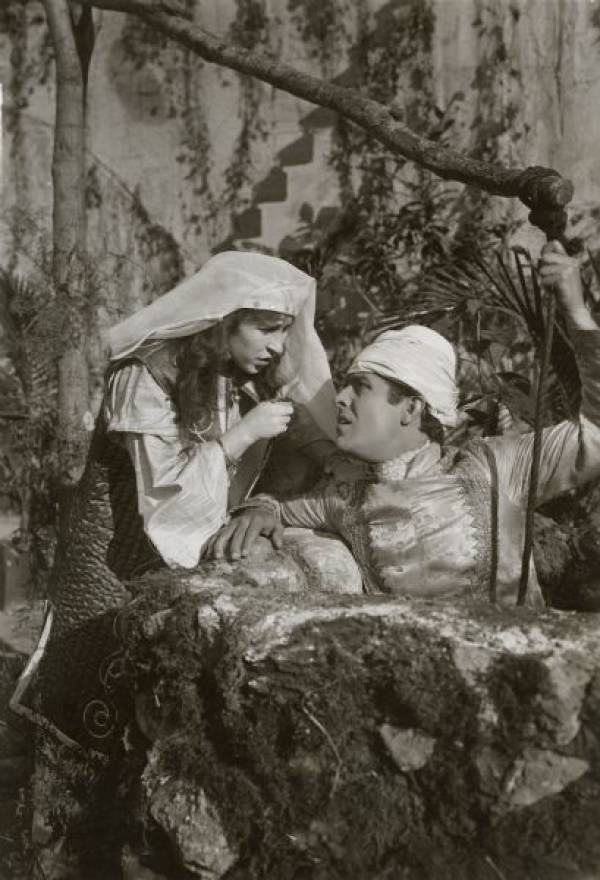
Antonio Moreno’s performance is a masterclass in silent film physicality. He moves with a grace that suggests both the Jewish storyteller and the American athlete, shifting between disguises with a fluidity that keeps the audience perpetually off-balance. This chameleon-like quality is essential for a film that deals so heavily in the 'othering' of its characters. It brings to mind the theatricality found in Loves and Adventures in the Life of Shakespeare, where the performance of the self is as critical as the plot itself.
Furthermore, the supporting cast, including Otto Lederer as the villainous Sadi and George Holt as Amad, provide a necessary weight to the antagonists. They are not mere caricatures; Amad’s eventual admission of Stanton’s self-sacrifice adds a layer of complexity to a character who could have easily remained a one-dimensional foil. This nuance in characterization is something that elevates Aladdin from Broadway above contemporary potboilers like The Fighting Trail.
Released in 1917, the film cannot be divorced from the global context of the Great War and the shifting borders of the Middle East. There is a palpable anxiety about the stability of empires—both British and Ottoman—that permeates the background of Fitzgerald’s inheritance. The search for the prayer book is a search for a lost order, a tangible connection to a pre-war past that has been shattered by 'Turkish uprisings.' In this sense, the film shares a certain melancholic DNA with Germania, though it masks its sorrow in the trappings of an adventure serial.
The final act, which sees Stanton staggering into Fitzgerald’s apartment in a state of 'brain fever,' is a classic melodramatic trope. His delirious utterance of the triple divorce, based on a tragic misunderstanding of Faimeh’s relationship with her father, provides one last hurdle before the inevitable happy ending. This sequence of recovery and explanation mirrors the emotional arcs found in A Change of Heart, where the resolution of a misunderstanding is the key to domestic bliss.
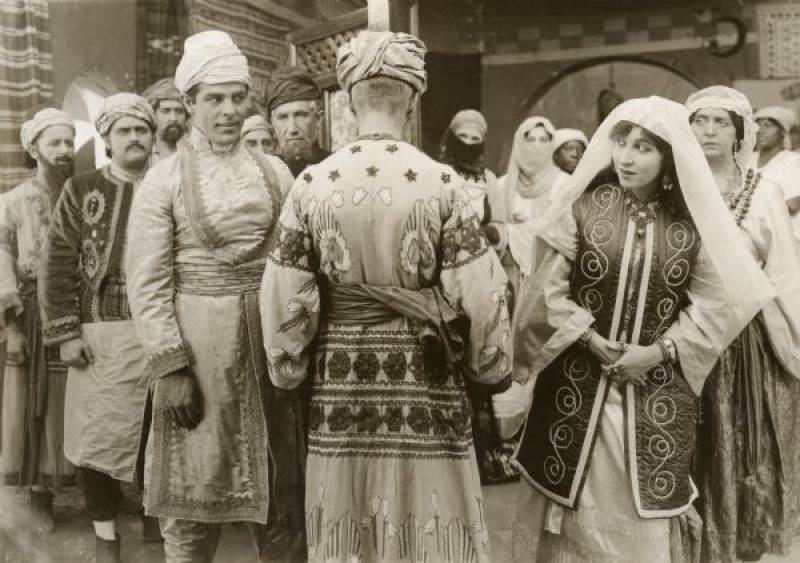
The pacing of Aladdin from Broadway is surprisingly modern. The writers, Frederic S. Isham and Helmer Walton Bergman, have constructed a script that avoids the static nature of many 1910s dramas. The cross-cutting between the desert pursuit and Fitzgerald’s search for his daughter creates a rhythmic tension that keeps the viewer engaged across its multi-reel runtime. It possesses a narrative drive similar to The Woman Who Dared (1916), another film that refused to be bound by the conventional limits of its genre.
Moreover, the film’s use of location—or at least, very convincing sets—gives it an atmospheric depth that is often missing from early silent features. The 'walled garden' where Stanton and Faimeh find their first moment of peace is a masterclass in production design, using shadow and light to create a sense of sanctuary amidst the chaos. This aesthetic choice echoes the moody, atmospheric environments of Der Hund von Baskerville.
The film’s conclusion, shifting from the exoticism of Damascus to the familiar bustle of Broadway, serves as a symbolic homecoming. It suggests that while the East is a place of trial and transformation, the West is the place where those transformations are codified and celebrated. The 'Christian marriage' that concludes the film is more than just a romantic resolution; it is a reassertion of the protagonists' original identities, now enriched by the trials they have endured.
In comparing this work to others of its time, such as Far from the Madding Crowd or Caste, one notices a distinct lack of provincialism. Aladdin from Broadway is a global film, unconcerned with the minutiae of English class systems or rural traditions, opting instead for a grand, cinematic language that speaks to the universal themes of loss, bravery, and the search for home. Even when it stumbles into the cliches of its time—such as the depiction of 'Light of Life' or the somewhat convenient recovery from 'brain fever'—it does so with a sincerity that is hard to dislike.
For the modern viewer, Aladdin from Broadway offers a window into a world where the map was still being drawn, and the cinema was the primary tool for exploring its furthest reaches. It is a film of immense ambition, realized through the formidable talents of its cast and the visionary direction of its crew. It remains a vital piece of cinematic history, much like The Image Maker or A Night in New Arabia, capturing a moment when the world felt both impossibly large and, through the magic of the silver screen, intimately accessible.
© 1917 Cinema Archive & Review. All rights reserved.
IMDb 6.1
1931
Community
Log in to comment.