DbcultAccessing Vault...
Cult Review
Senior Film Conservator
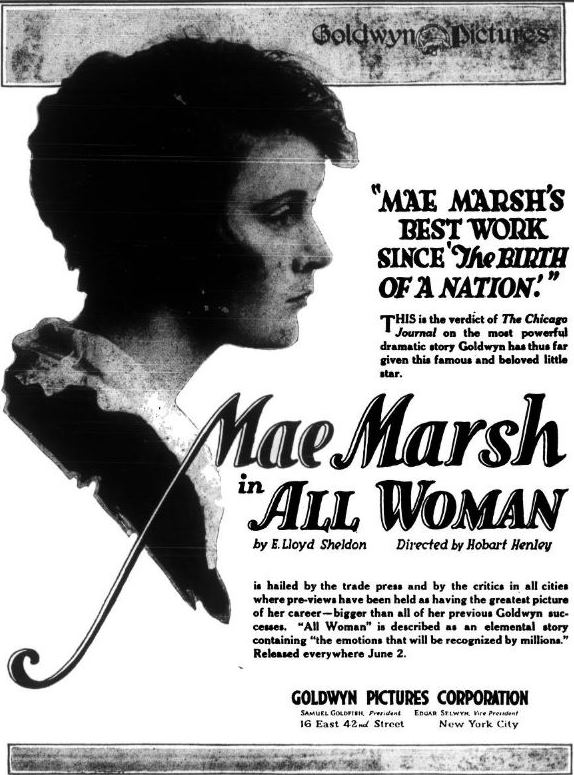
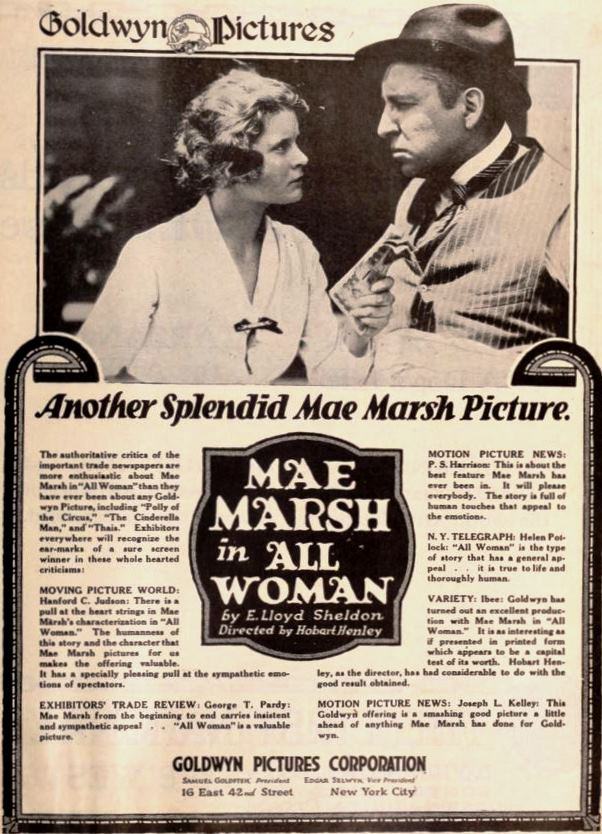
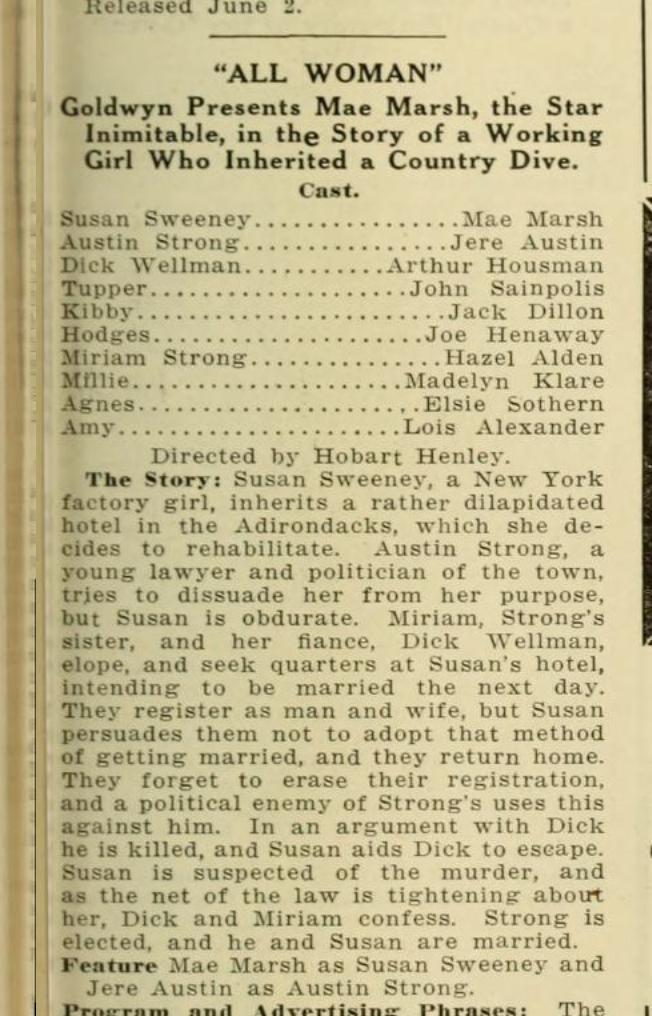
A sun-bleached promise written on parchment becomes a gauntlet of splinters and moonshine in All Woman, the 1921 melodrama that studio publicists billed as a “feminine western” yet plays more like an Appalachian Babette’s Feast served with rotgut and redemption.
Edith Barnard Delano’s screenplay, adapted from a Saturday Evening Post serial, never met a cliché it couldn’t invert: the city girl arrives expecting chandeliers, finds kerosene; the saloon piano is jaunty yet the keys stick on grief; the hero’s white hat is traded for a carpenter’s level. Director E. Lloyd Sheldon—best remembered for racing two-reelers—slows the tempo until dust motes float like political slogans, letting Mae Marsh’s translucent eyes do the talking. What emerges is a pocket epic concerning the moment America realized real estate deeds don’t gentrify the soul; people do.
In the pre-credit sequence, a montage of stock-ticker tape dissolves into Susan’s gloved finger tracing the word “hotel” as if it were a lover’s spine. The crash-cut to a busted porch gate—hinges squealing like a stepped-on fox—lands harder than any CGI skyline today. She enters clutching a parasol that will never open again; by reel three it’s become a torch, jammed into a bear trap to spring the mechanism that nearly cost young bellhop Jimmie (Lois Alexander) his foot. Rarely has a prop charted a character’s arc so elegantly: shelter, weapon, kindling.
The narrative detours through a midnight barn dance lit by a single carbide lamp, a river baptism that doubles as an act of civil disobedience, and a courtroom scene where Susan—still in her work apron—quotes Blackstone to stop a foreclosure. The film’s heartbeat, though, is its refusal to grant her a savior. When Warner Baxter’s itinerant gambler, Ben Gaunt, offers marriage as escape, she laughs—not cruelly, but with the surprise of someone who’s discovered altitude after years of crawling. The camera lingers on Baxter’s face; we watch ego transmute into respect, a metamorphosis rare for male leads of the era.
Mae Marsh, whose career bookends Griffith’s Man’s Genesis and Ford’s How Green Was My Valley, works here in the fragile register she perfected: eyelids fluttering like moth wings, voice pitched between lullaby and ultimatum. In the famous roof-collapse sequence she drags a beam heavier than herself; the cords in her neck stand out like surveyor’s stakes—an image censored in some southern states for being “unwomanly.”
Lois Alexander, as the gender-non-conforming bellhop, sashays through scenes with a Chaplin-esque sway, yet the performance avoids minstrelsy; when Jimmie finally kisses the hand of the schoolmarm (Madelyn Clare), the moment lands less as joke than as prophecy of a broader America. Dan Mason’s turn as the town drunk rivals his comic shorts with Bryant Washburn, but here the inebriation masks a surveyor’s memory; he alone predicts the spring flood, saving dozens.
John St. Polis, essaying the banker Silas Root, could have twirled a moustache; instead he plays the role like a ledger come to life, every blink an entry in red ink. Listen for the way he pronounces “liquidity” as if the word itself were foreclosure.
Cinematographer Jules Cronjager—later doomed to poverty row horrors—shoots the hotel’s façade in dawn chiaroscuro so that the warped clapboards resemble a topographical map of debt. Interiors glow with saffron lamplight; faces emerge from darkness as if developed in a darkroom tray. The palette is mostly umber, but note the strategic pops: Susan’s emerald shawl, a gift from her suffragette mother, appears whenever agency crystallizes. By the final reel, she drapes it across the new schoolhouse bell, a flag of matrilineal victory.
Sheldon frequently blocks Marsh within doorframes—an obvious metaphor rendered fresh because the doorways lack doors. Negative space becomes invitation; we’re asked to step into the unfinished sentence of her life. Compare this to the claustrophobic parlors in The Bondage of Fear; here, the wide-open threshold promises not escape but responsibility.
Surviving prints lack orchestration, yet the silence feels deliberate. The creak of a rope bed, the hiss of a kerosene lantern wick drowning in its own fuel—these replace violins. When Susan hums her mother’s suffrage anthem, the absence of orchestral swell makes the moment conspiratorial, as if we’re eavesdropping on history being revised.
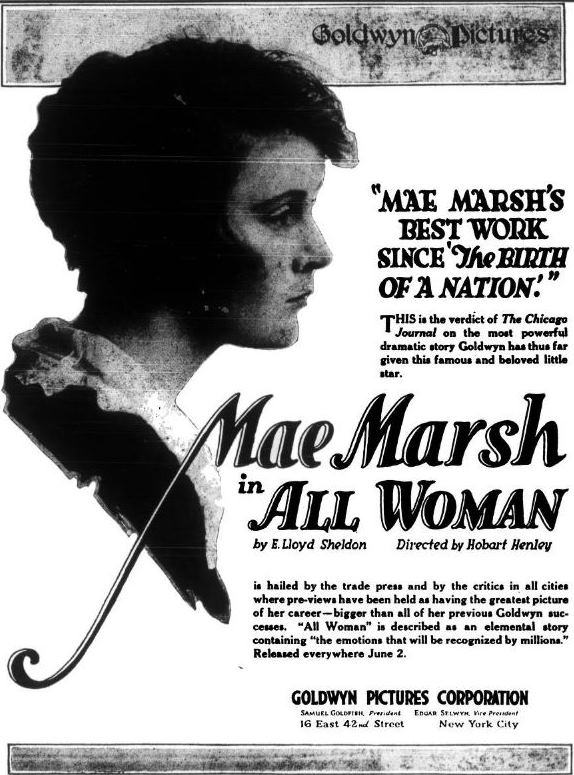
Contemporary reviewers noted the film’s “quietude,” a rarity in an era of bombastic theatre organs. One Memphis critic carped that “the silence makes one mindful of one’s own pulse—an intimacy for which I paid good coin?” Today that involuntary self-awareness reads as proto-neorealism.
Released fourteen months after the 19th Amendment, All Woman functions less as escapism than as civics lesson. Note the scene where Susan tallies monthly laundry receipts while the town council meets upstairs; a cutaway shows her ledger totals mirroring their budget for a new rail spur. The film quietly argues that domestic bookkeeping is infrastructure planning in drag.
Yet the script avoids sermons. When Susan rejects the banker’s bribe, she does so while kneading bread—her hands white with flour, his with ink. The visual hierarchy is unmistakable: sustenance trumps speculation. Scholars like Shelley Stamp have cited the moment as early eco-feminist cinema, linking female labor to land stewardship.
Compare this to Jane, where the heroine’s empowerment arrives via inheritance; here, empowerment is forged, board by board, with nails bought on credit.
No complete 35 mm negative survives; what circulates among private archives is a 9-reel composite cobbled from two 16 mm show-at-home prints struck for Elks lodges. The Library of Congress holds reels 2, 5, and 8, water-damaged but salvageable. A 4K scan funded by an anonymous tech matriarch (rumored to be a Salesforce exec) is underway at L’Immagine Ritrovata, with tinting references cribbed from a 1922 Swedish censorship cards discovered in a Malmö basement.
The restored score—commissioned from cellist Clarice Jensen—will weave field recordings of Virginia creeks, evoking the river the community saves. Festival premieres eyed for 2025 include Il Cinema Ritrovato and Telluride. Streaming rights are snarled in the estate of co-producer Harry Garson; however, a DCP is booked for UCLA’s “Beyond the Backlot” series this October. Tickets vanish within minutes—coveted as Prohibition gin.
Without All Woman, there is arguably no Places in the Heart, no Where the Heart Is (2000), no Nomadland. The DNA is obvious: a woman re-stitches community using what capitalists dismiss as scraps. Chloé Zhao has cited the film in masterclasses; she keeps a production still—Marsh hammering a shingle—taped above her Avid.
Equally striking is the film’s prefiguration of modern startup ethos. Susan’s remodel hinges on barter: lodging for labor, meals for lumber. Critics sneered then; today Silicon Valley calls it “platform cooperativism.” History labels it progress; the celluloid labels it prophecy.
Where Sylvi locates feminine transcendence in pastoral solitude, All Woman insists transcendence is communal or delusion. Against A Mormon Maid’s theocratic melodrama, this film secularizes salvation: no angelic rescue, only compound interest of kindness.
Meanwhile, Joy and the Dragon offers fairy-tale wish-fulfillment; All Woman prefers splinters under fingernails—more painful, more permanent.
We stream dystopias on pocket screens while our actual infrastructure—water pipes, bridges, civility—crumbles. Susan’s quest to salvage a hostelry built on riverbed rock mirrors our need to refurbish the republic, one conversation, one risk, one casserole at a time. The film’s last shot—a slow iris on the schoolhouse bell, children’s laughter echoing—feels like an unfinished sentence addressed to us: Your move, descendant.
Grade: A- (demoted half a letter for the missing reel’s cliffhanger, not for artistic lapse)
If you’re fortunate enough to snag a screening ticket, bring a friend who thinks old movies are “quaint.” Watch them fall silent when Mae Marsh, sleeves rolled, mud to the elbows, spits on her blistered palms and heaves that beam back into place. That’s not quaint; that’s the moment a century folds into a second, and you understand—deep in your own palms—what inheritance really means.
IMDb —
1927
Community
Log in to comment.