DbcultAccessing Vault...
4.1/10
Senior Film Conservator
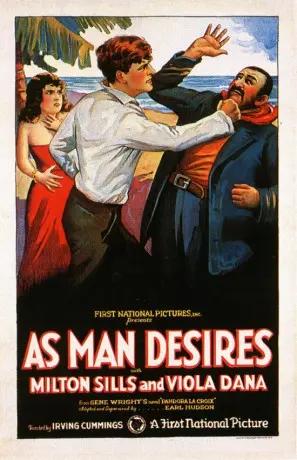
A definitive 4.1/10 rating for a film that redefined the boundaries of cult cinema. As Man Desires remains a cornerstone of transgressive art.
Short answer: Yes, but only if you have an appetite for the heightened emotional stakes and slow-burn pacing of late-silent era dramas. This film is for the cinephile who values atmospheric storytelling and the stoic masculinity of the 1920s, while it is certainly not for audiences who require rapid-fire dialogue or modern subversion of tropes.
This film works because it utilizes its tropical setting not as a postcard, but as a psychological pressure cooker that reflects the protagonist's internal decay.
This film fails because the third-act transition from a revenge thriller to a redemption romance feels slightly unearned given the darkness of the preceding hour.
You should watch it if you are a fan of Milton Sills’ rugged screen presence or if you enjoyed similar period explorations of exile like The City of Silent Men.
As Man Desires is worth watching for anyone interested in the evolution of the 'exile' narrative in American cinema. It offers a fascinating look at how the 1920s viewed the concept of the 'fallen man' and the redemptive power of the 'exotic' other. If you appreciate films that take their time to establish a sense of place—much like the deliberate world-building in '49-'17—this will resonate with you. However, casual viewers may find the melodrama a bit thick for modern tastes.
The setting of the 'pawn trees' is more than just a backdrop; it is a character in itself. In the mid-1920s, the South Seas were often depicted as a paradise, but director Irving Cummings—who would later become a staple of the studio system—treats the location with a surprising amount of grit. The men gathered here are the refuse of empires. They are individuals who have been 'pawned' by fate, much like the characters we see in Breaking Home Ties.
Milton Sills delivers a performance that is uncharacteristically grounded for the era. While many of his contemporaries were still leaning into the grand gestures of the stage, Sills uses his eyes to convey a man whose spirit has been cauterized. When he first encounters Viola Dana’s character, Pandora, there is a moment of stillness that is genuinely arresting. He doesn't fall in love; he fights against the very idea of it. It works. But it’s flawed. The script occasionally forces him into traditional heroics that feel at odds with the complex bitterness established in the first two reels.
The cinematography by the uncredited camera team captures the South Seas with a chiaroscuro intensity. The shadows in the bars where the 'men of all nations' gather are deep and oppressive. This isn't the bright, sun-drenched world of Wild Women; it is a world of sweat and regret. The way Cummings frames the wildflower-strewn landscapes against the jagged rocks of the coast serves as a constant visual metaphor for the clash between Pandora’s innocence and Craig’s hardness.
The film treats the South Seas not as a destination, but as a dirty, sweaty waiting room for the damned.
One of the most striking sequences involves a confrontation on the docks. The use of natural light and the movement of the extras creates a sense of chaotic realism that was rare for 1925. It reminds one of the social textures found in Jamestown, where the environment dictates the behavior of the characters. Cummings understands that for the audience to believe in Craig’s redemption, they first have to believe in the hell he’s living in.

While Sills and Dana carry the emotional weight, the supporting cast provides the necessary friction. Tom Kennedy and Ruth Clifford offer solid performances that anchor the more fantastical elements of the plot. Clifford, in particular, brings a level of dignity to her role that prevents the film from sliding into pure camp. Her performance provides a stark contrast to the more theatrical turns seen in Die Frau mit dem schlechten Ruf.
The inclusion of actors like Anna Mae Walthall and Rosemary Theby adds a layer of depth to the 'international' feel of the pawn tree land. These characters aren't just there for window dressing; they represent the various paths Craig could have taken—apathy, vice, or total surrender. In many ways, the film is a precursor to the existential noirs of the 1940s, where the protagonist is surrounded by 'ghosts' of his potential future selves.
Here is a stance that might bother traditionalists: the vengeance plot in As Man Desires is the least interesting part of the movie. The film is at its strongest when it focuses on the psychological stasis of John Craig. The moments where he is simply sitting in a darkened room, listening to the waves, are more evocative than any of the scenes involving the 'men seeking vengeance.' We've seen revenge a thousand times, from I promessi sposi to modern blockbusters.
What we don't see often enough is a nuanced portrayal of how a man loses his 'greatest love' and replaces it with a cold, hard shell. The film’s insistence on a traditional climax—where the villains are punished—actually weakens the emotional resonance of the ending. I would argue that a more daring version of this film would have left the vengeance unfulfilled, forcing Craig to find peace purely through his relationship with Pandora. But 1925 was not an era for such ambiguity.
Pros:
Cons:
When placed alongside other films of its time, such as A Man and His Money or the more European sensibilities of Die Bettelgräfin, As Man Desires stands out for its masculine vulnerability. It doesn't have the scientific rigor of Pasteur, nor does it have the lightheartedness of Miss Jackie of the Navy. Instead, it occupies a middle ground of serious, adult drama that was trying to prove cinema could handle complex human emotions without the need for spoken words.
The writing by Marion Orth, Gene Wright, and Earl Hudson is surprisingly tight for a silent film. They avoid the excessive intertitles that plague many productions from this year, allowing the visual storytelling to do the heavy lifting. While it doesn't reach the heights of a masterpiece, it is a solid, professional piece of filmmaking that deserves more than to be a footnote in a catalog.
As Man Desires is a compelling relic. It is a film that captures a very specific moment in cinematic history—where the industry was mastering the art of the silent epic just before the 'talkies' arrived to change everything. It isn't perfect; the story is as old as time and the resolutions are a bit too neat. But for those willing to sit with its shadows and its silence, it offers a hauntingly beautiful look at a man trying to find his way back from the edge of the world. It’s a 7/10 that feels like an 8/10 on a rainy afternoon.

IMDb —
1920
Community
Log in to comment.