DbcultAccessing Vault...
6.4/10
Senior Film Conservator
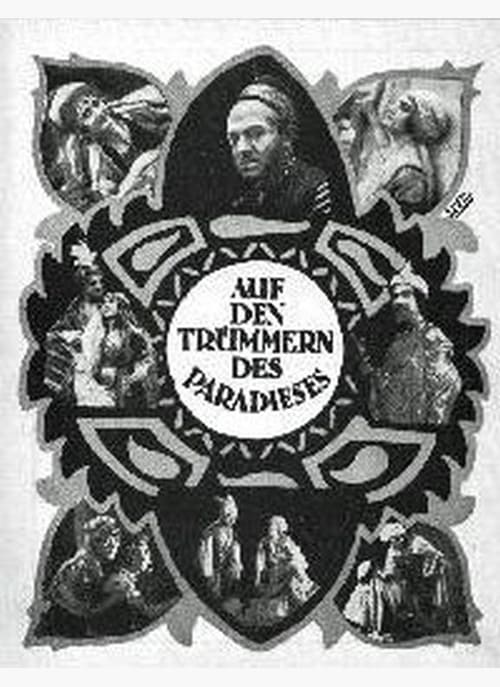
A definitive 6.4/10 rating for a film that redefined the boundaries of cult cinema. Auf den Trümmern des Paradieses remains a cornerstone of transgressive art.
The first thing that strikes you is the silence—the kind that feels excavated, not merely omitted. In the opening shot of Auf den Trümmern des Paradieses, a Balkan ridge stretches like a spine snapped in three places; no intertitles intrude for a full 42 seconds, an eternity in 1919 syntax. Wind rasps across the celluloid, scratching the emulsion the way guilt scratches memory. Already the film positions itself outside the grammar of its contemporaries: this is no Mágnás Miska carnival of operetta tropes, nor the moralising pageant of Womanhood, the Glory of the Nation. Instead, it plays like a missing link between Conscience and the later nihilist tide of Satan Junior—a poem whose every stanza ends with a gunshot.
Director Marie Luise Droop, working from a serialised Karl May novel that most adaptors would have swaddled in orientalist pomp, instead peels away the imperial loincloth. She shoots ruins as if they were fresh wounds: the camera tilts downward into fissures, catching the glint of bullet jackets half-buried in wild oregano. These shards aren’t set dressing; they are the film’s nervous system. When Vera’s silk sleeve snags on a rusted bayonet, the tear is audible—an intimate rip that echoes across the Balkans’ 1913 scar tissue. From that moment on, costume becomes archaeology: every frayed hem, every smear of ochre on de Vogt’s cheek is a breadcrumb leading us deeper into Europe’s unexpiated cul-de-sac.
Anna von Palen possesses the sort of profile that Expressionism was invented for: cheekbones like scythes, eyes that seem to bruise the air they survey. In close-up, her skin is the colour of parchment left too near a candle. The film’s publicity stills promised audiences a standard adventure romance; what unfolds is closer to reverse anthropology. Rather than civilising the wilderness, her Vera is gradually mineralised by it. Mid-film, she descends into a subterranean cistern lit by a single magnesium flare; water laps at her waist while stalactites drip onto her hair, calcifying her into yet another column. The scene lasts three minutes without a cut, daring us to confront the seduction of petrifaction. When she finally gasps, the sound is less human than geological—tectonic plates shifting.
Carl de Vogt, often derided as a slab of teutonic mahogany, here weaponises his stiffness. Harald’s stride is so erect it seems braced against an invisible cross; his inevitable downfall feels choreographed from the first frame. Watch the way he fingers the map of Paradise—really a coffee-stained military survey from 1878—as though it were holy writ. Each fold in the paper is matched by a furrow in his brow; by the time Strahil ambushes him, the map has become a second skin, lacerated simultaneously with his flesh. The film refuses the catharsis of a valiant last stand: Harald’s crucifixion is framed in wide shot, tiny against the broken arch, while a donkey grazes in the foreground, indifferent. The cruelty is casual, almost bucolic.
Those hunting for proto-Dracula signifiers will be confounded. Bela Lugosi’s revolutionary priest never bares fangs; instead, he brandishes a lantern jaw and a voice like velvet soaked in kerosene. His first appearance is a tracking shot that keeps his eyes just out of frame, a trick Droop repeats whenever chaos crests. We see only the clerical collar, the rifle butt slung over his shoulder like a crozier. When the lens finally lands on his irises, they burn with a messianic fever that makes you understand why peasants would trade confession for conspiracy. In the confessional scene—shot inside a gutted mosque whose mihrab gapes like a scream—he whispers a parable about two brothers who discover Eden and burn it to keep the other out. The camera holds on Vera’s reaction: a single tear that never falls, suspended as though the Balkans themselves refuse it burial.
Lugosi’s cadence prefigures the hypnotic rolls he would later bring to Murnau’s Dracula, but here the seduction is ideological. His promise of paradise regained curdles into a pogrom against the landowners; the film neither endorses nor condemns, only observes the metastasis. In one of the most upsetting sequences, children reenact a battle using human femurs as sabres. The priest strolls among them, blessing the skirmish with a languid sign of the cross. Off-camera laughter (is it the children’s? the crew’s?) seeps into the optical track, producing a shudder that no horror film of the decade—not even The Labyrinth—can rival.
Traditional adventure narratives hinge upon the recovery of plunder; Droop’s film hinges upon the impossibility of recovery. The Roman gold functions like a Rorschach blot: every character projects onto it the fantasy they most desperately need. For Harald, it is the seedbed of a restored aristocracy; for Strahil, the seedbed of an anarchist republic; for Vera, a syringe-full of oblivion. Yet the longer they quest, the more the treasure recedes, until it exists only as a rumour of sunlight on a riverbed. When at last they unearth the chest, it contains a cracked mirror and a parchment scrawled with a single word: "Veritas." The moment is staged without triumphant horns; instead, the score—sparse, percussive, built from timpani and distant artillery—drops into silence. One expects a final twist, a reveal that the gold was hidden elsewhere. None arrives. Truth, the film insists, is the only spoil, and it is worthless on the open market.
This anti-climax feels shockingly contemporary, predating the existentialist heist films of the 1950s. Compare it to Back to God’s Country, where nature eventually rewards virtue, or The Golden Wall, where industrial zeal yields redemption. Here, the earth offers only cavities. In a reverse of Genesis, the ground opens not to receive Abel’s blood but to vomit forth the bones of everyone who ever believed in property. The camera tilts up to reveal the dig site: a crater shaped like Europe, 1919.
Though nominally monochromatic, the surviving print bears evidence of ambitious tinting: amber for exterior daylight, viridian for underground sequences, a bruised magenta for the nightmare montage. The restoration team at Deutsche Kinemathek opted to retain the colour cues rather than normalise them, recognising that they function like emotional brackets. When Vera injects herself with morphine, the frame floods with a sickly chartreuse that makes her pupils glow sulphurous. It is as though the film anticipates the psychedelic horror of the 1970s, yet achieves its hallucinations through chemistry rather than optical printers.

Textures are haptic to the point of forensic. You can almost taste the dust that cakes Strahil’s beard, smell the mildew on the priest’s cassock. Such tactility is rare in films of the era; even Potop, for all its mud-drenched set pieces, keeps grime at a pictorial distance. Here, filth is existential: by the finale, every character’s skin appears to be flaking away, revealing not muscle but cartographic ink—veins that resemble river routes, scars that echo borders redrawn at gunpoint.
Weimar cinema frequently bifurcates women into angelic victims or femmes fatales; Droop detonates the binary. Vera’s arc is neither redemption nor damnation but erosion. She trades her last emerald for a vial of morphine, then uses the needle to scratch a new map onto Harald’s back while he hangs unconscious. The act fuses eroticism, cartography, and desecration into a single gesture. Beate Herwigh’s minor role as a deaf camp follower offers a counter-melody: she communicates solely through tactile sign, pressing objects into people’s palms—stones, teeth, once a live bullet still warm. In her silence resides a critique of the men’s logorrheal justifications for violence. The film never patronises her as noble; she steals, betrays, even kills, but each act is suffused with the urgency of someone rewriting history in the absence of language.
This complex approach to gender anticipates the murkier shadings of The Bride, yet arrives seven years earlier. Where that later film still frames its heroine through a male gaze that oscillates between reverence and terror, Droop’s camera treats femininity as a site of strategic knowledge rather than mystique. When Vera finally walks away from the ruins, her gait is uneven, arthritic; the film denies us the satisfaction of a restored Eden or avenging Valkyrie. She carries no treasure, only a rusted compass that spins wildly, as if even magnetism has lost faith in north.
Silent films, obviously, lack synchronous dialogue, yet many compensate with verbose intertitles. Droop and co-writer Baron pare text to a skeletal 37 cards, several consisting of single verbs: "Flee." "Burn." "Forget." The vacuum compels the viewer to listen to ambient absence: the scrape of leather on scree, the wet click of a cartridge eased into a chamber. During the morphine sequence, the projector’s own chatter merges with the on-screen action, producing a Brechtian rupture. You become hyper-aware of the celluloid’s mortality—scratches blooming like lichen across Vera’s face—mirroring the characters’ dawning realisation that their quest is merely a funeral postponed.
Compare this strategy to Dull Care, where orchestral bombast instructs the viewer how to feel at every beat. Here, emotional signposts are uprooted, leaving you stranded in interpretive fog. The effect is cognitively exhausting, akin to reading a novel with every third page torn out. Yet that lacuna is the very conduit through which the film insinuates its most radical idea: history itself is an incomplete print, spliced by censors, scarred by missing frames, forever screening to an audience that arrives too late.
For decades, Auf den Trümmern des Paradieses survived only as a footnote in trade papers, misfiled under Heimatfilme and presumed lost during the 1927 studio fire at Terra. In 1978, an incomplete 35 mm nitrate negative surfaced in the attic of a Ljubljana dentist who had once treated an itinerant cameraman. Even in its decrepitude—half the third reel dissolved into a molten mass—it outshone many a pristine classic. Each splice bore the aroma of Balkan sage; each missing frame felt like a deliberate ellipsis rather than casualty. Subsequent restorations added a chamber-score by Slovenian composer Nataša Kovačič, performed on cimbalom and prepared piano, further estranging the film from its Germanic roots.
Modern critics eager to map national cinema into tidy bloodlines find themselves thwarted. The film is too cosmopolitan for Serbian filmography, too Balkan for Weimar canon, too proto-noir for adventure serials. It exists in a liminal zone, a cinematic terra nullius where genres bleed into one another like watercolours in rain. Yet its influence flickers in surprising corners: the vertiginous wide shots of The Captive, the nihilistic terminus of Satan Junior, even the anti-treasure ethos of certain 1960s spaghetti westerns. You could splice 30 seconds of Strahil’s trek across the scree into Betty Be Good and no one would blink; his silhouette belongs to the grammar of the displaced.
Approach this not as you would a museum artefact—glass-cased, didactic—but as you would a half-remembered nightmare that visits at 3 a.m. Its pleasures are not cathartic; they are corrosive. You will not cheer when the villain falls, because the film insists there are only survivors, no heroes. You will not exit into sunlight whistling a theme tune; you will squint at the street outside and wonder which of its asphalt scars conceal Roman gold, which conceal only more mirrors.
Yet the experience is oddly life-affirming, in the way that any honest confrontation with annihilation can be. To witness Vera limp toward an unmarked horizon, compass spinning, is to recognise your own navigation by broken instruments. The film’s greatest gift is its refusal to console. In an age when even disaster is commodified into uplift, Auf den Trümmern des Paradieses dares to leave its audience buried under rubble, ears ringing with a silence that predates language. From that burial, something stubbornly verdant might grow—not paradise, perhaps, but the fragile conviction that acknowledging ruins is the first, necessary spadeful of earth on the path toward whatever comes next.

IMDb 7.8
1935
Community
Log in to comment.