DbcultAccessing Vault...
4.6/10
Senior Film Conservator
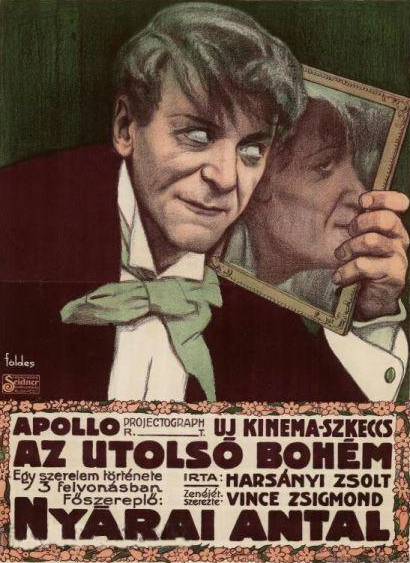
A definitive 4.6/10 rating for a film that redefined the boundaries of cult cinema. Az utolsó bohém remains a cornerstone of transgressive art.
There is a moment—about two-thirds through Zsolt Harsányi’s 1912 elegy Az utolsó bohém—when the celluloid itself seems to inhale ether and exhale ghosts.
The camera, starved of light yet drunk on contrast, lingers on Béla Bodonyi’s cheekbones: two razor-thin ridges rising from the hollow dusk of his face like the corroded battlements of some abandoned fortress. Behind him, Antal Nyáray’s violin droops, a pendulum counting down not time but temperature; the gut strings slacken in the clammy flat, and every note sags a centitone lower, as though music itself were melting. We are not watching actors; we are eavesdropping on a chemical reaction between pride, laudanum, and the invisible microbes chewing through lung tissue. The spectacle is so intimate it feels criminal, the way a coroner's photograph feels criminal—an intolerable clarity about a body you once loved.
Forget the cliché of the starving artist; Harsányi offers the starving medium. Paint, gin, women, even daylight—all are pigments already drying on the social palette. Bodonyi’s painter begins the film convinced he can still add to the world; he ends it convinced the world has already subtracted him. Between those poles, the script scatters incidents like cigarette ash: a pawnbroker who accepts sonatas as collateral; a carnival strongman who buys the poet’s last quill to pick his teeth; a secretary who types love letters on carbon paper so she can keep a copy of desire. None of these events coalesce into a climax; they merely accumulate, like the yellowed sheets of sheet-music that wallpaper the flat, each page a failed overture.
Compare this to the muscular linearity of Les Misérables or the moral geometry of The Count of Monte Cristo. Harsányi refuses redemption the way a starving man refuses a glass of water—he knows it will only prolong the agony. Instead, he structures the film like a fever chart: spikes of delirious color (a harlot’s vermilion shawl, a absinthe-green halo around a gaslamp) followed by troughs of soot-black ennui. The rhythm is arrhythmic, arrhythmic like a heart that has forgotten how to beat yet refuses to stop.
Bodonyi never plays dissolution; he exudes it, the way a cracked vase weeps whatever bouquet it once held. Watch the way his fingers tremble while buttering a scrap of bread: the butter is rancid, the bread fossil-hard, yet he drags the knife across it with the reverence of a priest dividing the Host. The gesture is futile, sacramental, obscene. Nyáray, by contrast, is all sound—not merely the violin but the creak of his boots, the click of his Adam’s apple when he swallows a lie. In one scene he rehearses a czardas for a countess so broke she pays him in candle-stubs; he plays fortissimo until the bow hairs snap, then continues with the wood itself, screeching a hymn to the idea that art can be forged from debt.
Elemér Thury has the least screen time yet etches the deepest scar. His poet enters mid-film, clutching a manuscript titled Songs for the Unborn. We never hear the poems; instead, we watch him sell individual pages to a rag-picker for kindling. Each time the rag-picker tears out a sheet, Thury winces as if flayed. By the time the book is empty, his character has literally disappeared from the narrative—a magician whose final trick is self-erasure.
Restorationists at the Hungarian Filmlab scanned the nitrate at 4K, then subjected each frame to a chromatic séance. The original tinting was reproduced using hand-mixed aniline dyes—amber for interior lamplight, aquamarine for dawn over the Danube, and a sickly orange for scenes of creative ecstasy. The result is a color palette that itches. You feel the urge to scratch the screen, to flake off the fungus of age, only to realize the fungus is the art.
Note the recurring visual rhyme: whenever a character sells a possession, the camera frames the coin in extreme close-up, the monarch’s profile gleaming like a death-mask. Cut to a wide shot of the recipient’s hand: the coin has already oxidized, a verdigris halo creeping across the royal cheek. In 1912 Budapest, money rusts faster than iron.
Archival records indicate the film premiered with a live Gypsy trio instructed to improvise deterioration—each subsequent reel slower, lower, more slurred. Today’s Blu-ray offers a reconstructed score by the ensemble Budapest Nocturne: violin strings tuned a quarter-tone flat, accordion bellows weighted with sand, a cimbalom struck with thimbles instead of mallets. The audio is mixed so low you strain to hear it, the cinematic equivalent of a whisper that makes you lean forward until you fall off your chair.
Where The Springtime of Life romanticizes poverty as pastoral prelude, and Marga aestheticizes squalor through art-nouveau curves, Az utolsó bohém deglamorizes glamorization itself. Imagine La Dame aux Camélias shot through a syphilitic haze, or Der Zug des Herzens stripped of every redemptive kiss. Harsányi’s bohemia is not a stage but a quarantine.
In an era when content creators monetize authenticity in real time, the film’s refusal to monetize anything—not suffering, not beauty, not even narrative closure—feels like a throat-punch. The characters are pre-influencer: they fail in private, they starve in private, they die in private, and the world lets them. Streaming platforms now peddle the myth that struggle is temporary, that every downfall is a story arc awaiting sponsorship. Harsányi offers the older, truer creed: some downfalls are just down.
The 4K restoration streams on criterionchannel.com through the end of the year; a limited-edition steel-book drops this December from Arbelos Films with a 72-page booklet featuring Harsányi’s shooting diary (“Day 14: the cat walked through the set and I kept the take—its tail looked like a paintbrush dragged across destiny”). Warning: do not watch on a phone. The film’s micro-tremors of despair demand a screen large enough to swallow you.
By the time the last reel judders to a halt, you will not applaud. You will sit in the dark tasting iron—your own blood, perhaps, or maybe the rust of coins that no longer exist. Somewhere in the gloaming, the violin’s final note still vibrates, a frequency too faint for microphones yet too loud for comfort. It is the sound of talent curdling into resentment, of beauty discovering that its truest color is gangrene.
Az utolsó bohém
does not end; it abandons. And in that abandonment, it grants the bitter mercy of truth: every masterpiece is merely the scar left by the wound of having been alive.
IMDb 7.3
1929
Community
Log in to comment.