DbcultAccessing Vault...
Cult Review
Senior Film Conservator
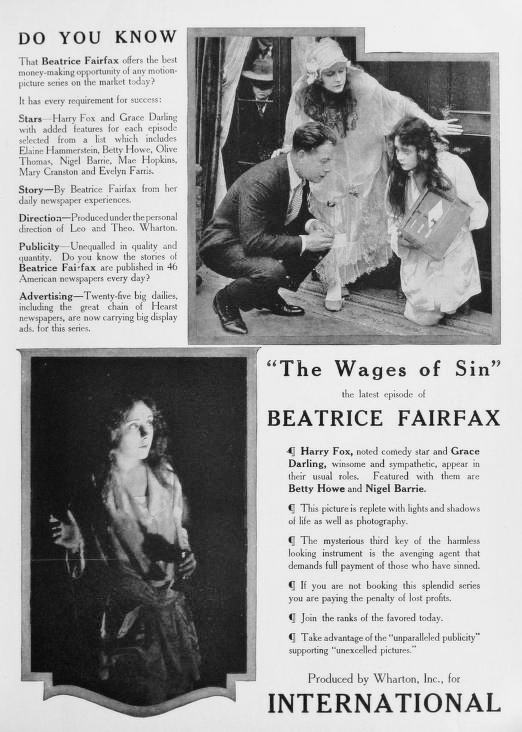
A single tungsten bulb burns low in the library, and the celluloid itself seems to inhale the kerosene-scented dusk. Episode 11 of Beatrice Fairfax—The Wages of Sin—unspools like a soot-black sonnet: every close-up a stanza of dread, every iris-in a tightening noose. Here the serial form achieves gothic apotheosis; the cliff-hanger is no mere marketing hook but a moral reckoning with the price of treachery.
The eponymous contraption—equal parts Fabergé and Frankenstein—rests inside a cast-iron safe whose door yawns like a portcullis. Jane’s discovery is shot from a steep Dutch angle, so the device appears to slide toward us, a metallic newborn hungry for oxygen and flesh. Its brass valves gleam with the same ochre that stains the film’s intertitles, suggesting that even the typography is infected.
Nigel Barrie plays the fiancé with a repertoire of micro-gestures: the left eyebrow hitches when he lies, the signet ring rotates compulsively as though screwing deceit deeper into his skin. The performance is calibrated for the front-row balcony yet whispers to the camera alone, a proto-film noir cadence that anticipates Rupert of Hentzau’s urbane rot.
Director Harry Harvey juxtaposes the Hamlin mansion’s chaste interiors with a cellar where ratty bourgeois intellectuals stroke their beards and plot apocalypse. Sverdrup—Otto Hahn in wolfish mode—laughs not with sound but with the flicker of a candle that stutters across his monocle. The montage recalls contemporaneous European anxieties visible in The Vampires: The Poisoner, yet locates terror not in Parisian catacombs but in a Manhattan brownstone.
When Boyd dons the phosphorescent shroud of Jane’s dead father, the film stages an Oedipal coup: capital speaks from beyond the grave, commanding filial obedience. The sheeted silhouette, back-lit by magnesium glare, is a negative image of maternal comfort; instead of lullabies it offers mercantile realpolitik. Jane’s faint is not theatrical but ontological—her world tilts, gravity reverses, the paternal superego becomes a ventriloquist for venality.
Grace Darling’s Beatrice enters wearing a tailored traveling coat the color of wet ash, a visual retort to the anarchists’ soot-stained jackets. She is the first woman in American serial cinema who investigates not for love or loot but for epistemological justice. Her revolver is petite, pearl-handled, yet when she fires from the doorway the recoil ripples the wallpaper’s damask pattern—a ripple that prefigures CGI but is achieved with actual gunpowder and stitched celluloid.
Harry Fox’s reporter, all cowlicks and caffeinated jitters, supplies slapstick that never dilutes dread. His shadowing of Boyd through rooftops is choreographed like a Harold Lloyd gag—except the precipice ends in geopolitical catastrophe rather than personal pratfall. When he overpowers Sverdrup, the scuffle is framed in long shot so the city’s electric hoardings bleed into the mise-en-scène, turning urban modernity itself into a reluctant referee.
The anarchists’ ultimate theft of the device lands with ironic punch: Jimmy has already pressed the forbidden third stud. The cutaway to an abstract seascape—stock footage of waves gnawing a jetty—implies that poison drifts toward an unspoken armada. It is 1916; the Great War looms; chemical warfare is not yet household vocabulary. Thus the film weaponizes foreknowledge, making viewers complicit in a terror that history will soon authenticate.
Tinting protocols render night scenes in cobalt, interiors in ochre, flashbacks in sepia. Yet no crimson appears—blood is suggested only through the imagination of color’s omission. The resultant palette is a fever chart: ochre for avarice, cobalt for surveillance, sepia for the irrevocable past. The absence of red becomes a negative space where audiences spill their own sanguine fears.
Jane begins as heiress-in-distress but ends by guiding Beatrice and Jimmy to the library, asserting archival mastery over her father’s toxic heritage. The arc rhymes with suffrage-era texts like Your Girl and Mine: A Woman Suffrage Play, yet refuses didacticism; liberation is earned through strategic alliance rather than oratory.
Exhibitor manuals suggested playing Saint-Saëns’ Danse Macabre during the ghost sequences and John Philip Sousa for the rooftop pursuit. Modern revivals often commission discordant string quartets that bow behind the screen, creating a stereo haunt between past and present. The tension between scored and unscored exhibition history adds another palimpsest to an already layered artifact.
The infernal machine as MacGuffin reverberates through Hungarian cinema in Bánk bán and later through noir classics. Meanwhile the anarchist cell prefigures the shadow-lists of The Blacklist, proving that political paranoia is a renewable resource.
Seriality demands deferral; yet here the deferral is not of life-vs-death but of ethics-vs-extinction. Viewers return not to learn who survives—survival is cheap—but to discover whether knowledge itself can outrun catastrophe. The episode ends on a question mark that clangs like a dropped wrench in an empty battleship.
Only two 35mm prints are known: one in the BFI archive (shrinkage level .8 %), another in a private Rochester collection. A 4K scan circulated among silent-film message boards shows Barber’s scratches transformed into snowfall, an accidental beauty that rivals the intentional decay in The Glory of Youth.
In 1916 Moving Picture World praised the episode’s “feminine pluck,” while Variety sniffed at its “melodramatic excess.” Contemporary censors objected to the poison-gas detail; several states excised the intertitle. Modern scholars read the film as proto-eco-horror: a toxic device released into the commons anticipates 20th-century ecological guilt.
At 22 minutes, The Wages of Sin compresses enough ideological nitroglycerin to fuel a semester’s syllabus: gender, capital, technology, terror. It is neither quaint relic nor antiquarian footnote but a live cartridge whose gunpowder still sneezes when exposed to the oxygen of the present.
Community
Log in to comment.