DbcultAccessing Vault...
Cult Review
Senior Film Conservator
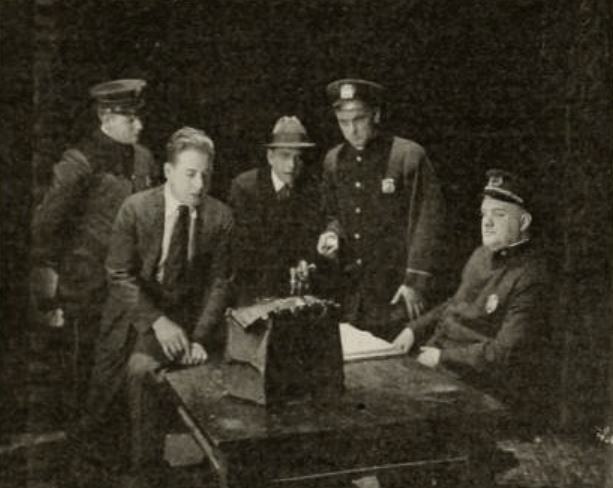
Beatrice Fairfax—newspaper soothsayer to the lovelorn—never expected her ink-stained sanctuary to become a battleground for a fortune’s soul. Yet the moment Alice Masters’ lilac-scented plea lands on her desk, the serial’s fourteenth chapter pivots from epistolary fluff to proto-noir arsenic.
Alice, platinum heiress and convenient orphan, writes of engagement bliss with chemist David Holmes, a match her guardian-cum-purse-string-tyrant Mr. Harvey deems “financially inexpedient.” The second trustee, Mr. Wells, plays benevolent uncle—until he ends up rigor-mortised beside an open window, lips the color of week-old bruise. Enter Jimmy Barton, sob-sister-turned-crime-hound, who spots the nominative echo—“Wells”—and sniffs story like a bloodhound on truffle.
What follows is a Rube Goldberg of homicide: a black leather physician’s bag rigged with a timer, a spring-loaded valve, and a crystal ampoule of something that smells like burnt almond and screams like absinthe. Harvey, in panicked brocade, hauls the valise into Wells’ mahogany cloister, leaves, and lets chemistry do what jurisprudence would not. An hour later the bag yawns; cyanogen curls; Wells collapses mid-telephone call, clutching margin calls he will never answer.
Director Edward V. Durling, saddled with nickelodeon budgets, turns parsimony into perverse poetry. The bag itself—shot in chiaroscuro against white tile—becomes a character, its brass latch glinting like a wink from Mephistopheles. When Jimmy, disguised in crimson union-suit horns, waves the infernal satchel under Harvey’s nose, we’re miles away from the drawing-room politesse of The Fates and Flora Fourflush and knee-deep in German-expressionist sludge.
Meanwhile Beatrice, refused entry by a butler who could out-glower David Harum’s sly horse-trader, camps bedside like Florence Nightingale with a notebook. Alice’s “delusions” flicker across her iris—phantom serpents, chandeliers bleeding molasses—yet Beatrice intuits the gaslighting before the term exists. The film’s proto-feminist pulse quickens: a woman’s word against a man’s ledger, her sanity on trial because her portfolio is large.
Jimmy’s break-in—via balcony balustrade worthy of Hampels Abenteuer—yields a taxidermic wunderkammer: peacock tails, glass-eyed marmosets, and a crocodile-skin smoking jacket. The bag nestles amid these curios like a Fabergé egg in a catacomb. When the servant locks it away, the key lands on a Chippendale table with a click that reverberates through the nitrate; Jimmy, under the four-poster, pockets it like a pickpocket at communion.
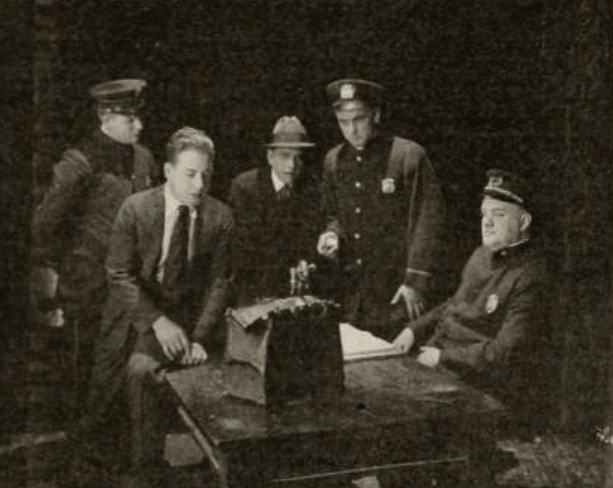
The second act is a masterclass in deferred revelation. At the precinct, Jimmy inserts the key not to unlock but to wind; gears whirr, the bag trembles, and a plume of vapor rises like incense to Mammon. Detectives recoil as if Beelzebub himself burped. Yet Jimmy—half-smiling, pocket-watch in hand—knows the real bomb is Harvey’s signed confession, not the chemical kabuki.
Costume alchemy arrives when Jimmy dons a devil suit pilfered from the mansion’s theatrical stash. The cape flares like a comet tail as he intercepts Harvey’s reptilian assault on Alice—rubber snake strapped to forearm, a parody of every patriarchal boogeyman. The scuffle ends with Harvey handcuffed to his own baroque bedpost, forced to watch the bag tick toward an hour that will never arrive. It’s Kafka meets Barnum, a shaming ritual predating the pillory of The Murdoch Trial.
Grace Darling’s Alice quavers between heiress fragility and steel-spined survival; her tremulous close-ups prefigure the neurotic heiresses of 1940s noir. Wellington A. Playter’s Harvey oozes fiduciary smarm—every narrowed eye a ledger column, every smile a promissory note. Betty Howe’s Beatrice, alas, is relegated to moral chaperone, but her mere presence sanctifies the narrative: a woman’s counsel as antidote to masculine avarice.
Technically, the episode flaunts 1916’s bag of tricks: double-exposed hallucinations, iris-ins on ticking mechanisms, a hand-cranked POV through the bag’s keyhole that turns the interior into a cavernous opera house of menace. Compared to the pageantry of The Kineto Coronation Series, the scale is intimate, but the emotional voltage is cranked higher.
Historians often slot early serials as cliff-hanger conveyor belts; here, the cliff is ethical. Harvey’s speculation with Alice’s trustfund—margin calls arriving by telegram like telegraphic subpoenas—mirrors the era’s unregulated stock-market orgy. The poison bag is merely the id of high finance: risk vaporized, liability atomized, death by proxy. The film’s prescient critique anticipates the venality exposed in Down with Weapons and the systemic rot limned in The Fixer.
Yet for all its pre-noir trappings, the tone retains nickelodeon bounce: title cards wink (“Harvey’s bag—like Pandora’s, but with better tailoring”), Jimmy’s pratfalls leaven the dread, and the climax restores moral equilibrium faster than you can say Ambition. The epilogue—Harvey’s signed parchment, Alice freed to wed, the bag defused—wraps with a curt “The End” superimposed over a cherub’s grin. We exit the dark, blinking, reminded that justice, like cinema, is a contraption we wind ourselves.
In the wider arc of Beatrice Fairfax’s 30-chapter run, Episode 14 stands as the moment the series grew fangs. It’s a Rosetta Stone for proto-feminist crime serials, a missing link between the moral melodrama of The Sorrows of Love and the urban cynicism soon to stain Warner gangster pictures. Seek it out in whichever archive has not yet crumbled to dust; let its ticking leather heart remind you that every era’s monsters carry bags—some stuffed with money, others with vapor, all demanding payment in full.
Community
Log in to comment.