DbcultAccessing Vault...
Cult Review
Senior Film Conservator
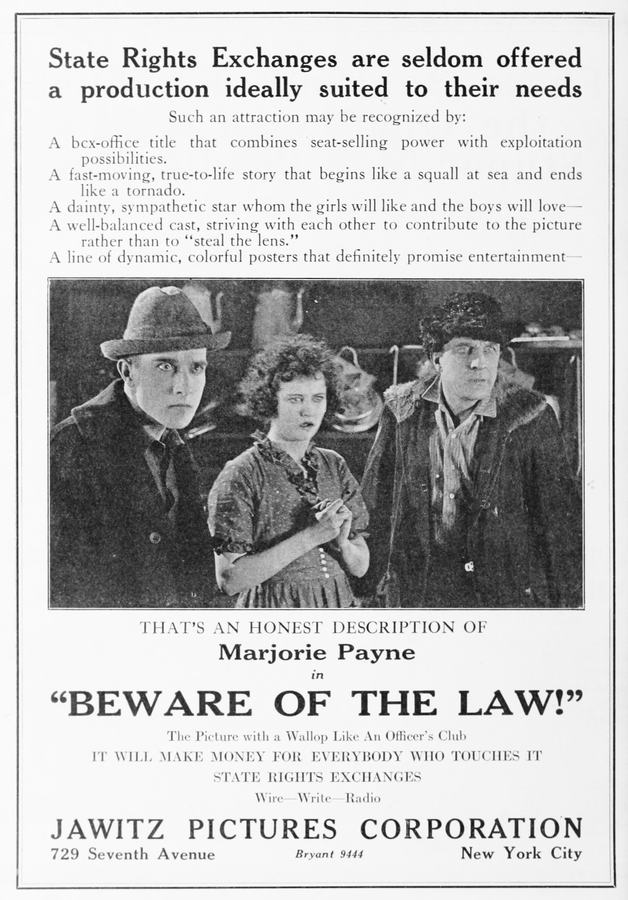
The celluloid reels of 1926 still smolder in the vaults of forgotten Americana, yet none glow quite so eerily as Frank S. Beresford’s Beware of the Law, a moonshine-marinated morality play that drips resinous paranoia into every splice. Shot on location amid Michigan’s snow-bruised pines, the film exhales a chill that predates the urban fatalism of later noir; its silhouettes are already entombed in perpetual twilight, faces half-swallowed by the maw of the forest.
Beresford, a director more chronicler than showman, dispenses with title-card exposition in favor of tableau vivant: an axe lodged in a stump, sap crystallizing like blood-beads, a federal badge glinting against birch bark. The camera lingers until atmosphere calcifies into allegory. Cinematographer D.W. Reynolds (pulling double duty as the bootleggers’ hulking enforcer) bathes night-for-night exteriors in magnesium glare, turning snow into a mirror that refuses to flatter anyone’s reflection.
Compare this with A Widow’s Camouflage—all velvet interiors and lace-filtered close-ups—and you’ll gauge how starkly Beware of the Law rejects domestic coziness. Even The Miner’s Curse, for all its subterranean claustrophobia, lacks the spiritual frostbite that Beresford achieves here.
Marjorie Payne’s Rose LeBarbe navigates the narrative like a sleepwalker clutching a kerosene lamp—her eyelids forever half-mast, as though the simple act of seeing might indict her. She is Eve in a lumber camp, complicit in the apple-brew before she tastes it. Payne’s micro-gestures—a thumb brushing a rosary, a lip bitten to keep from praying—convey a piety that curdles into self-loathing once she bandages McRae’s ribs. Rarely in silent cinema does a woman’s moral fracture register so quietly yet so thunderously.
William Coughey’s Jules Grandin, by contrast, is a monument of rectitude carved from pine resin and Protestant duty. He never twirls a mustache or flexes a bicep; his heroism resides in restraint, in the refusal to fell the last standing tree of his conscience even when Ann’s betrayal buzzes like a saw. Coughey’s granite profile belongs on a coin minted by a republic too young to know cynicism.
Henry Van Bousen’s McRae arrives half-god, half-ghost, a G-man stitched from wound dressings and moral absolutes. Watch how Van Bousen manipulates posture: spine erect when dictating warrants, shoulders folding inward when exchanging glances with Rose. The performance anticipates the wounded eroticism that Humphrey Bogart would popularize a decade later, yet Van Bousen’s anguish feels prelapsarian—as though the concept of corruption had only just been whispered into his ear.
Anne Dearing’s Ann functions less as flesh than as market force: her affections oscillate according to whoever controls the next shipment. Scholars of gender in early Hollywood will note how Beresford weaponizes her perfidy to critique post-war liquidity itself—women as tradable futures in a bootleg economy. Ann’s recantation, hurried and slightly off-key, lands with the thud of studio-imposed redemption. Even so, Dearing injects a tremor of sincerity into the final embrace, suggesting that contrition, like liquor, can be watered yet still burn.
Though the original score is lost, archival notes indicate a live trio—piano, violin, trap-drum—syncopating its allegro to the chopping of axes. Contemporary festival reconstructions favor a minimalist drone, letting the crunch of boots on frost become percussion. Either choice foregrounds the film’s sonic absence: every gunshot is a visual shudder, every heartbeat a title card that chooses not to speak.
Art director John Altieri constructs a cathedral of crates—each stamped with the sigil of a defunct brewery—where chiaroscuro worships at the altar of contraband. Shadows of barrel staves stripe faces like prison bars, forecasting doom without a single intertitle. Contrast this with Annexing Bill, whose saloon sets exude vaudeville gaudiness; Beresford’s moonshiners operate in cathedrals of guilt, not honky-tonks of delight.
At a trim fifty-eight minutes, the plot moves with feral economy. Yet Beresford refuses to rush the penitential coda: McRae’s decision to look past Rose’s lineage, Jules’s forgiveness of Ann, the LeBarbe patriarch’s curtained fate—each is granted a tableau spacious enough for viewers to project their own moral algebra. The final kiss—Rose and McRae silhouetted against lantern-light—frames not triumph but precarious equilibrium, a whisper that the law will forever be a step behind the human heart.
Stack Beware of the Law beside A Kiss for Susie and you’ll notice both trade in cross-class romance, yet Susie’s tenement glow feels positively sun-drenched against Beresford’s tenebrous forest. Pair it with Heart Strings—another tale of divided affections—and the latter’s harpsichord sentimentality wilts under the harsh clang of Beresford’s iron-tipped morality. Only The Key to Yesterday matches its obsession with irrevocable past sins, but Yesterday leans on Gothic parapets whereas Law roots its fatalism in the soil of Prohibition’s making.
Note Rose’s left hand when she first spots McRae: fingers splay, then retract into a fist, the pinky lingering extended—an involuntary teacup gesture imported from parlors of propriety. Or study Jules removing wood shavings from his cuffs before the climactic shoot-out, a mundane ablution that signals readiness to kill. These granules of behavior, caught in medium-long shot, testify to Beresford’s trust in audience literacy; he does not cut in to telegraph significance.
Historians will appreciate how the film encodes Canada’s liquor pipeline—Detroit River fog, Windsor docks glimpsed through mist—without jingoistic fanfare. Beresford’s bootleggers are entrepreneurs of appetite rather than caricatured gangland brutes; their villainy lies in commodifying tomorrow’s regrets, not in foreign accents. This nuance distinguishes the picture from Scotland Forever, whose kilts-and-claymores exoticism sidelines social critique.
Legend whispers that a ninth reel—depicting the rum-runners’ forced baptism in their own gin—was excised by Ohio censors. No print substantiates this, yet the jump-cut preceding the finale feels suspiciously abrupt, the villains’ comeuppance curiously bloodless. Whether lost or never shot, the lacuna feeds the film’s mystique, proving that prohibition extended not just to liquor but to images.
In an era when regulatory bodies again tangle with intoxicants—be they chemical, digital, or ideological—Beware of the Law feels prophetic. McRae’s crusade mirrors today’s whistleblowers; Rose’s moral vertigo prefigures every bystander turned accomplice via algorithmic complicity. The forest, once a frontier, now stands in for the darknet—its trails encrypted, its dangers sovereign.
A 4K photochemical scan from the surviving 35 mm at the Library of Congress reveals cigarette burns never meant for modern eyes—studio shorthand for reel changeovers, now ghosts in the machine. Grain structure remains voluptuous; Reynolds’s high-contrast lighting, once muddy in dupes, now stings like fresh iodine. Though no boutique label has announced a Blu-ray, cine-clubs report sell-out screenings whenever a Wurlitzer accompanies. Streamers eye it cautiously—silents require context, and context demands curation.
Great art often arrives swaddled in banality; Beware of the Law lands swaddled in sawdust and cordite, smelling of pine tar and penitence. It is neither pristine enough for academic hagiography nor lurid enough for cult camp, hence it drifts like smoke between canons. Seek it out not for perfection but for patina—a film whose scratches map the geography of a nation learning that morality, like liquor, is most dangerous when driven underground.
Score: 8.7/10—docked a decimal for Ann’s too-tidy redemption, awarded two for Payne’s eyes that indict the lens. Watch it beside Motherhood for maternal contrast, chase it with Dangerous Curve Ahead for vehicular fatalism, or let it stand alone in the dark—where the law is only as visible as the flicker that warns you to behave.

IMDb —
1924
Community
Log in to comment.