DbcultAccessing Vault...
Cult Review
Senior Film Conservator
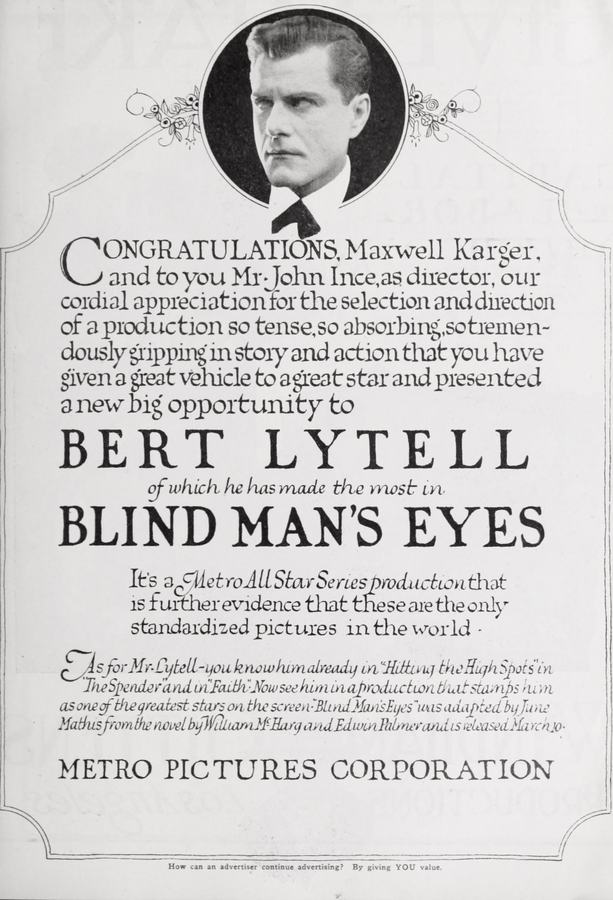
In the nascent years of the American thriller, few films managed to synthesize the anxiety of the 'wrong man' trope with the claustrophobic tension of transit as effectively as Blind Man's Eyes. Directed with a keen eye for spatial dynamics and scripted by the legendary June Mathis, this 1919 production transcends the simplistic moral binaries of its era. While many contemporary works like The Immigrant explored the external struggles of the displaced, Blind Man's Eyes turns its gaze inward, examining the psychological erosion of a man living under a borrowed skin.
The film opens not with a grand spectacle, but with the intimate, almost voyeuristic atmosphere of a Pullman sleeping car. This setting is more than a backdrop; it is a microcosm of a society in flux, where strangers share thin partitions and secrets are whispered over the roar of the engine. Bert Lytell, as Hugh Overton (alias Philip Eaton), delivers a performance of remarkable restraint. In an era often criticized for theatrical overacting, Lytell utilizes subtle shifts in posture and gaze to convey the perpetual vigilance of the hunted. His portrayal of Overton is a masterclass in suppressed trauma, echoing the thematic weight seen in other Mathis-penned dramas such as Secret Strings.
One cannot discuss the efficacy of this film without centering the contribution of June Mathis. As one of the most powerful women in early Hollywood, Mathis possessed an uncanny ability to structure complex plot density without sacrificing emotional resonance. In Blind Man's Eyes, she weaves a web of deception that feels surprisingly modern. The revelation that the antagonist, Matthew Latrone, is not a ghost but a living, breathing puppet master, serves as a searing critique of the untouchable nature of the financial elite. This exploration of corrupt wealth mirrors the social anxieties found in Hoarded Assets, yet here, the stakes are viscerally personal.
Mathis’s screenplay avoids the pitfalls of the 'melodrama of the week' by grounding the conflict in a tangible sense of dread. The 'Blind Man' of the title—referencing the original novel's blind lawyer Basil Santoine—acts as a sensory foil to Overton’s visual hyper-awareness. While the film focuses heavily on the Eaton/Overton pursuit, the metaphor of blindness permeates every frame. It is a film about what we refuse to see: the corruption behind the financier’s smile, the innocence behind the convict’s mask, and the lethal intent hidden in a crowded train car. This thematic depth elevates it above lighter fare like Getting Mary Married, positioning it instead as a precursor to the noir movement.
The cinematography in Blind Man's Eyes utilizes the limitations of the 1919 camera to its advantage. The use of low-key lighting in the train corridors creates a sense of encroaching doom, a technique that would later become a staple of the genre. When compared to the brighter, more expansive vistas of The Long Trail, this film feels remarkably modern in its use of shadows to dictate mood. The director understands that the true horror lies not in the assassin’s blade, but in the uncertainty of when it will strike.
The supporting cast, including Frank Currier and the luminous Naomi Childers, provide a solid foundation for the central conflict. Childers, in particular, navigates her role with a grace that avoids the 'damsel in distress' cliches, offering a performance that rivals the depth seen in His Parisian Wife. The chemistry between the leads is palpable, built on a foundation of shared secrets and mutual suspicion rather than instant, unearned romance. This grounded approach to character interaction is a hallmark of the film's enduring quality.
When examining Blind Man's Eyes alongside its peers, one notices a distinct departure from the escapist tendencies of the era. If The Captain's Captain is a voyage into adventure, and Heiress for a Day is a flight of social fancy, then Blind Man's Eyes is a descent into the reality of systemic injustice. It shares a certain grim realism with Parasites of Life, yet it maintains a propulsive energy that keeps the viewer engaged through every twist.
The film also engages with the concept of the 'double life' in a way that predates the psychological thrillers of the 1940s. Overton’s transformation is not merely a change of name, but a complete erasure of his former self—a theme echoed in the darker undertones of Emerald of Death. However, unlike the gothic sensibilities of Der Schloßherr von Hohenstein, the horror here is rooted in the industrial and the urban. The train is a machine that cannot be stopped, much like the legal system that has condemned an innocent man.
The post-WWI era was a time of significant upheaval, and cinema reflected this instability. Blind Man's Eyes captures the disillusionment with authority figures that was beginning to permeate the American consciousness. Matthew Latrone is the ultimate personification of this distrust—a man who can fake his own death and manipulate the law from beyond the 'grave.' This cynical view of the upper class was a bold choice, contrasting sharply with the more traditional social hierarchies presented in Old Wives for New.
Furthermore, the film's pacing is relentless. From the initial introduction of 'Philip Eaton' to the final confrontation, there is a sense of kinetic momentum. It avoids the static nature of many early features, opting instead for a fluid narrative that mirrors the movement of the Pullman car. This sense of urgency is something often missing in experimental works like The Upstart or the more leisurely paced The Little Girl That He Forgot. In Blind Man's Eyes, every second counts, and every shadow could hide a killer.
To watch Blind Man's Eyes today is to witness the birth of the modern suspense thriller. It is a film that understands the power of the unseen and the weight of a secret. The collaboration between Bert Lytell’s stoic magnetism and June Mathis’s intricate plotting creates a cinematic experience that remains remarkably potent. It is a reminder that even in the silent era, filmmakers were capable of crafting stories that were as intellectually stimulating as they were visually arresting.
While it may not have the slapstick energy of Keep Moving, it offers something far more substantial: a meditation on the fragility of identity and the resilience of the human spirit in the face of overwhelming corruption. For any serious student of film history, or for those who simply appreciate a well-told mystery, Blind Man's Eyes is an essential piece of the puzzle. It is a testament to the fact that while technology evolves, the core elements of a great thriller—tension, character, and a touch of the macabre—are truly timeless. The film lingers in the mind like the low whistle of a distant train, a haunting reminder of a man who had to lose his eyes to truly see the world for what it was.
IMDb —
1917
Community
Log in to comment.