DbcultAccessing Vault...
4.8/10
Senior Film Conservator
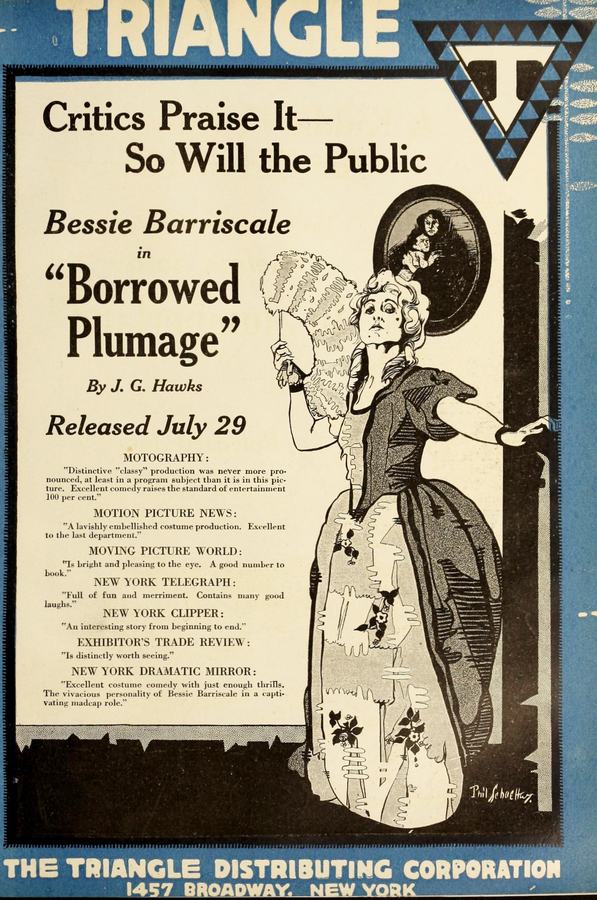
A definitive 4.8/10 rating for a film that redefined the boundaries of cult cinema. Borrowed Plumage remains a cornerstone of transgressive art.
There is a moment—wordless, of course, this being 1915—when Nora lifts the Countess’s gown from its cedar chest and the camera lingers on her cracked fingernails against the lace flounce. That juxtaposition, grubby skin on aristocratic silk, is the whole film in microcosm. Borrowed Plumage understands that identity is fabric deep: change the costume, rewrite the cosmos. The silent frame vibrates with the same subversive frisson that would later electrify Her Triumph yet does so without the cushion of royal patronage. Here, the proletarian body dares to occupy the aristocratic void, and the camera—operated by Wallace Worsley with pirouetting pans—refuses to moralize.
Tinted prints survive in only two archives: one in Paris, one in Rochester. Both carry the amber wash that turns granite battlements into molten sponge cake. Night sequences are bathed in poisonous aquamarine, a hue somewhere between bruise and deep-sea phosphorescence. Those blues make the soldiers’ scarlet tunics pop like fresh blood on snow, a chromatic strategy that prefigures the expressionist palettes of Die toten Augen. Yet unlike German studio fantasias, Borrowed Plumage roots its chromatic excess in the salty air of a very real shoreline—captured on location at Mendocino’s cliffs doubling for the Firth of Forth. Salt spray, caught by the lens, etches white comets across each frame, so the screen itself seems to perspire.
As Nora, Bessie Barriscale pivots from hunched servitude to regal poise without a cutaway. Watch her spine elongate in real time: shoulders roll back, clavicles lift, chin angles to accept the phantom weight of a diamond tiara she will never wear. The performance is not mimicry of the Countess but erasure of the drudge—a negative space performance long before the Method boys coined the term. In close-up, her irises flicker between terror and rapture, as though she is reading captions the audience cannot see. When she finally lowers herself into the carved mahogany chair at table’s head, the gesture lands with the solemnity of a coronation. Yet the actress never lets us forget the kitchen: every dainty sip of claret ends with a reflexive wipe of the mouth’s corner, the ghost of coarse linen still haunting her muscles.
Notice the thrift of the production: one gown, one castle courtyard, a handful of redcoats. Out of that austerity the filmmakers spin class vertigo, a miniature revolution cheaper than a single torpedo effect in Captain Alvarez. Poverty births invention; invention births poetry.
Sherry plays both the panic-frozen Earl glimpsed in the prologue and the granite-jawed American pirate captain whose shadow falls across the narrative like a guillotine blade. The casting is economical trickery—think of it as an ancestor to the split-screen narcissism of A Modern Monte Cristo—yet it carries ideological heft. The same physiognomy that flees the fortress later storms it; ruling-class cowardice and revolutionary appetite share one face. The audience, denied dialogue, must decode the irony through posture: the Earl’s gait is all mincing heel-first steps; Jones lands each foot like a cleaver.
As Darby, Tod Burns carries the film’s romantic throughput. His cheekbones could slice cod, but the performance is no matinee-idle preen. Watch him register three successive shocks—homecoming, heartbreak, peril—without intertitle assistance. The eyes widen, contract, then frost over: a triptych of memory, desire, dread. Contemporary reviewers dismissed the role as “another Irish scamp,” yet Burns’ micro-gestures anticipate the interiorized swashbuckling of later Fairbanks. When he whispers “Nora” (a title card finally grants us the word), the single syllable detonates like a broadside.
Nora’s final transformation into a shakoed foot soldier is no quaint trouser-role gag. The uniform is too large; the helmet slips over her brow, turning her into a child playing dress-up in Daddy’s war. Yet the musket she shoulders is real, and the film grants her the traditionally male prerogative of rescue. She signals the pirate brig not with a swoon but with a lantern semaphore learned from dockworkers—working-class knowledge weaponized. In 1915, when suffragettes were being force-fed in Holloway, this image of a woman commanding cannon-smoke must have felt like a manifesto set in nitrate.
The skirmish lasts a scant four minutes but is choreographed like a fugue. Worsley cross-cuts between three planes: cliff-top redcoats priming rifles, pirates knee-deep in surf hauling a carronade, Nora inside the castle turret counting heartbeats. The tempo accelerates until the shots themselves seem to edit the film—each muzzle flash a splice. Smoke, tinted umber, swallows the frame, and out of that visual roar emerges a peculiar tenderness: Darby, manacled, glimpses Nora through the haze, and for two seconds the war drops away. It is cinema’s first battlefield “over-the-shoulder” shot predating Wings by twelve years.
Though the original Sinnock cue sheets are lost, trade columns report that exhibitors were advised to weave “The Bonny Banks o’ Loch Lomond” into the scene of Nora’s solitary waltz through the grand salon. The tune’s pentatonic melancholy undercuts the visual farce; a servant girl pirouetting in stolen silk becomes a folk-ghost lamenting a homeland she will never possess. Try humming it while watching; the gown suddenly weighs heavier.
On paper the plot reeks of Victorian stage hokum: mistaken identities, last-minute reprieves, love transcending rank. Yet the film refuses to punish transgression. Nora is not struck dead by lightning; the Countess does not return to reclaim her wardrobe and moral order. Instead, the final shot—an iris closing on a schooner receding into a painted sunrise—sanctions elopement, class treason, and cross-dressing all at once. Compare this to the punitive endings of House of Cards or The Waifs: Hawks’ screenplay is a love letter to social mobility sealed with gunpowder.
Moving Picture World (Oct 9, 1915) called it “a lively if improbable romp,” fixating on the “delightful absurdity” of Bessie Barriscale’s swagger. A century later, after Butler and Foucault, the film reads as an ur-text of performative identity. Twitter threads label Nora a “proletarian Mulan,” while Letterboxd cinephiles gif her helmet tilt to oblivion. Yet both eras agree on one thing: the thing moves. Even at a scholarly archive screening, when the projector clatters like a coffee mill, the narrative velocity pins modern viewers to their seats.
A 2K restoration toured in 2019 but remains commercially unavailable. Bootlegs circulate with a honky-tonk piano track that murders the film’s delicate class tension; avoid them. The Eastman Museum has 35 mm elements; persuade your local cinematheque to book it. Demand a live trio—fiddle, bodhrán, squeezebox—to approximate the maritime heartbeat. Anything less and the ghosts of Selkirk will stay trapped in their amber fog.
“To steal a dress is theft; to steal an identity is revolution.” —caption chalked on a 1915 Brooklyn nickelodeon sidewalk
Great silent cinema doesn’t require colossi like Macbeth or budgets like Charles IV. Sometimes a castle corridor, a kitchen maid, and a pirate’s promise are enough to tilt the axis on which the world spins. Borrowed Plumage is that tilt, a celluloid slip of a girl who slips her class, slips her gender, slips the very horizon—proof that even in 1915 you could sail to America on nothing but nerve and a gown that never belonged to you.
IMDb 6.5
1935
Community
Log in to comment.