DbcultAccessing Vault...
Cult Review
Senior Film Conservator
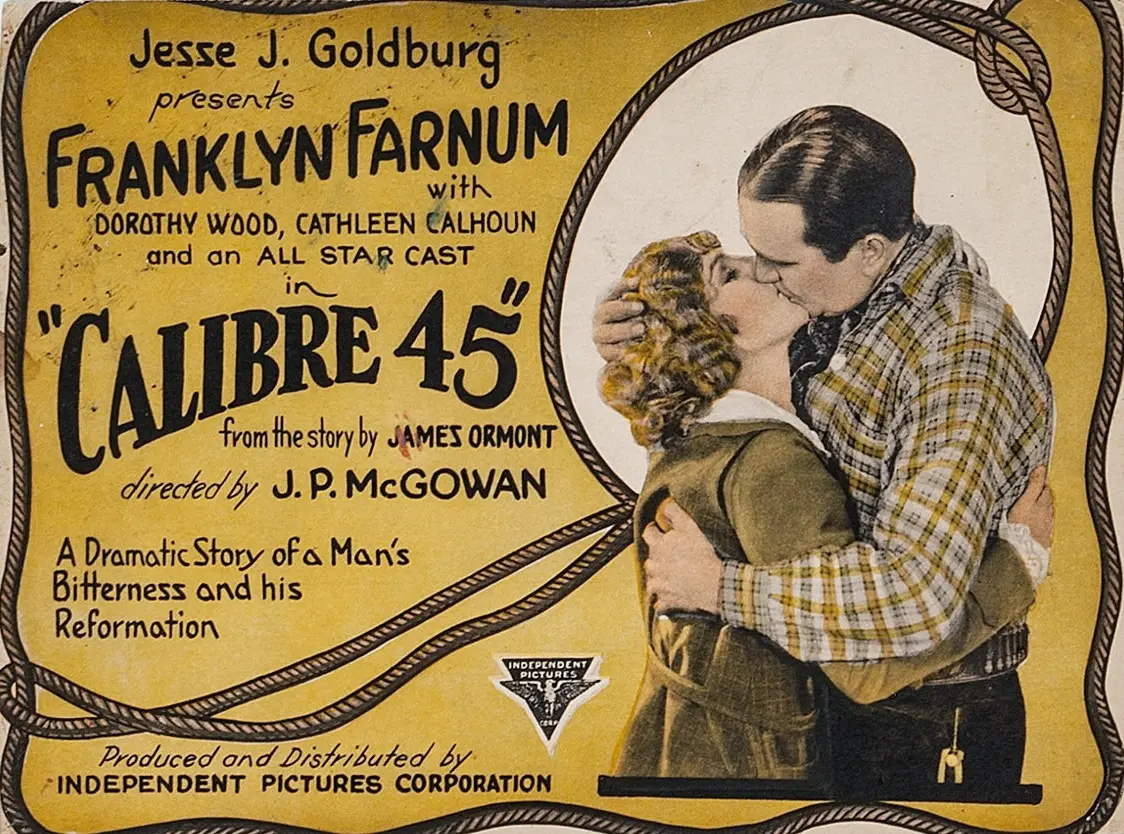
The year 1924 was a pivotal juncture for the American Western. While the industry was beginning to flirt with the monumental scale seen in films like Greed, the genre's heart remained in the gritty, character-driven narratives of the silent B-Western. Calibre 45, directed by the prolific J.P. McGowan, stands as a testament to this era's ability to weave complex moral quandaries into the fabric of pulp entertainment. At the center of this whirlwind is Franklyn Farnum, an actor whose presence commanded a unique blend of rugged stoicism and empathetic vulnerability.
The film’s opening movements are a masterclass in economic storytelling. We are introduced to Yaqui Dan, a man whose very name suggests a synthesis of cultural identities and a proximity to the wilder edges of the territory. When he is falsely accused of murder, the film doesn't just depict a legal failure; it portrays the total disintegration of a man's social identity. Unlike the more melodramatic flourishes found in The Deemster, Calibre 45 treats Dan’s descent into outlawry with a pragmatic, almost documentary-like gravity.
What distinguishes this work from contemporaneous entries like Trigger Fingers is its fascination with the concept of the 'charitable outlaw.' As Dan evades the reach of an imperfect law, he becomes a spectral figure of hope for the downtrodden. This is not the flamboyant banditry of Zorro, but a quiet, almost liturgical commitment to righting the wrongs of a harsh world. James Ormont’s screenplay avoids the saccharine traps that often ensnared silent dramas, opting instead for a series of vignettes that showcase Dan’s altruism as a form of penance for a crime he never committed.
The cinematography captures the vastness of the landscape, utilizing the natural light of the California hills to create a sense of isolation that mirrors Dan’s internal state. There is a specific visual cadence here that reminds one of The Storm, where the environment is not merely a backdrop but an active participant in the protagonist's struggle. The frames are frequently cluttered with the detritus of frontier life, grounding the high-stakes drama in a tangible, dusty reality.
Franklyn Farnum’s performance is a revelation of restraint. In an era where pantomime often veered into the hyperbolic, Farnum utilizes his eyes and the set of his shoulders to convey a profound sense of weary injustice. He doesn't play Dan as a victim, but as a man waiting for the tide to turn. This stoicism is beautifully contrasted by Dorothy Wood, whose role provides the emotional anchor the film requires to remain accessible. Her chemistry with Farnum adds a layer of domestic stakes that elevates the film beyond a simple chase narrative.
Special mention must be made of Tom London, a stalwart of the genre whose presence here adds a layer of menace that feels surprisingly modern. The antagonist in Calibre 45 is not a mustache-twirling villain but a shadow—a lingering threat that Dan must eventually confront. This cat-and-mouse dynamic is far more sophisticated than the simplistic heroics found in Skinning Skinners or the lighthearted antics of Hello, Judge.
When analyzing Calibre 45, it is impossible not to draw parallels to the psychological depth of European cinema from the same period. While it lacks the overt gothic undertones of Drama na okhote or the feudal weight of Der Leibeigene, it shares a preoccupation with the individual's struggle against an immovable social structure. Like the protagonist in The Man Unconquerable, Yaqui Dan is a figure defined by his resilience—a man who refuses to be broken by the machinery of false witness.
The film also touches upon themes of redemption that are explored with more tragic results in As a Man Sows. However, Calibre 45 remains fundamentally optimistic. It posits that the truth is a physical entity, something that can be tracked, cornered, and eventually brought to light. This belief in the ultimate triumph of justice is a hallmark of the early American Western, serving as a cultural balm for a society navigating the complexities of post-war industrialization.
James Ormont’s writing deserves a closer look. The structure of the film is remarkably tight for a 1924 production. The middle act, which could have easily devolved into repetitive action sequences, is instead populated with meaningful interactions that build Dan's legend. We see echoes of this tight pacing in In the Python's Den, yet Calibre 45 feels more grounded in human emotion. The way the clues are planted—subtle visual cues that pay off in the final confrontation—suggests a level of foresight often missing from the 'quickie' Westerns of the era.
The editing, too, is surprisingly fluid. The transition from Dan’s life as a respected citizen to his existence as a pariah is handled with a jarring intensity that makes the audience feel the weight of his fall. This isn't the languid pace of Flickering Youth; it is a propulsive, urgent piece of filmmaking that demands attention.
The climax of the film, where Dan returns to the scene of the crime to confront the real murderer, is a masterclass in suspense. The realization that the killer has been hiding in plain sight—living in the vicinity while Dan suffered in exile—adds a layer of psychological horror to the proceedings. It’s a trope that would later be explored with varying degrees of success in films like The Other Man's Wife or the tense His Convict Bride.
In Calibre 45, the resolution is not just about violence; it is about the restoration of the social contract. When the evidence is finally presented and Dan is exonerated, there is a palpable sense of relief that transcends the screen. The film doesn't just end with the defeat of the villain; it ends with the reconstitution of a broken man. It is a powerful reminder of why the Western remained the dominant American myth for so long—it offered a space where the complexities of morality could be distilled into a single, decisive action.
Looking back from a modern perspective, it is easy to dismiss silent Westerns as primitive relics. However, Calibre 45 defies such easy categorization. It possesses a thematic density that rivals more prestigious productions like Whom the Gods Would Destroy. It understands that the greatest battles are not fought with guns, but with the unyielding pursuit of the truth. Franklyn Farnum and J.P. McGowan crafted a film that is as much about the human spirit as it is about the American frontier.
For the cinephile, Calibre 45 is more than just a historical curiosity. It is a vibrant, breathing piece of art that captures a specific moment in the evolution of visual language. It manages to be both a thrilling adventure and a poignant character study, a feat that many modern blockbusters fail to achieve. As we navigate our own era of complex truths and social fractures, the story of Yaqui Dan—the man who became an outlaw to save his soul—remains as relevant as ever. It is a quintessential piece of silent cinema that deserves a prominent place in the pantheon of the genre, standing tall alongside the giants of its time and continuing to inspire those who seek justice in an unjust world.
In the final analysis, Calibre 45 is a triumph of narrative economy and emotional resonance. It is a film that speaks in the silent language of the heart, proving that even without words, the cry for justice can be deafening.
IMDb 6.7
1935
Community
Log in to comment.