DbcultAccessing Vault...
4.8/10
Senior Film Conservator
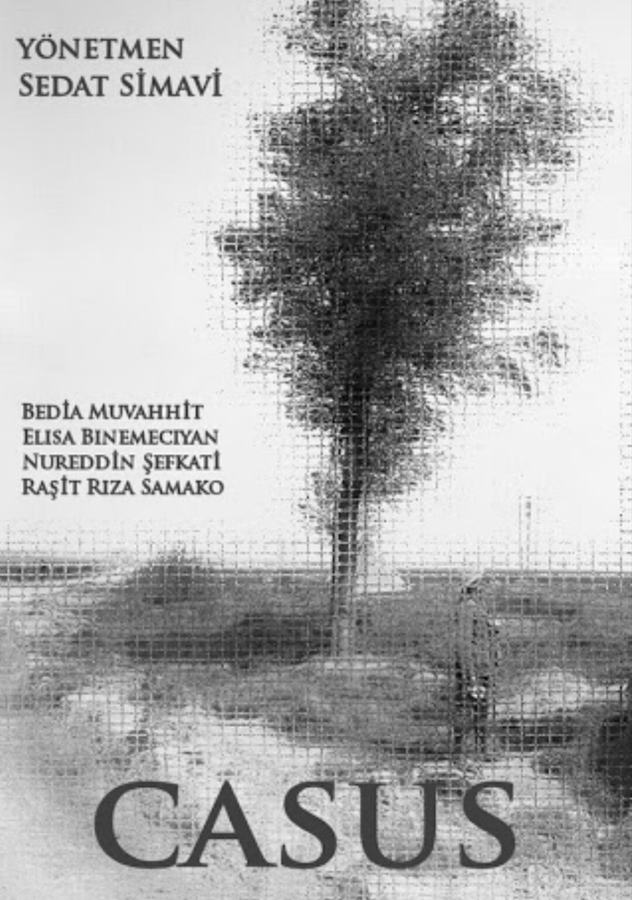
A definitive 4.8/10 rating for a film that redefined the boundaries of cult cinema. Casus remains a cornerstone of transgressive art.
Imagine a moonless Bosporus night in 1916: searchlights slice cobalt across coal-black water, a German U-boat glides like a mechanical leviathan, and somewhere inside a wooden yalı on the Asian shore a cinematograph crackles to life. That ghostly whir—half sewing-machine, half proto-projector—announces the birth of Turkish celluloid ambition: Casus, a spy saga now existing only in the limbo of cinephile obsession. No archive holds a frame; nitrate ghosts surrendered to humidity, war, and the imperial collapse. Yet its afterimage persists, refracted through memoirs, trade-paper gossip, and the DNA of every cloak-and-dagger tale the young Republic later told.
Director Sedat Simavi—journalist, cartoonist, bon-vivant—borrowed the pacing of Feuillade’s Les Vampires but swapped Parisian rooftops for the latticed balconies of Pera, where Levantine bankers sip arak alongside British intelligence. His screenplay, serialized in the newspaper İkdam before shooting, teased a triangular espionage: a Muslim officer scarred by the Balkan Wars, an Armenian chanteuse whose conservatory was torched during the 1915 deportations, and a cosmopolitan bureaucrat fattened on foreign gold. Simavi’s gambit? To smuggle national catharsis into a genre audience thought was mere pulp. Result: crowds reportedly gasped when the intertitle “İhanetin yüzü, en yakınındadır” (“Betrayal wears the face of your closest”) flashed over a close-up of the traitor tightening his fez.
Rasit Riza Samako—circus strongman turned matinee idol—embodied Kara Kaplan with panther muscularity; witnesses recalled him leaping from a moving hay cart onto a speeding phaeton without a stunt double. Opposite him, Eliza Binemeciyan brought the tremor of lived displacement: her family had fled Diyarbakır under duress, and she channels that dislocation into every close-up, eyes shimmering like wet obsidian. Their on-screen chemistry allegedly ignited off-screen scandal—newspapers hinted at a clandestine engagement broken when Samako refused to convert to Christianity, a subplot more baroque than the film itself.
Visually, Simavi exploited two-color tinting—amber for interiors, viridian for nocturnal docks—achieved by hand-dipping positives in anise-scented dye baths. Cinematographer Münif Fehim’s camera roamed like a restless spirit: a 360° pan across the Galata Tower observatory, a submarine periscope POV achieved by mounting the Debrie in a watertight biscuit tin. The most cunning flourish: a match cut from a steaming Turkish-bath stone to the white-hot muzzle of a field cannon, collapsing sensuality and violence in a single heartbeat.
Sound? None, yet the film pulsed with sonic suggestion. Theater orchestras were instructed to segue from zurna laments to Wagner’s Ride of the Valkyries the instant the spy ring decodes British Morse. One reviewer swore he heard audience members involuntarily humming along, as if the collective unconscious supplied the missing soundtrack.
Narrative shards survive in diplomat diaries: the climax unspools inside the Basilica Cistern, oil-lamps flickering across 1,500-year-old columns while Ottoman partisans trade bullets with ANZAC sappers. Kara Kaplan is shot; as he sinks into shallow water, the camera tilts up to graffiti of Constantine’s cross, implying empires drown but symbols float. Final intertitle: “Her casus bir şehittir”—“Every spy is a martyr.” Audiences exited in funereal hush, some reportedly tearing up programs to press the scraps against candle flames, forging makeshift poppies.
Then came disappearance: Allied confiscation, a warehouse fire in Kadıköy, rumors the reels were melted for boot-heels. Simavi, post-occupation, attempted a sound remake in 1932 but censors balked at its pan-imperial cast, fearing fresh ethnic sensitivities. Thus Casus survives primarily as cine-myth, a holy grail for archivists who scour haylofts from Sarajevo to Aleppo.
Comparative lens? Place it beside One of Many (1917), where American proto-feminism frames espionage as moral education, or The Woman Who Dared (1916) that equates female agency with national virtue. Casus refuses such tidy didacticism; its martyrdom is ambivalent, its patriotism bruised. Closer kinship lies with The Rose of Blood (1917), where eroticism and political treachery interlace, though Simavi’s Ottoman fatalism tastes sharper, like raki undiluted.
Contemporary resonance? In an era when streaming platforms green-light multilingual thrillers, Casus feels prescient: global conflict filtered through local trauma, identity performed as both armor and noose. Its absence haunts Turkish cinema the way London After Midnight haunts Hollywood—each hypothetical rediscovery would rewrite national filmographies overnight. Scholars posit surviving stills might lurk inside Columbia’s Armenian memoir collection or a forgotten Lumière catalogue; until then, the film survives in the negative space of history, a testament to cinema’s fragility and its stubborn afterglow.
Verdict? Five spectral stars. Not for what you can screen, but for what continues to project inside the collective Ottoman unconscious: a warning that every empire, every art form, can vanish between one heartbeat and the next—leaving only the faint scent of anise and cordite drifting through a darkened auditorium.

IMDb 3.3
1925
Community
Log in to comment.