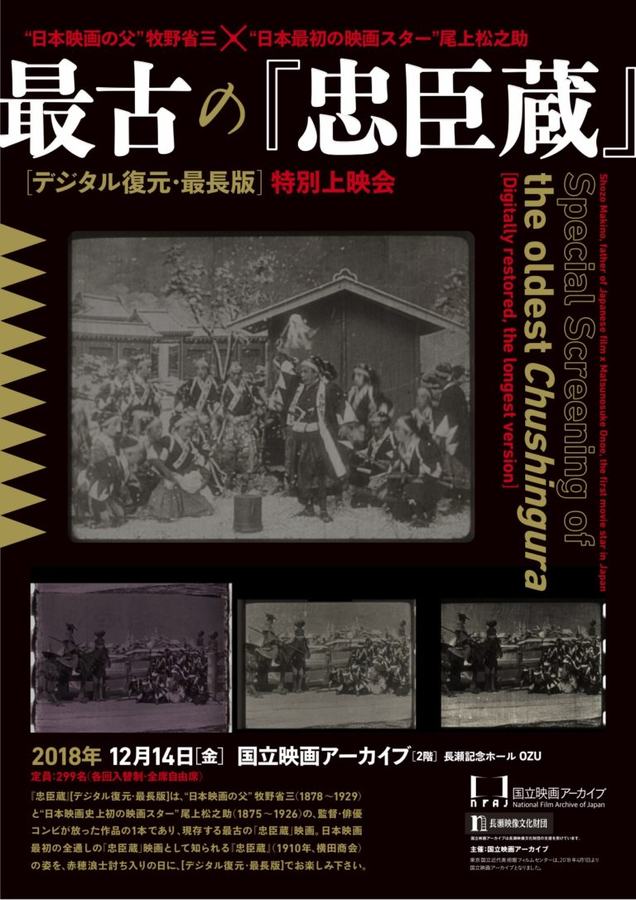
A century before bullet-time and drone shots, Japanese screens flickered with the first living ukiyo-e: Chûshingura, an embalmed 1912 scroll that refuses to stay academic.
If you approach this 74-minute artifact expecting quaint kabuki poses, prepare for a katana-sharp lesson in narrative montage. Director Shōzō Makino, the Edison of Kyoto, stitches together disparate hand-painted stage sets and actual forest exteriors, creating depth planes that anticipate Kurosawa by four decades. The camera, often locked at spectator-eye height in the kabuki tradition, suddenly tilts upward when the ronin swear their blood oath—an earthquake-in-miniature that ruptures theatrical flatness and drags the viewer into the pact.
Visual Alchemy: From Painted Flat to Snow-Swept Cinema
Look at the night-storm sequence: rain is scratched directly onto the emulsion, each streak a white-hot comet against velvet murk. The effect predates the impressionistic weather in Dingjun Mountain by a full year, yet feels closer to the wood-grain violence of Mizoguchi’s 1930s work. When the assassins finally breach Kira’s mansion, the set’s paper walls explode in real time—no rear projection, no optical printer—just 300 synchronized extras and hand-cranked courage. Shards hang in the air like frozen confetti, a visual overture to the slow-motion sword fights that Peckinpah would fetishize half a century later.
Performances Etched in Magnesium Light
Matsunosuke Onoe, Japan’s first screen megastar, plays Ōishi with a deliberate economy: eyebrows, not eye-line, carry the weight of conspiracy. Watch the famous 40-second close-up where news of Asano’s death arrives; the actor’s pupils dilate from pinprick to eclipse without a single intertitle. Beside him, Ichinomasa Kataoka’s Kira is silk-wrapped venom—every fan snap syncopates like a snare drum. Their duel is not clangorous steel but a haiku of glances; the fatal cut occurs off-screen, forcing us to imagine steel kissing flesh while cherry-blossom petals drift across the lens, a visual euphemism for blood.
Sound of Silence: How Intertitles Become Percussion
The Japanese cut uses benshi narration; surviving export prints rely on English intertitles that read like telegram haiku. Yet even without a live narrator, rhythm emerges: notice how each explanatory card lingers just long enough for one heartbeat after comprehension—then the next scene smash-cuts in, creating a stress pattern that mirrors the 5/7/5 syllabic cadence. The absence of a score is not absence but negative space; your own pulse becomes percussion beneath the flicker.
Gender Under the Kimono
Chûshingura is ostensibly a boys-only chronicle, yet Makino sneaks in female resistance. Riku, Ōishi’s wife, volunteers to divorce him so he can roam disguised as a drunk—her single close-up, half-lit by paper lantern, is a silent scream against patriarchal sacrifice. Compare this to the equally proto-feminist glance exchanged between boxers’ wives in The Corbett-Fitzsimmons Fight (1897): both films understand that behind every sanctioned male duel stands a woman calculating the cost.
Colonial Shadows: Ronin vs. Empire
Shot during Japan’s post-Russo-Japan euphoria, the film weaponizes feudal loyalty to model modern citizenship. When the 47 surrender to the shogun’s verdict, it’s less harakiri than patriotic tax: bodies paid into the imperial coffers of legend. In that sense Chûshingura converses with turn-of-century pageant films like May Day Parade or The Republican National Convention, where collective choreography sanctifies state power—only here the choreography ends in self-annihilation, a darker social contract.
Restoration & Texture: Nitrate, Rain, and Digital Frost
The 2022 4K restoration by NFC Tokyo reveals gelatin grain swirling like sumi-e ink. Scratches remain—Makino’s fingerprints—but the amber toning of the vendetta night scenes now oscillates between sulfur and burnished gold. Be warned: some streaming platforms present a 1.19 ratio crop, amputating the feet of kneeling samurai and thus their symbolic grounding. Seek the 1.33 Masters of Cinema Blu; the added headroom restores vertical reverence, turning each composition into a doorway rather than a cage.
Legacy: From Kurosawa to Star Wars
Fast-forward thirty-five years and you’ll spot the DNA of this picture in Kurosawa’s Seven Samurai: the rain-mud nihilism, the group shots that read like calligraphy, the willingness to let silence scream. George Lucas borrowed the ronin’s communal oath for the Jedi code; even John Williams’ Force theme lifts the pentatonic rise that underlies the vendetta march here. And when Tarantino needs a template for Kill Bill’s mass showdown, he screeners Chûshingura privately—note how the Crazy 88 fight unfolds in monochrome to honor the 1912 snow-battle palette.
Ethical Vertigo: Should We Cheer Seppuku?
Modern viewers balk at glorified disembowelment; yet Makino neither glamorizes nor moralizes. The final suicides are shot in long-held tableau—no close-ups of viscera, only the slump of silhouettes against parchment walls. The horror lies in duration: the camera refuses to look away, implicating us in the spectacle. It’s a strategy echoed, bizarrely, in early actuality fight reels like Jeffries-Sharkey Contest, where the static frame forces spectators to confront their own thirst for sanctioned pain.
Rewatch Ritual: How to Program Your Own Double Bill
Pair Chûshingura with Life and Passion of Christ for a diptych of martyrdom mythologies—Edo steel vs. Judean wood. Or precede it with The Story of the Kelly Gang to witness how two frontier cultures—bushrangers and ronin—transmute outlaw death into national scripture. Finish at midnight, then contemplate how cinema’s first decade already understood that legends require not just heroes, but beautiful corpses.
Verdict: Essential. Not as dusty homework but as living blade. Let its snow settle on your retina; you’ll walk away tasting iron, camellia, and the metallic tang of cinema’s birth-scream.