DbcultAccessing Vault...
Cult Review
Senior Film Conservator
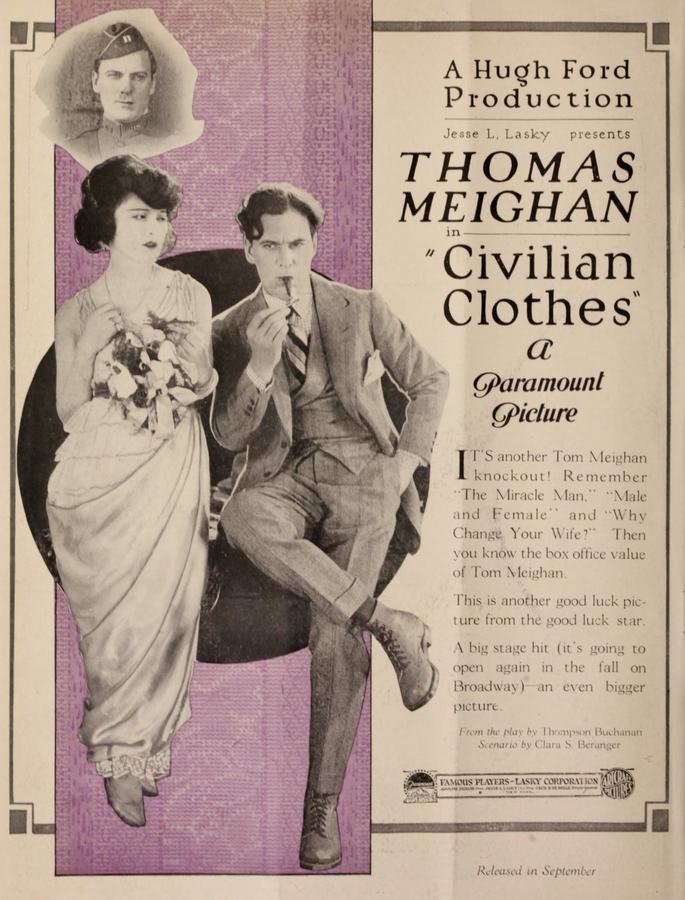
The cinematic landscape of 1920 was a crucible of transition, a period where the haunting echoes of the Great War collided with the burgeoning decadence of the Jazz Age. In this interstitial space, Civilian Clothes emerges not merely as a romantic comedy of errors, but as a biting, sophisticated interrogation of the American class structure. Directed with a keen eye for spatial dynamics and social nuance, the film leverages the 'returning soldier' trope to expose the superficiality of the domestic front. While many contemporary works like Redemption focused on the spiritual or existential toll of conflict, Civilian Clothes pivots toward the sartorial and the sociological, suggesting that the uniform is a mask that grants dignity to those whom society would otherwise disregard.
Thomas Meighan, an actor of remarkable gravitational pull, portrays Captain Sam McGinnis with a rugged authenticity that anchors the film’s more whimsical elements. His performance is a masterclass in controlled charisma; he transitions from the heroic posture of a battlefield commander to the humble, almost invisible presence of a domestic servant without losing the core of his character’s integrity. This duality is the film's heartbeat. When Sam returns to find his wife, Florence—played with a delicate, if initially infuriating, fragility by Martha Mansfield—he is met not with the open arms of a lover, but with the judgmental squint of a woman who has forgotten that the man makes the clothes, not the reverse. The irony is palpable: the very heroism that won her heart in France is invisible to her when it is draped in 'civilian clothes' that do not meet the exacting standards of her zip code.
The screenplay, penned by the formidable Clara Beranger, is a razor-sharp instrument. Beranger, known for her ability to weave complex psychological threads into mainstream narratives, avoids the didactic traps that ensnared other films of the era, such as Public Opinion. Instead of preaching equality, she demonstrates the absurdity of inequality through the Lanham family’s interactions with Sam. By assuming the role of the butler, Sam engages in a form of class-based espionage. He observes the Lanhams when their guards are down, revealing a family obsessed with the performance of status. This domestic theater is expertly staged, with the camera often lingering on the ornate details of the Lanham estate to emphasize the physical weight of their wealth.
Martha Mansfield’s Florence is a fascinating study in cognitive dissonance. She represents a generation of women who were expanded by the war—serving in the Salvation Army, witnessing the raw reality of life and death—only to be retracted back into the stifling confines of Victorian-adjacent social expectations upon their return. Her horror at Sam’s appearance is not merely a personal failing but a systemic one. She has been re-indoctrinated into a world where aesthetics are the primary currency of worth. In many ways, her struggle mirrors the moral dilemmas found in The Devil, though transposed from the supernatural to the mundane. The 'devil' here is not a cloven-hoofed tempter, but the relentless pressure of social conformity.
To fully appreciate the subversive nature of Civilian Clothes, one must look at how it treats the concept of 'home.' In films like At Piney Ridge, the domestic sphere is often a site of traditional moral reckoning. Here, it is a battlefield of a different sort. Sam’s infiltration of the Lanham household is a tactical maneuver as calculated as any he might have performed in the trenches. The film utilizes a visual language of service—the silver tray, the silent footfall, the bowed head—to create a tension that is both comedic and profoundly uncomfortable. We, the audience, are complicit in Sam’s ruse, experiencing a vicarious thrill as he subtly mocks the very people he is serving.
The film’s pacing is brisk, avoiding the languid sentimentality that often bogged down silent dramas. It shares a certain rhythmic DNA with Branding Broadway, particularly in its fascination with the clash between rugged individualism and urban artifice. However, where Branding Broadway leans into the mythos of the cowboy, Civilian Clothes finds its power in the figure of the veteran. The 'civilian clothes' of the title are a metaphor for the invisibility of the soldier in peacetime—a theme that remains poignantly relevant over a century later.
Visually, the film is a testament to the sophistication of the 1920s studio system. The lighting in the Lanham mansion is high-key and unforgiving, highlighting the sharp lines of the furniture and the stiff collars of the men. This contrasts sharply with the soft-focus, almost ethereal quality of the flashback sequences in France. These visual cues signal to the viewer that the 'real' world—the world of the Lanhams—is actually the one that is artificial, while the 'dreamlike' world of the war was where Sam and Florence were their truest selves. This inversion of cinematic tropes is a hallmark of the film’s nuanced direction.
The supporting cast provides a robust framework for Meighan and Mansfield. Marie Shotwell and Warren Cook as the Lanham elders embody the calcified prejudices of the upper crust with chilling precision. Their interactions with Sam-as-butler are fraught with an unconscious condescension that Meighan deflects with a series of nearly imperceptible smirks. This interplay elevates the film from a simple farce to a sophisticated social commentary, reminiscent of the character depth seen in The Mantle of Charity, though with a much sharper comedic edge.
The 'butler' plot device is a recurring motif in cinema, often used to bridge the gap between the haves and the have-nots. In Civilian Clothes, it serves as a transformative crucible for Florence. As she watches Sam navigate her world with more grace and intelligence than her social peers, her internal architecture begins to crumble. The film cleverly uses Sam’s 'poor' civilian attire as a red herring; the real story is about the shedding of Florence’s own psychological 'uniform.' This thematic depth is what separates the film from more ephemeral comedies of the era like Ambrose's Day Off.
Furthermore, the film’s exploration of mistaken identity and the return of the 'dead' husband echoes the tragic weight of After Death, yet it chooses to resolve these tensions through wit rather than melodrama. This choice reflects a post-war desire for levity, but a levity that does not ignore the scars of the past. Sam McGinnis is a man who has seen the worst of humanity and has decided that the best way to combat the petty cruelties of the elite is through a sustained, humorous subversion of their rules.
Civilian Clothes is a vital piece of silent cinema that deserves a prominent place in the pantheon of social satires. It captures a specific moment in American history where the old world was dying and the new world had yet to find its footing. Through the lens of a domestic comedy, it asks profound questions about identity, merit, and the arbitrary nature of social standing. Is a man defined by the medals on his chest, the tray in his hand, or the character he displays when no one—or everyone—is watching?
The film’s conclusion, which I will not spoil for the uninitiated, is as satisfying as it is earned. It avoids the easy, sentimental out, opting instead for a resolution that acknowledges the growth of its characters. Like Bonnie Bonnie Lassie, there is a sense of adventurous spirit here, but it is tempered by the gravity of Sam’s experiences. Thomas Meighan’s Sam McGinnis remains one of the most compelling protagonists of the early 20th century—a man who refused to be defined by his 'civilian clothes' and instead redefined the very world he returned to. For those seeking a film that combines historical resonance with timeless wit, this is an essential viewing experience that proves, quite definitively, that the most revolutionary act one can perform is to simply be oneself, regardless of the outfit.
IMDb —
1919
Community
Log in to comment.