DbcultAccessing Vault...
5.3/10
Senior Film Conservator
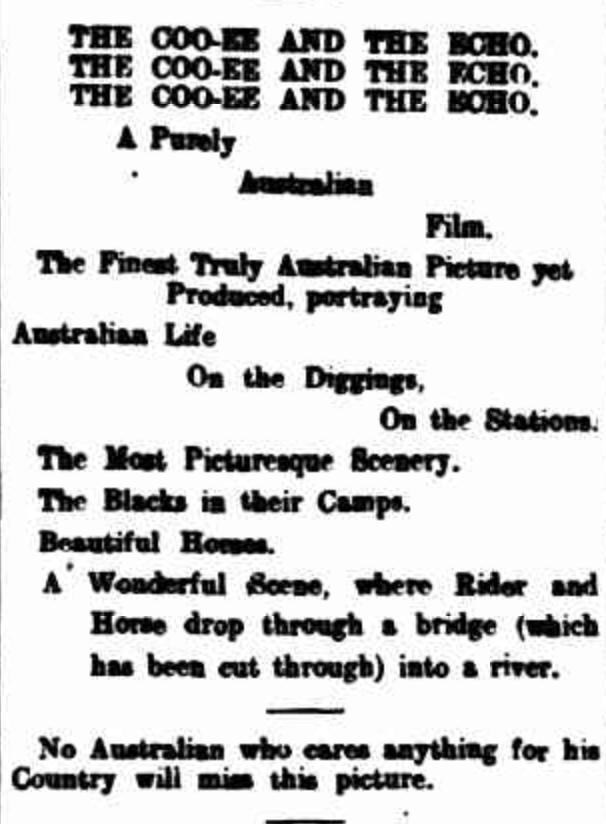
A definitive 5.3/10 rating for a film that redefined the boundaries of cult cinema. Cooee and the Echo remains a cornerstone of transgressive art.
The year 1912 stands as a monumental epoch in the annals of global cinema, a time when the medium was shedding its swaddling clothes and embracing the complexities of long-form narrative. In the rugged heart of the Southern Hemisphere, the Australian Life Biograph Company was busy sculpting a unique visual identity, one that found its most resonant voice in Cooee and the Echo. This film is not merely a relic of a bygone era; it is a visceral testament to the power of environmental storytelling, predating the polished artifice of Hollywood’s golden age. Unlike the curated majesty of Glacier National Park, which offered a documentary-style reverence for nature, Cooee and the Echo integrates the landscape into the very marrow of its melodramatic structure.
There is a profound irony at the heart of this production: it is a silent film centered entirely on a sound. The 'cooee'—that iconic Australian bush call—is rendered here through visual cues and the frantic physicality of the performers. It is a brilliant exercise in sensory translation. When Ethel Phillips throws her head back and cups her hands to her mouth, the audience doesn't just see a gesture; they feel the vibration of the call echoing across the celluloid valleys. This reliance on the 'echo' as a narrative device creates a haunting atmosphere of repetition and searching. It reminds one of the spiritual yearning found in Pilgrim's Progress, though transposed from a religious journey to a secular struggle for survival in a land that feels indifferent to human life.
The cinematography captures the harsh, unyielding light of the Australian interior with a starkness that was revolutionary for the time. There is no soft-focus romanticism here. Instead, we are treated to wide vistas that dwarf the human actors, emphasizing their fragility. This aesthetic choice places the film in direct conversation with other early Australian masterpieces like The Story of the Kelly Gang. However, where the Kelly narrative focused on the myth of the bushranger, Cooee and the Echo focuses on the myth of the land itself—a character that gives and takes with equal measure.
Ethel Phillips delivers a performance that transcends the often-caricatured histrionics of early silent cinema. Her portrayal of the heroine is marked by a quiet resilience, a departure from the 'damsel in distress' tropes that were beginning to solidify in European imports like Les amours de la reine Élisabeth. Phillips possesses a face made for the camera—expressive, yet capable of holding a stoic mask that mirrors the parched earth she traverses. Her chemistry with Stanley Walpole is palpable, even through the flickering grain of a century-old print. Walpole, who would later find success in the United States, brings a grounded, athletic energy to the role of the protector. His movements are purposeful, reflecting a man who has mastered the terrain rather than one who is merely passing through it.
Charles Villiers, as the antagonist, provides the necessary friction. In many ways, his character represents the corruptive influence of 'civilization' or greed, encroaching upon the purity of the bush life. This conflict between the individual and the interloper was a common theme in the 1912 cinematic landscape, seen in various forms from the historical drama of 1812 to the urban struggles of Oliver Twist. Yet, in Cooee and the Echo, the conflict feels uniquely antipodean, tied to the ownership of land and the sovereignty of the voice.
The pacing of the film is surprisingly modern. The director (often attributed to the collective efforts of the Australian Life Biograph team) understands the necessity of tension. The 'echo' is used not just as a plot point, but as a rhythmic beat. Every time the call is made and no answer returns, the tension ratchets up. It is a primitive form of suspense that works on a primal level. This structural integrity is something that was lacking in many contemporary 'spectacle' films, such as the grand but often disjointed Cleopatra of the same year. While Cleopatra relied on lavish sets and historical weight, Cooee and the Echo relies on the psychological weight of the unknown.
We must also consider the technical achievements. The location shooting was an arduous task in 1912. Transporting heavy hand-cranked cameras into the depths of the bush required a dedication that is reflected in the authenticity of the shots. There is a specific scene involving a descent into a ravine that rivals the stunt work seen in The Flying Circus. It is this willingness to engage with the physical world that gives the film its enduring power. The dirt on the actors' faces is real; the sweat is real; the fear of the vast, empty space is real.
When placed alongside other works from 1912, Cooee and the Echo feels like a bold outlier. While the world was captivated by religious epics like From the Manger to the Cross or the theatrical adaptations of The Life and Death of King Richard III, Australia was producing a cinema of the 'now.' It was a cinema focused on the immediate struggle of defining a national identity in a landscape that had yet to be fully 'tamed' by the colonial lens. It shares a certain DNA with The Girl from Outback, yet it pushes the atmospheric elements much further.
The film also touches upon themes of communication and its failure. In a world before radio or widespread telecommunications, the 'cooee' was a vital technology. The failure of the echo to return is a terrifying prospect—it signifies a total severance from the human community. This theme of isolation is explored in a different, more social context in A Victim of the Mormons, but here it is an elemental, almost existential isolation. The characters are not just lost in the woods; they are lost in the silence of history.
Visually, the film utilizes the natural chiaroscuro of the Australian sun. The deep shadows cast by the eucalyptus trees and the blinding brightness of the clearings create a high-contrast world that suits the binary morality of the plot. Good and evil are as clearly defined as the light and the dark. This visual clarity is a hallmark of the Australian Life Biograph style, also evident in The Squatter's Daughter. By using the natural environment to provide the 'set dressing,' the filmmakers achieved a level of realism that studio-bound productions of the era, such as As You Like It, simply could not replicate.
Furthermore, the film’s use of depth of field is surprisingly sophisticated. There are several shots where the action takes place in the mid-ground while the foreground is dominated by the tangled undergrowth, forcing the viewer to 'peer' through the bush along with the characters. This immersive technique creates a sense of voyeurism and complicity. We are not just watching the search; we are part of it. It is a far cry from the static, stage-like presentations of The Black Chancellor.
To watch Cooee and the Echo today is to engage with a ghost. Much of the original nitrate has succumbed to the ravages of time, leaving us with fragments and restored prints that hum with a strange, spectral energy. Yet, the 'echo' remains. The film influenced a generation of Australian filmmakers who would continue to explore the relationship between the settler and the soil. It paved the way for more complex bushranging tales like The Life and Adventures of John Vane, the Australian Bushranger.
In conclusion, Cooee and the Echo is a masterpiece of early Australian ingenuity. It manages to take a simple melodramatic premise and elevate it into a profound meditation on space, sound, and survival. The performances of Ethel Phillips and Stanley Walpole provide a human heart to the vast, indifferent wilderness, while the direction utilizes the landscape with a brilliance that was decades ahead of its time. It is a film that demands to be seen not just as a historical curiosity, but as a living, breathing piece of art that still has much to say about our place in the world. Like the call that gives the film its name, the impact of Cooee and the Echo continues to resonate, a lone voice from the past that still finds an answer in the present.
Reviewer's Note: For those interested in the evolution of regional cinema, comparing this to the Mexican independence films like El grito de Dolores provides a fascinating look at how different nations used the burgeoning medium of film to define their own unique landscapes and legends during the pivotal year of 1912.
IMDb 7.4
1936
Community
Log in to comment.